
Stadler FLIRT (Fast Light Intercity and Regional Train; German: Flinker Leichter Intercity- und Regional-Triebzug) is a passenger multiple unit trainset made by Stadler Rail of Switzerland. The baseline design of FLIRT is an electric multiple unit articulated trainset that can come in units of two to twelve cars with two to six motorized axles. The maximum speed is 200 km/h (125 mph). Standard floor height is 57 cm (22+7⁄16 in), but 78 cm (30+11⁄16 in) high floors are also available for platform heights of 76 cm (29+15⁄16 in).
| Stadler FLIRT | |
|---|---|
 RABe 522 of the Swiss Federal Railways at Basel SBB | |
| Manufacturer | Stadler Rail |
| Constructed | 2004–present |
| Number built | Over 2,500 sold (as of October 2021)[1] |
| Specifications | |
| Train length | 42–106 m (137 ft 10 in – 347 ft 9 in) |
| Width | 2,720 mm (8 ft 11 in) (UK) 2.82–2.88 m (9 ft 3 in – 9 ft 5 in) 3,200 mm (10 ft 6 in) (NSB) 3,480 mm (11 ft 5 in) (Flirt G) |
| Height | 4,185 mm (13 ft 8.8 in) 4,120 mm (13 ft 6 in) (Flirt 3) |
| Maximum speed | 200 km/h (125 mph) |
| Weight | 76–206 t (75–203 long tons; 84–227 short tons) |
| Power output | 1,300–4,500 kW (1,700–6,000 hp) |
| Acceleration | 0.8–1.3 m/s2 (1.8–2.9 mph/s) |
| UIC classification | Bo′2′2′2′Bo' |
| AAR wheel arrangement | B-2-2-2-B (four-section train) |
| Track gauge | |
The FLIRT train was originally developed for the Swiss Federal Railways and was first delivered in 2004. The trains quickly became a success and were ordered by operators[2] in Algeria, Azerbaijan, Belarus, Canada, the Czech Republic,[3] Estonia, Finland, Germany, Hungary, Italy, Lithuania, the Netherlands, Norway, Poland, Serbia, Slovenia, Sweden, Switzerland, the United Kingdom, and the United States.[4] As of October 2021, more than 2500 units have been sold.[5]
Aside from being electric (EMU), the FLIRT is available in diesel-electric (DEMU), battery-electric, bi-mode EDMU, tri-mode diesel/overhead electric/battery, and more recently hydrogen fuel cell versions. Bi-mode models were first ordered by Italy's Aosta Valley region as (BTR.813),[6][7][8][9] then by Greater Anglia as the British Rail Class 755,[10][11][12] and Norske Tog,[13]. Tri-mode versions were first ordered by Wales & Borders.[14] Hydrogen fuel-cell versions were first ordered by Arrow in San Bernardino County, California, USA.
Specifications edit
The FLIRT is a new generation of multiple units, even though the first versions resembles GTW vehicles. The trains can have two to six sections and electric variants are available for all commonly used power supply systems (AC and DC) as well as standard and broad gauge. It has Jacobs bogies shared between the individual coaches, with wide walk-through gangways. The floor height at the entrances can be chosen by the operator, providing level boarding at most stations. Automatic couplers of either Schwab type (on all Swiss units) or Scharfenberg type at both ends of the train allow up to four trains to be connected.

All FLIRT variations use IGBT-based traction converters from ABB, which drive the TSA induction motors located in the two bogies at either end of the train. On the two-section trains, only one bogie is powered, while on longer versions it is possible to have a third powered bogie in the middle, found on the trains for Vy in Norway and for PKP Intercity in Poland. Each bogie usually has a continuous power rating of 1,000 kW (1,300 hp) giving a typical four-section train 2,000 kW (2,700 hp) total power output as well as maximum power output of 2,600 kW (3,500 hp) over a short time. Depending on the number of powered bogies, the length and weight, they will reach top speeds between 120 and 200 km/h (75 and 124 mph) (typically 160 km/h or 99 mph). Acceleration also varies between 0.8 and 1.2 m/s2 (2.6 and 3.9 ft/s2).
The diesel, bi-mode electro-diesel, hybrid diesel-battery, battery, and hydrogen fuel cell versions are essentially baseline design with an additional non-passenger car inserted in the trainset – called a PowerPack car – which contains the electricity generating and storage components, such as diesel engines and batteries, that provide electricity to the train to run "off-wire". It has a gangway through the centre to allow passengers to pass between the two parts of the train.
In TEXRail application, the diesel power module contains two 520 kW (697 hp) Deutz AG TCD 16.0 V8 that complies with US EPA Tier 4 emission standard.[15]
On March 22, 2024 Stadler’s Flirt H2 hydrogen multiple unit has secured a Guinness World Record for the longest distance achieved by a hydrogen fuel cell multiple unit without refueling.[16]
Operators edit
Algeria edit

On 18 March 2006, the Algerian operator SNTF announced that it had ordered 64 four-car EMUs for suburban services in Algiers.[17] The trains were delivered between 2008 and 2010.[18]
Azerbaijan edit

In November 2019, it was announced that Azərbaycan Dəmir Yolları (Azerbaijan Railways) had placed a €115 million order for ten Russian gauge Stadler FLIRT units in various configurations, for delivery to start taking place in 2022.[19][20]
The order specification is as follows:[21]
Train length is to range between 93 and 107 m (305 ft 1+3⁄8 in and 351 ft 5⁄8 in), with capacity varying from 236 to 271 passengers.
Because the Azerbaijan Railway is currently converting the electrification voltage of many lines on its network from 3 kV DC to 25 kV AC, the diesel fleet will be introduced first, allowing the service to be upheld during this conversion process.
In December 2023, the first DMU DŞ1-001 has been delivered to Azerbaijan Railways.
Belarus edit
Ten Russian gauge units were delivered to the Belarusian Railways[22] in 2011. Six more were delivered from 2013 to 2014.[23]
The trains are mostly used on various suburban routes around Minsk, such as Minsk-Pasažyrski to Minsk National Airport. The Stadler FLIRT trains are also used as inter-regional transport in Belarus, on the routes Minsk–Homieĺ,[24] and Minsk–Brest.[25]
Two Stadler FLIRT units with an interior optimised for longer distance (EPm-class) were delivered to Belarus in 2015 to 2016,[26] and in January 2019, ten more of these trains were ordered for delivery in 2020.[27]
Canada edit

On 3 May 2018 it was announced that the city of Ottawa would be purchasing 7 diesel-electric FLIRT trains to use on its upgraded and extended Trillium Line.[4] The trains started tests for service in January 2022.
Czech Republic edit

The Czech private operator LEO Express ordered 5 units.[3] Units are modified as InterCity trains. All 5 units have operated on the Prague–Ostrava line since December 2012. Since December 2013 one unit is operated on the Prague–Staré Město u Uherského Hradiště and since December 2014 next one unit is operated on the international route Prague–Košice (Slovak Republic). The maximum speed of these units is 189 km/h (117 mph)[citation needed], but in service it is limited to 160 km/h (99 mph).
Estonia edit

Elron ordered 18 electric (6 4-car and 12 3-car) and 20 diesel (6 4-car, 8 3-car and 6 2-car) broad-gauged trains. By June 2014 all 38 trains were delivered. This has been the first time FLIRT DMUs were produced.[28] First 5 trains went into service on 1 July 2013 and by January 2014 all old trains were replaced by the new ones. On 16 April 2014 one of the new DMUs that had been operating for just 5 months had an accident near Raasiku (truck collision).[29] The unit was badly damaged. It will go back into service by 2015 when the two damaged carriages will be replaced with new ones.[30] In November 2014, Elron initiated an investigation into suspected flaws in some diesel trains. Two different build flaws were found in many of the trains and faulty components were replaced under warranty.[31]
Finland edit
81 4-section 1,524 mm (5 ft) broad-gauged FLIRT units, classified as Sm5 in the Finnish system, have been ordered by Pääkaupunkiseudun Junakalusto Oy (a joint venture between the cities of Helsinki, Espoo, Vantaa and Kauniainen[32]) for service on the Helsinki commuter rail network. The Sm5 units are leased by Pääkaupunkiseudun junakalusto to the Helsinki Regional Transport Authority, but they are currently operated by the VR Group.[33] The initial order in 2006 was for 32 trainsets. 9 further units were ordered in 2011 and 34 further units in 2014.[34]
The first Sm5 unit arrived in Finland on 11 November 2008.[35] Following preliminary testing the first unit was displayed to the public in Helsinki on 17 December 2008. During the remainder of on 2008 and for most of 2009 the Sm5 units were extensively tested in different parts of Finland.[36] The first unit entered passenger service on 18 November 2009.[37]

In November 2022, VR Group, the country's national rail operator, awarded Stadler Rail the contract to manufacture 20 new FLIRT 4 EMUs with an additional option for 50 trainsets, classified as Sm7, for use on for longer-distance Helsinki commuter rail and regional VR commuter rail services. These trains will be partly manufactured in Switzerland with final assembly taking place in Poland and are expected to enter service in spring 2026.[38]
Germany edit
The Cantus Verkehrsgesellschaft, a joint subsidiary of Hessische Landesbahn and Hamburger Hochbahn, became the first German FLIRT operator when they received their first train in 2006. Their fleet consists of 14 three-car and 6 four-car units.
Since December 2007 Abellio Rail NRW has operated 9 3-car and 8 2-car FLIRT trains for regional routes between Essen, Hagen, Iserlohn and Siegen. This was the first time that a FLIRT with only two sections was ordered.
Also since December 2007 WestfalenBahn uses 14 3-car and 5 five-car trains for trains services in the Teutoburg Forest region.
In 2006 DB Regio, a subsidiary of Deutsche Bahn ordered 5 5-section vehicles for regional services on the German east coast. The trains were delivered in August 2007 and, until December 2019, were used on the routes Rostock–Stralsund–Lietzow–Sassnitz (Hanse-Express), Sassnitz–Stralsund and Binz–Lietzow. Since October 2020, they run the RB17 (Wismar – Ludwigslust).
The biggest order from Germany so far came in October 2006 from the leasing company Angel Trains Europa when they ordered 25 4-car FLIRT trains. All 25 units have been leased to Eurobahn who uses them on the Hellweg Network in North Rhine-Westphalia.[39] Only a year later, in November 2007, Angel Trains ordered 4 more four-car and 14 five-car trains that will also be used by Eurobahn.[40] In 2017, Eurobahn also took over the WestfalenBahn operation of the Teutoburger-Wald-Network, taking over 18 FLIRT 1 units, as well as ordering 8 new FLIRT 3 units.[41]
On the InnoTrans 2008, a trade fair focused on rail transport, Vias announced their order for 12 four-section and 7 three-section units. Starting in December 2010, the trains were put on the Frankfurt–Koblenz route.[42] The same year, the Hessische Landesbahn (HLB) started to operate 3 three- and 5 six car FLIRT units on the Frankfurt – Gießen – Siegen line.
Starting in December 2013, the Bayerische Oberlandbahn, called Bayerische Regiobahn (BRB) since 2020, uses 3 three car and 28 six car FLIRTs for their Meridian services, which run between Munich-Salzburg and Kufstein. Since August 2014, the ownership of the trains was transferred to AlphaTrains, only to be leased back for the Meridian.
From December 2014 on, the RE 1 (Koblenz – Trier (– Luxembourg /) – Saarbrücken – Ludwigshafen – Mannheim), RE 2 (Koblenz – Frankfurt), RE 4 (Frankfurt (Main) – Mainz – Ludwigshafen – Karlsruhe), RE 14 (Frankfurt (Main) – Mainz – Ludwigshafen – Mannheim), are operated with FLIRT 3 units, with the RE 1 being coupled with a CFL-operated KISS between Trier and Koblenz.[citation needed]
Go-Ahead Germany ordered 45 units in 2016 for delivery in 2019.[43][44]
Transdev ordered 64 3-car units in November 2018, planned to enter service in 2021 on Hanover S-Bahn lines.[45] In June 2019, Transdev subsidiary NordWestBahn awarded Stadler a €100m order to supply 16 Flirt electric multiple-units for the Bremen/Niedersachsen S-Bahn services. The trains will enter service starting December 2022.[46]
In July 2019, Schleswig-Holstein rail authority NAH.SH awarded Stadler a €600m order for 55 battery-powered Flirt Akku multiple unit trains along with maintenance for 30 years. The trains, which offer 150 km (93 mi) of battery range, were originally scheduled to enter operations in 2022 to replace DMUs on non-electrified routes.[47] Regular operations began in October 2023.[48]
-
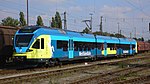 FLIRT of WestfalenBahn
 -
 FLIRT of SBB GmbH at Constance station
 -
 FLIRT of DB Regio
 -
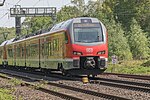 DB Regio Flirt 3 on Wanne-Eickel–Hamburg railway
 -
 FLIRT of Abellio NRW
 -
 FLIRT of Go-Ahead Germany
 -
 Flirt Akku
 -
 FLIRT 3 of NordWestBahn

.jpg)


.jpg)

Hungary edit

- Hungarian State Railways[49] operates 123 units. Technical details: single voltage 25 kV, maximum speed 160 km/h, four section trains with 200+11 (folding) seats, up to 3 trains can be connected together. The first 60 units got Red-black-white livery. During the first modernization the paint scheme was unified with other electric trains of MÁV. Now all 123 units have Blue-black-white livery with yellow doors.
- Győr–Sopron–Ebenfurth railway[50] (in 2012 ordered 4 units, delivery until Q2 2014. First 2 units arrived on 6 December 2014 and started their public service on 15 December of the same year.[51])
- Hungarian State Railways (in 2013 ordered further 42 units, delivery until Q3 2015). The first 2 units arrived on 27 February 2014[52] and the first one presented to the public at Kápolnásnyék on 19 March.[53] New units have arrived in new livery of blue and white colour scheme with yellow doors instead of the previous red and white one.
- Győr–Sopron–Ebenfurth railway (in 2013 ordered further 6 units, delivery until Q3 2015)
- Hungarian State Railways (in July 2015 ordered further 21 units, delivery until Q4 2016). The first unit arrived on 11 September 2015[54] These four section units have the same blue and white colour scheme with yellow doors which is the same as the 2013 orders livery.
- Győr–Sopron–Ebenfurth railway in September 2016 ordered further 10 units (the first order of the new FLIRT 3 version, delivery until Q1 2019)
MÁV operates 123 units, while GYSEV operates 20 units from this series (2019).
It is planned that the first 60 units will be equipped with ETCS L2 signaling, control and train protection system, while all newer units are already equipped with ETCS L2. The units will also receive the blue and white colour scheme.
Italy edit
In Italy FLIRT are used by 6 regional railways, in total units ordered and built are so divided among the following companies:
Ferrovie del Gargano: name ETR 330, single voltage to 3 kV DC, maximum speed 160 km/h (99 mph). Fleet: three units.[55]
Ferrotramviaria: name ETR 340, single voltage to 3 kV DC, maximum speed 160 km/h (99 mph). Fleet: four units.[56]
SAD used on Pustertal Railway name ETR 155 and ETR 170. C.a dual voltage 15 kV AC / 3 kV DC. Fleet: 4 units (ETR 155) and 6 units (ETR 170), In July 2011 have been ordered 8 new units for routes within the jurisdiction of SAD. Now there are (2020) 8 Flirt dual voltage 001-008 (005-008 ex ETR 155) and 24 ETR 170.1/.2 dual / tri voltage (3 kV DC / 15 kV AC / 25 kV 50 Hz)[57]
Sistemi Territoriali: name ETR 340, single voltage to 3 kV DC, maximum speed 160 km/h (99 mph) [10]. Fleet: 2 units from 2008,[58] 4 and 16 FLIRT ordered in 2009. The FLIRT ordered in 2009 will be built in conjunction with the AnsaldoBreda: the Stadler Rail will carry vehicles head of convoys, systems of traction and onboard auxiliary, the bogies and bearing while AnsaldoBreda realize intermediate cars, the staging and the final composition of the train and the delivery to the operators at the plant in Pistoia.[59]
Tilo (Switzerland / Italy):[60] RABe 524/ETR 150 C.a dual voltage 15 kV AC / 3 kV DC. Maximum speed 160 km/h (99 mph). The first 19 units of this type to be delivered were 4 sections long, and were followed by 11 units ordered that 6 sections long and are additionally equipped with the ETCS Level 2 train control system.[61]
Ferrovie Emilia Romagna: 12 units, in conjunction with the construction AnsaldoBreda: the Stadler Rail will carry out the head of the convoys of vehicles, systems, traction and onboard auxiliary, engines and carriages bearing while AnsaldoBreda carry out intermediate cars, the staging and the final composition of the train and the delivery to the operators at the plant in Pistoia.[59][62]
Valle d'Aosta region (licensed to Trenitalia): BTR 813, EMU-DMU tractions, maximum speed 160 km/h (99 mph) [Electric] – 140 km/h (87 mph) [Diesel]
-
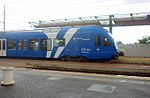 ST ETR 340 unit
 -
 SAD ETR 170 unit at Bruneck railway station
 -
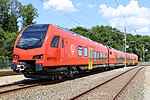 BTR 813 unit


Netherlands edit
On 23 April 2015 the Netherlands' railway operator Nederlandse Spoorwegen announced that it was ordering 58 Stadler FLIRT EMUs, comprising 25 4-car units and 33 3-car units, to be delivered by the end of 2016.[63][64] The very short delivery deadline (20 months), to meet capacity needs, allowed NS to invoke 'urgency mode' provisions in EU procurement rules and place the order without tendering. The 58 FLIRT EMUs for NS were produced at Stadler's plant in Siedlce, Poland, 92 km east of Warsaw, following the order which that plant completed for PKP Intercity in Poland.[65] Meanwhile, Arriva Nederland also ordered two- and three-car units for operation in the province of Limburg.
As of 2023[update], FLIRT 2, 3 and 4 EMUs are in service in the Netherlands with the following operators:
- Arriva
- Connexxion
- Nederlandse Spoorwegen (some of them with R-net branding)
- Keolis
-
 Nederlandse Spoorwegen FLIRT
 -
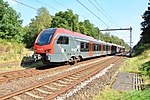 NS R-Net FLIRT
 -
 Keolis FLIRT


Norway edit
50 Flirt units were ordered by Vy (formerly Norwegian State Railways (NSB)), with a further 100 on option. 26 units were placed on the Oslo Commuter Rail and the remaining 24 units were used on regional and express routes.[66] During spring and summer 2012 all Flirt trains used by Vy were fitted with free wireless Internet access for passengers. In Vy's system, the FLIRT trains are classified as "Class 74" for regional trainsets and "Class 75" for local trainsets.

All trains have 5 cars; unlike previous 5-car FLIRTs they will have a third powered bogie giving them a maximum power output of 4,500 kW (6,000 hp) and a top speed of 200 km/h (124 mph).[67] Trial runs started on the Bergen Line in 2009, using a SBB-CFF-FFS unit. The first units were scheduled to enter passenger service on 29 February 2012. The FLIRT's introduction was delayed after a unit derailed during tests by NSB on 15 February 2012, injuring five people. The train was running much too fast, and there were no safety systems along the railway to catch the driver's error.[68][69]
The first train entered regular service on 2 May 2012 on the line from Skien to Lillehammer.[70] The last of the 50 trains was delivered on 24 January 2014.[71] Vy had ordered a further 57 trains, for a total of 107, as of October 2015. In 2017 an order for additional 18 was placed, for a total of 125, forty of which are short regional trains, and the rest local commuter trains. In July 2018, 36 short regional and 64 local commuter trains had been delivered.
Local class 75 trains are configured with 5 seats (2+3) abreast. The class 74 regional trains were also delivered with 2+3 seating on regional trains except in the premium "Komfort" section that had 2+2 seating. Significant passenger complaints over cramped seating led Vy to reconfigure the regional trains into 2+2 seating in 2014.[72]
These fleets have 800 mm (31+1⁄2 in) floor without steps. Many Norwegian platforms are too low for this floor height, so they will have to be raised to 550 mm (21+5⁄8 in) platform height.[73] These fleets cannot operate on low-platform lines such as Bergen Line, Sørlandet Line west of Kongsberg, Dovre Line north of Lillehammer. Raised platforms will be matched with conventional train steps; vertical gaps between this fleet and platforms will remain.
In 2018 the last options were used, which includes 25 trainsets, most of which include the Class 75 and 74 that are set to operate on Gjøvikbanen and Vossebanen.
The two last are bi-mode/hybrid trains named Class 76. These are similar to the FLIRT 3's owned by Greater Anglia in the UK will have an extra carriage for diesel generators, in order to operate fully electric on electrified parts of the railway and diesel supported by batteries on tracks without wires.
In total 14 trainsets of the bi-modal type 76[74] will be delivered to serve the Trønder Commuter Rail as well as the Meråker and Røros Lines. These will replace the aging Class 92's built by Duewag which are fully diesel. All this is included in Bane Nor (Norway's Rail Management Agency) and Jernbaneverkets's plan to finally modernize the Trøndelag Railways, which have outdated buildings and infrastructure. These lines had been partially electrified, between Støren and Trondheim, by 2021, with further electrification to be implemented.[75]
In November 2022 the final 150th train set was delivered.[76]
In February 2023 Norway ordered 17 FLIRT NEX long-distance trains, with the option of up to 100 train sets, to enter testing in 2025 and service on the Bergen Line in 2026, replacing end-of-life trainsets on the line. These will be classified as "Class 79" and have 8 wagons including reclining seats, flexible sleeping compartments that can be used as private seating areas during daytime use, bistro, and a family area.[77]
Poland edit
.jpg)
Koleje Mazowieckie in 2008 bought 10 4-car 3 kV DC (class ER75) units for services in the Warsaw region. Koleje Śląskie (KŚ) bought 4 4-car 3 kV DC units (class EN75) for service in Silesia. Łódzka Kolej Aglomeracyjna[78] (ŁKA) in 2012 ordered 20 2-car FLIRT3 units for service in the region around Łódź, for delivery by February 2015.[79] PKP Intercity in August 2013 ordered 20 8-car 3 kV DC FLIRT3 units (class ED160) with interiors for long-distance travel and top speed of 160 km/h (99 mph), for service on four long-distance routes in Poland, from a consortium of Stadler Polska and Newag for delivery by October 2015.[80] In 2018 Koleje Mazowieckie started another order of total 61 5-car 3 kV DC FLIRT3 units (class ER160) in 5 batches slated for deliveries from 2020 to 2022.[81] In 2019 PKP Intercity ordered further 12 8-car 3 kV DC FLIRT3 units for deliveries through 2023.[82]
Portugal edit
In October 2020, Comboios de Portugal have ordered a delivery of 22 FLIRT units in 1,668 mm (5 ft 5+21⁄32 in) for the renewal of its regional fleet, these are the first FLIRT trains in the Iberian Peninsula.[83] The order of 22 trains comprises 10 electric units (EMU) and 12 bimodal units (BMU). They will consist of 3 aluminium car-bodies with a maximum capacity for 375 passengers, 214 of them seated, with one additional generator car in bimodal units[citation needed]. These trains can reach a maximum speed of 160 respectively 140 kilometres per hour, depending on the power source used. The trains will have a length of 63.2 metres (207 ft 4+1⁄4 in) (EMU) and 74.4 metres (244 ft 1+1⁄8 in) (BMU).[84] Delivery is delayed, and expected for October 2025. [85]
Serbia edit

Serbian Railways operates 21 FLIRT3 4-car EMUs with top speed of 160 km/h for regional traffic which were delivered in 2014 and 2015.[86] In 2022 further 18 units were ordered with deliveries expected to start from October 2023.[87] Trains are numbered ŽS 413/417.[88]
Slovenia edit
Slovenian Railways ordered 11 235-passenger FLIRT EMUs (SŽ 510/515) and 5 171-passenger DMUs (SŽ 610/615) in April 2018, for delivery by early 2020[89] and exercised an option for a further 10 EMUs and 16 DMUs in May 2019 for delivery by late 2021,[90] bringing the total order up to 21 4-car EMUs and 21 3-car DMUs. Together with 10 Stadler KISS units there are 52 Stadler trainsets in Slovenia as of October 2022.[91]
-
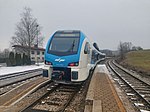 SŽ 610/615
 -
 SŽ 510/515


Spain edit
Renfe's Cercanías division ordered 24 100 m (328 ft 1 in) trains and 35 200 m (656 ft 2 in) combined FLIRT/KISS EMUs in 1,668 mm (5 ft 5+21⁄32 in) for Cercanías Madrid and Rodalies de Catalunya in 2021, which are expected to enter service in 2024, replacing older rolling stock dating from the 1970s to the early-1990s.[92][93] The 100 m variants will consist of two single-deck FLIRT end cars connected to two bilevel KISS intermediate cars, while the 200 m variants will feature additional two single-deck FLIRT intermediate cars.[94]
Sweden edit

MTRX ordered six Flirt EMUs for inter-city operation between Stockholm and Gothenburg. They are very similar to the Norwegian units, maximum 200 km/h, but have more comfortable seats aimed for longer distances, and a small café area. The first unit was delivered in November 2014. They started customer operation in March 2015.[95]
Transitio in 2014 signed an agreement with Stadler, CAF and Bombardier, that these three companies are chosen to get orders for regional and local trains during 2015–2021.[96] Transitio is a train purchasing company owned by the regional transport authorities in Sweden. The rolling stock chosen was ER1 which was delivered from 2020.
Switzerland edit

The Swiss Federal Railways were Stadler's first customer for the FLIRT when they ordered 42 units with options for 100 more in September 2002. The first vehicle was delivered in 2004 for the use on the Stadtbahn Zug.[97]
Meanwhile, the Swiss Federal Railways have ordered a total of 117 units that can be broken down into 4 different types that differ in their equipment for driving in neighboring countries. The base version is the RABe 523 that is used on the Stadtbahn Zug and the RER Vaud. These 43 4-section units can only be used within Switzerland. The 30 RABe 521 and 14 RABe 522 are versions that can also be used in Germany and France respectively. They also consist of 4 sections and are used on the Basel S-Bahn. The last version is the Italy-capable RABe 524/ETR 150 that is used on Treni Regionali Ticino Lombardia (TILO) services in Ticino and northern Italy. The first 19 units of this type to be delivered were 4 sections long, and were followed by eleven units ordered that six-sections long and are additionally equipped with the ETCS Level 2 train control system.[61]
In December 2018, SBB ordered 7 trains, with an option of 7 more. They will be manufactured 2019–2021. Each train has four single-deck cars, with a total of 27 seats in first class and 154 in second class. The SBB name is 'Mouette' (Seagull).[98]
Besides the Swiss Federal Railways two other companies in Switzerland operate FLIRT trains: The Südostbahn (SOB) uses several trains with the designation RABe 526 (FLIRT and FLIRT-III, including the Traverso used as Voralpen Express, Treno Gottardo, and Aare-Linth). The Transports Publics Neuchâtelois (TransN) owns 3 RABe 527 and 4 RABe 523 trains.
BLS AG ordered 58 6-car EMU sets in May 2017 for service on RegioExpress and Bern S-Bahn routes, with delivery scheduled to take place between 2021 and 2026.[99]
United Kingdom edit

In August 2016 Greater Anglia selected Stadler FLIRT electric and bi-mode units for the East Anglia franchise to replace its Class 90 electric locomotives, Mark 3 carriages and Driving Van Trailers, Class 153, 156 and 170 diesel multiple units, and Class 379 electric multiple units. This comprised 14 3-car and 24 4-car bi-mode multiple units (Class 755) and 20 12-car electric multiple units (Class 745) (of which 10 will be used for Stansted Express and 10 for Intercity services).[100]
In June 2018, KeolisAmey Wales announced it would purchase 35 FLIRT trains: 24 (seven 3-car and 17 4-car) tri-mode Class 756 units and 11 4-car diesel-electric Class 231 units for the South Wales Metro.
United States edit
On 9 June 2015 Trinity Metro signed a contract for the supply of eight 4-car articulated FLIRT3 diesel-electric multiple units for the TEXRail commuter line, which opened in January 2019. The contract was signed at a ceremony held at Fort Worth Central Station. The contract is valued at $107 million, and includes the supply of components for 10 years. The contract also includes an option for an additional 24 DMUs. This is Stadler's first order for its FLIRT family in the US (previous orders have been for the GTW), and the first to include federal funding and thus be subject to the Buy America Act. As such, one element of the contract is that the final assembly of the trains will take place in the US, and several assembly sites such as in Lewisville were considered for the facility. Stadler eventually leased space from the Utah Transit Authority in their former Union Pacific shops in Salt Lake City, Utah.
Public unveiling events for the completed American-built FLIRT units occurred in both Atlanta, Georgia on 9 October 2017 and Salt Lake City, on the Salt Lake, Garfield and Western Railway, on 13 October 2017 as Stadler broke ground for their permanent Salt Lake facility.[101][102][103] [104]
Three 2-car FLIRT sets were built for the Arrow commuter rail service in Redlands, California,[105] which started operation in 2022.[106] The $31.4 million contract includes the vehicles themselves, spare parts, and training for servicing and operation.[107] In November 2019, the San Bernardino County Transportation Authority ordered an additional FLIRT powered via hydrogen fuel cell, the first such train in the United States.[108] In September 2022, an order of four additional hydrogen-powered trains were announced by Stadler and CalSTA for Amtrak California inter-city services.[109]
Eight 4-car sets are to enter service with Dallas Area Rapid Transit on the Silver Line when it opens in 2024.[110][111][112]
In February 2024, Metra ordered 16 of the battery electric Akku model for use on the Beverly Branch of the Rock Island Line.[113]
-

-

-
 A Stadler FLIRT DMU, painted in DART Silver Line colors at rest on the Salt Lake Garfield & Western Railway.


Cancelled contracts edit
Latvia edit
On 1 July 2014 Latvian rail operator Pasažieru vilciens announced that it would acquire FLIRT trains as part of a hire/purchase contract,[114] however Pv owner Latvian Railways ultimately withdrew the contract and no procurement went ahead.
Philippines edit
The Department of Transportation (DOTr) is procuring 56 airport express EMU cars for its North–South Commuter Railway project, which will be operated by the Philippine National Railways (PNR). Bids commenced on 15 October 2021 with three contractors offered their proposed designs. One of the three bidders was the joint venture of Japanese firm Marubeni and Stadler Rail.[115] The venture proposed a high-floor variant of the FLIRT200. Unlike the presently-available variants of the FLIRT, the trains will have a floor height of 1,150 mm (45 in) to support the line's 1,100 mm (43 in) platforms. It would also run on standard gauge track and used 1.5 kilovolt DC power. The maximum operational speed for these trains shall be at 160 km/h (99 mph) and the maximum line speed will be at 180 km/h (110 mph).[116][117]
On 24 August 2023, the DOTr has accepted the rivalling bid of Mitsubishi and Construcciones y Auxiliar de Ferrocarriles (CAF).[118] Japanese industrial media website JKNews.jp reported earlier in June that the Notice of Award will be granted by October.[119]
Accidents and incidents edit
- On 15 February 2012, a FLIRT unit used for tests and driver education, without passengers, derailed near Holmestrand in Norway, injuring five people. The train had been entering a bend at 135 km/h (84 mph) instead of the allowed maximum speed of 70 km/h (43 mph).[68] The train driver was convicted of negligence but given a conditional discharge by the court who also faulted the lack of safety systems that could catch the driver's error.[69]
- On 16 April 2014, a FLIRT operated by Elron heading from Tallinn to Tartu was involved in an accident in Raasiku. A dump truck hit the third wagon at a level crossing, causing multiple wagons to derail. One female passenger aged 43 was killed, 12 people received injuries. The dump truck driver, a man aged 59, received fatal injuries. The damaged units were repaired and resumed service.[120]
- On 5 November 2014, a FLIRT operated by SNTF derailed in Hussein-Dey, on the eastern suburb of Algiers in Algeria, it was heading to Thenia, 50 kilometers from the capital, the train was supposed to be commuted to a passing loop at 150m from Hussein-Dey train station to allow the fast Algiers-Oran to overtake, because the latter is not programmed to stop at that station, the train derailed on the switch at a higher speed than limited, the accident killed a 55-year-old woman and injured 70, according to the local authorities.[121][122]
- On 16 May 2015, a FLIRT operated by WestfalenBahn was involved in a collision on a level crossing at Ibbenbüren, North Rhine-Westphalia, Germany. Two people were killed and twenty were injured.[123] The train was scrapped.
- On 9 February 2016, two FLIRTs operated by the Bayerische Oberlandbahn were involved in a head-on collision near Bad Aibling, Germany. 11 people were killed, 80 were injured.[124][125]
- On 12 July 2016, a FLIRT was involved in a head-on collision at Andria, Apulia, Italy that killed 23 people.[126]
- On 5 June 2017, a FLIRT operated by Leo Express ignored a stop signal and crashed into a buffer stop at Přerov, Czech republic. 18 people were injured including staff.[127]
- On 24 November 2019, a Class 755 train operated by Greater Anglia was approaching a level crossing at Thorpe End, Norfolk, United Kingdom at 45 miles per hour (72 km/h) when the barriers lifted as the train was 220 yards (200 m) from the crossing and cars started crossing in front of the train. Despite emergency braking, the train was unable to stop before the crossing. A collision was avoided by half a second. The Rail Accident Investigation Branch has opened an investigation into the incident. In response, Greater Anglia has imposed a 20 miles per hour (32 km/h) speed restriction over five level crossings on the Bittern Line.[128][129]
Fleet details edit
| Class | Operator | No. built | Year built | Cars per set | Unit nos. | Notes |
|---|---|---|---|---|---|---|
| Canada | ||||||
| FLIRT3 | OC Transpo | 7 | 2021 | 4 | C10-C16 | For use on the Trillium Line.
DEMU |
| Estonia | ||||||
| Elron | 12 | 2012–2013 | 3 | EMU | ||
| 6 | 4 | |||||
| 2 | DEMU | |||||
| 8 | 2012–2014 | 3 | ||||
| 6 | 4 | |||||
| Finland | ||||||
| Sm5 | VR | 81 | 2008–2017 | 4 | 01-81 | 25 kV AC EMU, Owned by Pääkaupunkiseudun Junakalusto Oy, leased to the Helsinki Regional Transport Authority (HSL), operated by VR, used on the Helsinki commuter rail network |
| Hungary | ||||||
| 415 | MAV | 60 | 2007–2010 | 4 | ||
| GYSEV | 4 | 2012 | ||||
| MAV | 42 | 2013 | ||||
| GYSEV | 6 | |||||
| MAV | 21 | 2015 | ||||
| 435 | GYSEV | 10 | 2016 | FLIRT3 | ||
| Netherlands | ||||||
| FLIRT-III | NS | 33 | 2015–2017 | 3 | 2201–2233 | Hoofdrailnet (South Eastern parts of the Netherlands)
FLIRT3 |
| FLIRT-IV | 25 | 4 | 2501–2525 | |||
| FLIRT-III | Keolis Nederland | 9 | 2017 | 3 | 7301–7309 | Regional services between Zwolle – Enschede and Zwolle – Kampen
FLIRT3 |
| FLIRT-IV | 7 | 4 | 7401–7407 | |||
| FLIRT-III | Keolis Nederland
(RRReis) |
2 | 2017 | 3 | 5038-5039 | Ex Connexxion units for use on the Valleilijn between Ede-Wageningen and Amersfoort. |
| FLIRT-II | Arriva Nederland | 15 | 2016 | 2 | 450-464 | Regional services in Limburg |
| FLIRT-III | Arriva Nederland | 13 | 2023 | 3 | 560-572 | Regional services in Limburg |
| FLIRT-IIImc | Arriva Nederland | 8 | 2017-2018 | 3 | 550-557 | Multiple voltage EMU suitable for Belgium, the Netherlands and Germany. Have been fitted with ECTS between 2021 and 2023 for operations in Belgium in order to operate a service between Aachen - Heerlen - Maastricht - Liège. |
| Norway | ||||||
| 74 | Vy | 38[131] | 2010–2022 | 5 | Regional services (Eastern Parts of Norway) | |
| 75 | 63[132] | 2012–2020 | Oslo Commuter Rail | |||
| 75-2 | Vy Gjøvikbanen Vy Tog |
20[133] | 2017–2019 | Gjøvik Line Bergen Commuter Rail | ||
| 76 | SJ Norge | 14 | 2020–2021 | 5 (6) | Trøndelag/Trondheim Commuter Rail, Røros Line | |
| Switzerland | ||||||
| FLIRT | SBB CFF FFS | 43 | 2004–2005 | 4 | 523 001-523 043 | Used in the Stadtbahn Zug and in the RER Vaud as RABe 523 |
| 30 | 2004–2006 | 521 001-521 030 | Used in the Regio S-Bahn Basel as RABe 521 they also have a permit for Germany | |||
| 19 | 2007–2008 | 524 001-524 019 | First set of regional trains for the TILO network in Ticino and the Lombardia-Region(Italy), used as RABe 524 and also holds a permit for Italy | |||
| TransN | 3 | 2007–2009 | 527 331–527 333 | Used as regional trains and RegioExpress. | ||
| SOB | 23 | 2007–2013 | 526 041-526 063 | Used on Lucerne S-Bahn line S31, St. Gallen S-Bahn lines S4 and S6, Zurich S-Bahn lines S13 and S40, and as extension set to "Traverso" (FLIRT-III) sets on the InterRegio Voralpen Express during peak-hours. | ||
| SBB CFF FFS | 17 | 2010–2011
(2014) |
5 | 524 101-524 117 | Second set of regional trains for the TILO network in Ticino and the Lombardia-Region(Italy), used as RABe 524.1 and also holds a permit for Italy. As an improvement over the previous iteration, it now has 5 cars instead of 4 and a second onboard toilet. | |
| TPF | 8 | 2011–2014 | 4 | 527 191–527 198 | Used as RER Fribourg and RegioExpress(Bern-Fribourg/Freibourg-Romont-Bulle) as RABe 527 | |
| SBB CFF FFS | 4 | 2014 | 524 201–524 204 | Third set of regional trains for the TILO network in Ticino and the Lombardia-Region(Italy), used as RABe 524.2 and also holds a permit for Italy. This model is back to 4 cars but has a brand new color theme to be applied to the original RABe 524 as well. | ||
| TransN | 2017 | 523 074-523 077 | Used as regional trains and RegioExpress. | |||
| SBB CFF FFS | 32 | (2011)
2017–2019 |
522 201 -522 232 | Used in multiple regional lines and the Léman Express as RABe 522 they also have a permit for France | ||
| FLIRT-III | SOB | 6 | 2019–2021 | 526 001-526 006 | Used on St. Gallen S-Bahn lines S4 and S6, Zurich S-Bahn lines S13 and S40, and as extension set to "Traverso" sets on InterRegio-Lines during peak-hours. | |
| 23 | 2019–2021 | 8 | 526 101/201-526 117/217 | Also known as "Traverso" used on InterRegio-Lines over the Gotthard Panoramaroute (Treno Gottardo), between Bern and Chur (Aare-Linth), and between Luzern and St. Gallen (Voralpen Express). | ||
| BLS AG | 56 | 2021–2026 | 6 | Used in the S-Bahn Bern and in RegioExpress lines. First rollout starting to happen (April 2021) | ||
| United Kingdom | ||||||
| 745/0 | Greater Anglia | 10 | (2018) | 12 (13) | 745001-745010 | Intercity services |
| 745/1 | 10 | 745101-745110 | Stansted Express services | |||
| 755/4 | 24 | 4 (5) | 755401-755424 | BMU | ||
| 755/3 | 14 | 3 (4) | 755301-755314 | |||
| 756 | Transport for Wales | 7 | (2021-2023) | 3 | Tri-mode | |
| 17 | 4 | |||||
| 231 | 11 | (2021-2022) | 231001-231011 | DEMU | ||
| United States | ||||||
| Trinity Metro | 8 | 2015–2018 | 4 | TEXRail DEMU #101–108 | TEXRail DEMU | |
| Metrolink | 3 | 2018–2022 | 2 | Arrow DEMU | ||
| 1 | 2019–2024 | Arrow Hydrail, on order | ||||
| Akku | Metra | 8[a] | 2024- | 2[b] | TBD | Battery electric multiple units for the Rock Island District. On order. |
See also edit
Sources edit
References edit
- ^ Stadler wins tender for up to 510 FLIRT trains for Switzerland, stadlerrail.com, 5 October 2021
- ^ "Home – Stadler".
- ^ a b "Vlaky Leo Express budou černo-zlaté a vyjdou o třetinu levněji než pendolino" (in Czech). 11 December 2010.
- ^ a b "City secures funding to extend O-Train Trillium Line to the heart of Riverside South – Stage 2 Ottawa". Stage 2 Ottawa. Archived from the original on 15 August 2019. Retrieved 16 July 2018.
- ^ "Stadler wins tender for up to 510 FLIRT trains for Switzerland, October 2021" (PDF).
- ^ "Italian region orders bi-mode Stadler Flirts". 13 May 2015.
- ^ "Archived copy" (PDF). wwwstadlerrailcom-live-01e96f7.s3-eu-central-1.amazonaws.com. Archived from the original (PDF) on 3 February 2017. Retrieved 13 January 2022.
{{cite web}}: CS1 maint: archived copy as title (link) - ^ "[UK] New images of the Stadler FLIRT UK interior and exterior". Railcolor News. 8 October 2016.
- ^ "Innotrans: Stadler presenta alla Regione Val d'Aosta il modello del BMU". 26 September 2016.
- ^ "New trains as Abellio scoops East Anglia franchise". railmagazine.com. Retrieved 3 June 2017.
- ^ "Abellio confirms deal with Stadler and Rock Rail for new trains | Abellio". abellio.com. Retrieved 3 June 2017.
- ^ "Stadler signs largest UK order with Abellio East Anglia and Rock Rail". Stadler Rail. Retrieved 3 June 2017.
- ^ railcolornews.com/2019/02/06/no-expert-25-flirts-for-norske-tog-bimodal-units-included-update-edit/
"[NO / Expert] +25 FLIRTs for Norske Tog – bimodal units included [update/edit]"
Written by Ferry Lissenberg on 6 February 2019 - ^ "[UK] Official: Stadler is preferred bidder to supply 71 trains for Wales & Borders (video)". 13 August 2018.
- ^ "Stadler unveils TEX Rail Flirt DMU". 10 October 2017.
- ^ Hill, Joshua S. (3 April 2024). "Hydrogen powered train achieves new distance record". The Driven. Retrieved 9 April 2024.
- ^ "Stadler wins Alger contract". Railway Gazette International. 1 May 2006.
- ^ "First Flirt to Algeria". Railway Gazette International. 8 January 2008.
- ^ "Broad-gauge network FLIRTs for Azerbaijan". Railcolor News. 27 November 2019.
- ^ "Azerbaijan Brings Stadler's Cutting-Edge Trains to Caspian". Caspian News. 27 November 2019.
- ^ "Stadler sells its FLIRT to Azerbaijan for the first time". Stadler Rail AG. 27 November 2019.
- ^ Stadler wins in Belarus Archived 16 July 2011 at the Wayback Machine
- ^ UK, DVV Media. "More Flirts for Belarus".
- ^ "3 июня из Гомеля в Минск отправилась первая электричка". gp.by.
- ^ "Поездом без остановок из Бреста в Минск за 3 часа 15 минут – БрестСИТИ". 29 May 2014.
- ^ "Belarus Railways receives Stadler inter-city EMU". 30 December 2015.
- ^ "Belarus Railways orders more Stadler Flirt EMUs". 18 January 2019.
- ^ "Elektriraudtee orders Stadler Flirt trains". Railway Gazette International. 12 April 2010.
- ^ "Train accident takes two lives". 17 April 2014.
- ^ "FOTOD ja VIDEO: Tallinna-Tartu rongile sõitis veoauto sisse, hukkus kaks inimest, vigastada sai 12 inimest". Delfi. 16 April 2014.
- ^ "Stadleri praakrongid: majandusminister Palo kohtub Elroni juhiga". Ärileht. 19 November 2014.
- ^ "Helsingin kaupunki – Esisopimus VR-Yhtymä Oy:n omistamien Pääkaupunkiseudun Junakalusto Oy:n osakkeiden ostamisesta". Retrieved 27 May 2018.
- ^ "Electric low-floor multiple unit FLIRT: Sm5 trains for Junakalusto Oy, Finland" (PDF). Stadler Rail. Archived from the original (PDF) on 27 July 2011. Retrieved 12 November 2008.
- ^ "34 new Flirt trains for commuter train services". HSL. 12 September 2014. Retrieved 7 December 2014.
- ^ "SRS uutiset 2008" (in Finnish). Suomen raitiotieseura. 12 November 2008. Archived from the original on 5 June 2008. Retrieved 12 November 2008.
- ^ "Uusi Sm5 toimii kuin junan vessa". HS.fi (in Finnish). Helsingin Sanomat. 18 December 2008. Retrieved 19 December 2008.
- ^ "Uusi kaupunkijuna liikenteeseen" (in Finnish). Pääkaupunkiseudun Junakalusto Oy. 13 November 2009. Retrieved 20 November 2009.
- ^ "Finnish rail firm VR unveils new Swiss-designed commuter trains". News. 29 November 2022.
- ^ "Major order for Stadler Pankow". Stadler Rail. 18 October 2006. Archived from the original on 18 July 2011. Retrieved 28 November 2009.
- ^ "Eurobahn signs operating contract". Railway Gazette International. 25 August 2009. Archived from the original on 4 January 2010.
- ^ "Zahlen, Daten & Fakten". Keolis Deutschland (in German). Retrieved 9 August 2021.
- ^ "World rolling stock market November 2008". Railway Gazette. 16 November 2008. Archived from the original on 7 June 2012. Retrieved 28 November 2009.
- ^ Go-Ahead orders Flirt EMU fleet Railway Gazette International 11 May 2016
- ^ Stadler wins Go-Ahead Stuttgart train contract International Railway Journal 11 May 2016
- ^ "Transdev announces EMU order as Hannover S-Bahn operating contract confirmed". Railway Gazette International. 7 November 2018. Retrieved 8 November 2018.
- ^ "Transdev orders Regio-S-Bahn Bremen Flirts". Railway Gazette. 13 June 2019.
- ^ "Battery answer to Schleswig-Holstein's diesel replacement question". Railway Gazette. 2 July 2019.
- ^ "FLIRT Akku BEMU certified for commercial service - start in October". 11 September 2023.
- ^ "Budapest Flirt depot inaugurated". Railway Gazette International. 2 June 2007. Archived from the original on 9 June 2012.
- ^ "GySEV orders Flirts for upgraded line". Railway Gazette International. 18 April 2012.
- ^ "Szolgálatban az első GYSEV FLIRT motorvonatok". GySEV/Raaberbahn. 18 December 2013. Archived from the original on 22 March 2014. Retrieved 22 March 2014.
- ^ "Megérkezett az első két kék FLIRT". RegionalBahn. 27 February 2014. Retrieved 22 March 2014.
- ^ "Megérkezett az első két új FLIRT motorvonat". Elvira. MÁV-Start. 19 March 2014. Retrieved 22 March 2014.
- ^ "És már százhárom!". IHO. 11 September 2015. Retrieved 11 September 2015.
- ^ "Archived copy" (PDF). Archived from the original (PDF) on 4 March 2016. Retrieved 17 February 2013.
{{cite web}}: CS1 maint: archived copy as title (link) - ^ "Archived copy" (PDF). Archived from the original (PDF) on 22 March 2013. Retrieved 17 February 2013.
{{cite web}}: CS1 maint: archived copy as title (link) - ^ "Ferrovie: Widmann in Svizzera per l'acquisto di nuovi convogli – Bolzano – Alto Adige". altoadige.gelocal.it. Archived from the original on 29 October 2013. Retrieved 17 February 2013.
- ^ "Archived copy" (PDF). Archived from the original (PDF) on 8 March 2013. Retrieved 17 February 2013.
{{cite web}}: CS1 maint: archived copy as title (link) - ^ a b "Stadler e AnsaldoBreda si aggiudicano la... | Media | Stadler". Archived from the original on 29 October 2013. Retrieved 15 November 2009.
- ^ "Chi siamo | TILO Treni Regionali Ticino Lombardia". Archived from the original on 12 February 2013. Retrieved 17 February 2013.
- ^ a b Bruno Lämmli. "SBB CFF FFS RABe 521 – 524" (in German). Archived from the original on 1 March 2009. Retrieved 29 November 2009.
- ^ "Stadler/AnsaldoBreda win the tender for new trains in the Veneto and Emilia Romagna regions". Archived from the original on 18 July 2011.
- ^ 'Stadler on track for success in the Netherlands,' Stadler Rail press release 23 April 2015,"Archived copy" (PDF). Archived from the original (PDF) on 1 July 2015. Retrieved 28 June 2015.
{{cite web}}: CS1 maint: archived copy as title (link) - ^ Ltd, DVV Media International. "NS confirms direct order for 58 Stadler EMUs". Railway Gazette.
- ^ Kolejowy, Kurier. "58 FLIRT-ów dla Holendrów powstanie w Polsce". kurierkolejowy.eu.
- ^ "NSB selects Stadler for largest train order". Railway Gazette International. 20 August 2008. Archived from the original on 4 June 2012.
- ^ "FLIRT for the Norwegian State Railways Datasheet" (PDF). Stadler Rail AG. Archived from the original (PDF) on 6 June 2011. Retrieved 27 November 2005.
- ^ a b "Flirt-toget kjørte i 135 km/t i 70-sonen". Aftenposten. 17 February 2012. Retrieved 17 February 2012.
- ^ a b Indreiten, Aina Beate; Stensholt, Anette Dotseth (6 June 2014). "Dømmes, men slipper straff" (in Norwegian). NRK. Retrieved 22 July 2014.
- ^ "Dette blir bedre med de nye Flirt-togene". Teknisk Ukeblad. 2 May 2012. Retrieved 2 May 2012.
- ^ "50 FLIRTs delivered to Norway on schedule". Archived from the original on 8 December 2015.
- ^ Garathun, Mari Gisvold (11 March 2014). "Mot slutten av sommeren vil alle setene på Flirt-togene være komfortseter" (in Norwegian). Teknisk Ukeblad. Retrieved 22 July 2014.
- ^ Also in Poland, low platforms have been raised during Polish Flirt delivery.
- ^ "Bi-mode Multiple Unit – FLIRT Nordic" (PDF). Stadler Rail.
- ^ "Samferdselsministeren avduket nye hybridtog i Trondheim". 7 September 2021. Retrieved 11 October 2021.
- ^ "Norske tog har mottatt FLIRT-tog nr 150". www.norsketog.no (in Norwegian Bokmål). Retrieved 19 February 2023.
- ^ "Stadler skal levere Norges nye fjerntog". www.norsketog.no (in Norwegian Bokmål). Retrieved 19 February 2023.
- ^ pl:Łódzka Kolej Aglomeracyjna
- ^ "Archived copy" (PDF). www.stadlerrail.pl. Archived from the original (PDF) on 21 October 2013. Retrieved 13 January 2022.
{{cite web}}: CS1 maint: archived copy as title (link) - ^ Ltd, DVV Media International. "Stadler and Newag win PKP Intercity train order". Railway Gazette.
- ^ "FLIRT bez tajemnic – pięcioczłonowe pojazdy ER160 Kolei Mazowieckich". Koleje Mazowieckie (in Polish). 11 June 2021. Retrieved 14 October 2022.
- ^ "PKP Intercity odbiera pierwsze FLIRTY" [PKP Intercity receives the first FLIRTS] (in Polish). PKP Intercity. 16 September 2022. Retrieved 27 January 2023.
- ^ "Artikel – Stadler". Stadler Rail. Retrieved 22 October 2020.
- ^ 2020-10-22T07:53:00+01:00. "CP orders 1 668 mm gauge electric and bi-mode multiple-units". Railway Gazette International. Retrieved 22 October 2020.
{{cite web}}: CS1 maint: numeric names: authors list (link) - ^ Ferreira Nunes, Diogo. "Novos comboios regionais da CP chegam em outubro de 2025 (New CP regional trains arrive in October 2025)". Eco Sapo.
- ^ "Stadler flirting in Serbia". Stadler Rail. 4 March 2013. Archived from the original on 28 May 2013.
- ^ "Srbija kupuje 18 garnitura elektromotornih vozova od švajcarskog Štadlera – Ekonomija – Dnevni list Danas" (in Serbian). 1 February 2022. Retrieved 5 January 2023.
- ^ "FLIRT electrical low-floor multiple-unit trains" (PDF). Stadler Rail. 19 June 2014. Archived from the original (PDF) on 28 June 2014.
- ^ "Slovenian Railways orders 26 multiple units from Stadler". International Rail Journal. 18 April 2018. Retrieved 23 April 2018.
- ^ "SZ orders 26 more Stadler multiple units". International Rail Journal. 28 May 2019. Retrieved 22 February 2020.
- ^ "V promet prihaja še zadnji od 52 novih potniških vlakov" (in Slovenian). Slovenske Železnice. 30 September 2022. Retrieved 3 December 2022.
- ^ "Renfe y Stadler firman la compra de 59 trenes para Cercanías". Economia3 (in Spanish). 15 July 2021. Retrieved 3 October 2021.
- ^ Deia (8 March 2021). "Alstom y Stadler se llevan el gran contrato de Renfe". www.deia.eus (in Spanish). Retrieved 3 October 2021.
- ^ "New EMUs for Renfe Cercanías".
- ^ "Boka tågbiljetter – Res Stockholm–Göteborg | MTR Express". mtrexpress.travel.
- ^ Transitio säkrar fordon för framtiden (published 2014-05-07, in Swedish)
- ^ "Ein FLIRT für die Stadt Zug und die S-Bahn Basel" (Press release) (in German). Stadler Rail. 27 September 2002. Archived from the original on 6 June 2011. Retrieved 29 November 2009.
- ^ "SBB and Stadler Sign Contract for New 'Mouette' FLIRT Trains". railway-news.com. 20 December 2018. Retrieved 8 December 2022.
- ^ "BLS selects Stadler for its largest rolling stock order". Railway Gazette International. 2 May 2017. Retrieved 3 May 2017.
- ^ "Stadler and Bombardier to supply trains for Abellio East Anglia franchise". Railway Gazette International. 10 August 2016.
- ^ "TEX Rail orders Stadler Flirt DMUs". Railway Gazette. 11 June 2015.
- ^ "Stadler Rail wins 100-million-dollar contract in Texas". Stadler Rail. 10 June 2015. Archived from the original on 21 June 2015.
- ^ Dickson, Gordon (9 June 2015). "Fort Worth authority signs deal for TEX Rail cars". Fort Worth Star-Telegram.
- ^ "Stadler breaks ground on railcar manufacturing plant expected to employ 1,000 in west Salt Lake City". The Salt Lake Tribune.
- ^ "Technical Proposal" (PDF). San Bernardino County Transportation Authority. Stadler. Retrieved 2 March 2021.
- ^ "Construction begins for rail connecting Redlands to San Bernardino". Redlands Daily Facts. 19 July 2019.
- ^ Emerson, Sandra (28 July 2017). "Redlands takes next step in bringing passenger rail service to city". Redlands Daily Facts. Retrieved 31 July 2017.
- ^ "Stadler to deliver hydrogen-powered train to SBCTA". Railway Age. 15 November 2019. Retrieved 24 November 2019.
- ^ Fender, Keith (21 September 2022). "Stadler unveils first hydrogen train for U.S., announces order for up to 29 more". Trains. Retrieved 21 September 2022.
- ^ Stadler secures contract to build 8 Flirt trains for Texas Metro 3 June 2019
- ^ Cotton Belt railway DMU order placed Metro Report International 3 June 2019
- ^ Newsroom, T. R. A. "Texas Rail Advocates". Retrieved 17 November 2021.
- ^ a b c "Summary of Metra Procurement" (PDF).
- ^ "Archived copy". www.pv.lv. Archived from the original on 18 July 2014. Retrieved 13 January 2022.
{{cite web}}: CS1 maint: archived copy as title (link) - ^ "交通システム" [Transportation system]. jknews.jp (in Japanese). Heavy & Chemical Industries News Agency. October 2021. Retrieved 24 October 2021.
- ^ LIVE: Bid Opening for the Contract Package NS-03 – Limited Express Rolling Stock. Department of Transportation (Philippines). 15 October 2021. Retrieved 30 December 2021.
- ^ "General Bid Bulletin No. 28" (PDF). Philippine National Railways. 7 October 2021. Retrieved 30 December 2021.
- ^ "Letter of Acceptance". Department of Transportation (Philippines). 24 August 2023. Retrieved 8 October 2023.
- ^ "三菱商事、比・南北通勤鉄道の特急車両供給案件を10月受注へ" [Mitsubishi Corporation to receive orders for limited express train supply project for North-South Commuter Railway in the Philippines in October] (in Japanese). 28 June 2023. Retrieved 1 July 2023.
- ^ "Train accident takes two lives". Postimees. 17 April 2014. Retrieved 20 January 2022.
- ^ liberte-algerie.com. "Déraillement spectaculaire d'un train à Alger: Toute l'actualité sur liberte-algerie.com". liberte-algerie.com (in French). Retrieved 21 June 2019.
- ^ à 11h32, Le 5 novembre 2014 (5 November 2014). "Algérie : au moins un mort et 70 blessés dans le déraillement d'un train". leparisien.fr (in French). Retrieved 21 June 2019.
{{cite web}}: CS1 maint: numeric names: authors list (link) - ^ "German train crash kills two near Ibbenbueren". BBC News. 16 May 2015. Retrieved 16 May 2015.
- ^ "Germany train crash: Several killed in Bavarian town of Bad Aibling". BBC News Online. 9 February 2016. Retrieved 9 February 2016.
- ^ "Bavaria train crash: at least eight dead in southern Germany". TheGuardian.com. 9 February 2016. Retrieved 9 February 2016.
- ^ "Italy train crash: 'Twenty killed' near Bari". BBC News Online. 12 July 2016. Retrieved 12 July 2016.
- ^ "Leo Express: Ze nehodou vlaku v Přerově nebyla technická závada | ČeskéNoviny.cz". ceskenoviny.cz (in Czech). Retrieved 3 October 2017.
- ^ "New trains investigated after shocking near miss with car at level crossing". Eastern Daily Press. Archant Media Ltd. 6 December 2019. Retrieved 6 December 2019.
- ^ "Near miss at Norwich Road level crossing". Rail Accident Investigation Branch. Retrieved 6 December 2019.
- ^ "Sprinter (Stadler/Flirt)" (PDF). NS. Retrieved 3 March 2021.
- ^ "Norske tog – type 74". Retrieved 20 November 2018.
- ^ "Norske tog – type 75". Retrieved 20 November 2018.
- ^ "Norske tog – type 75-2". Retrieved 20 November 2018.
External links edit
 Media related to Stadler FLIRT at Wikimedia Commons