
Spaghetti squash or vegetable spaghetti is a group of cultivars of Cucurbita pepo subsp. pepo.[3] They are available in a variety of shapes, sizes, and colours, including ivory, yellow and orange, with orange having the highest amount of carotene. Its center contains many large seeds. When raw, the flesh is solid and similar to other raw squash. When cooked, the meat of the fruit falls away from the flesh in ribbons or strands that look like and can be used as an alternative to spaghetti.
| Spaghetti squash | |
|---|---|
 Fruit of a yellow-skinned cultivar | |
| Species | Cucurbita pepo |
| Origin | Asia |
| Nutritional value per 100 g (3.5 oz) | |
|---|---|
| Energy | 130 kJ (31 kcal) |
6.91 g | |
| Sugars | 2.76 g |
| Dietary fiber | 1.5 g |
0.57 g | |
0.64 g | |
| Vitamins | Quantity %DV† |
| Vitamin A equiv. | 1% 6 μg1% 64 μg |
| Thiamine (B1) | 3% 0.037 mg |
| Riboflavin (B2) | 1% 0.018 mg |
| Niacin (B3) | 6% 0.95 mg |
| Pantothenic acid (B5) | 7% 0.36 mg |
| Vitamin B6 | 6% 0.101 mg |
| Folate (B9) | 3% 12 μg |
| Vitamin C | 2% 2.1 mg |
| Vitamin E | 1% 0.13 mg |
| Minerals | Quantity %DV† |
| Calcium | 2% 23 mg |
| Iron | 2% 0.31 mg |
| Magnesium | 3% 12 mg |
| Manganese | 5% 0.125 mg |
| Phosphorus | 1% 12 mg |
| Potassium | 4% 108 mg |
| Zinc | 2% 0.19 mg |
| †Percentages estimated using US recommendations for adults,[1] except for potassium, which is estimated based on expert recommendation from the National Academies.[2] | |
Preparation edit
Spaghetti squash can be cooked in a variety of ways, including baking, boiling, steaming, air frying,[4] or microwaving.[5] Once cooked the flesh of this fruit can be prepared in a way that its “strands” look like and are as long as traditional spaghetti noodles.[6] It can be served with or without sauce as a substitute for pasta, and its seeds can be roasted, similar to pumpkin seeds.[citation needed]
Nutrition edit
Spaghetti squash contains many nutrients, including folic acid, potassium, and beta carotene. It is low in calories, averaging 42 calories per 1-cup (155 grams) serving.
Cultivation edit

Spaghetti squash is relatively easy to grow, thriving in gardens or pots.[7]
The plants are monoecious, with male and female flowers on the same plant.[citation needed] Male flowers have long, thin stems that extend upwards from the vine. Female flowers are shorter, with a small round growth underneath the petals. This round growth turns into the squash if the flower is successfully pollinated.[citation needed]
-
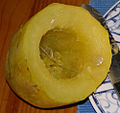 Cooked
 -
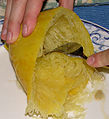 Prepared
 -
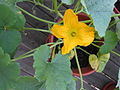 Male flower
 -
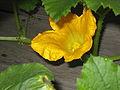 Female flower
 -
 Being sold at a Greengrocer in Japan
 -
 Served with marinara sauce


References edit
- ^ United States Food and Drug Administration (2024). "Daily Value on the Nutrition and Supplement Facts Labels". Retrieved 2024-03-28.
- ^ National Academies of Sciences, Engineering, and Medicine; Health and Medicine Division; Food and Nutrition Board; Committee to Review the Dietary Reference Intakes for Sodium and Potassium (2019). Oria, Maria; Harrison, Meghan; Stallings, Virginia A. (eds.). Dietary Reference Intakes for Sodium and Potassium. The National Academies Collection: Reports funded by National Institutes of Health. Washington, DC: National Academies Press (US). ISBN 978-0-309-48834-1. PMID 30844154.
- ^ "Cucurbita pepo". Germplasm Resources Information Network. Agricultural Research Service, United States Department of Agriculture. Retrieved 2015-01-31.
- ^ heather (2020-06-25). "Spaghetti Squash in Air Fryer". Food Lovin Family. Retrieved 2023-08-21.
- ^ How to Cook Spaghetti Squash
- ^ "How to Cook Spaghetti Squash | Eat Within Your Means". Eat Within Your Means. 2017-01-17. Retrieved 2017-11-19.
- ^ Liz Roberts. "Spaghetti squash: a vegetable with a surprise inside". AllWoodWork.com. Archived from the original on 2012-02-16.
External links edit

- A.H. Beany; P.J. Stoffella; N. Roe; D.H. Picha (2002). "Production, fruit quality, and nutritional value of spaghetti squash". In J. Janick; A. Whipkey (eds.). Trends in new crops and new uses. Alexandria, VA: ASHS Press. pp. 445–448.