

The North America Portal

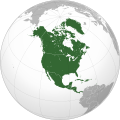
North America is a continent in the Northern and Western Hemispheres. North America is bordered to the north by the Arctic Ocean, to the east by the Atlantic Ocean, to the southeast by South America and the Caribbean Sea, and to the west and south by the Pacific Ocean. The region includes the Bahamas, Bermuda, Canada, the Caribbean, Central America, Clipperton Island, Greenland, Mexico, Saint Pierre and Miquelon, Turks and Caicos Islands, and the United States.
North America covers an area of about 24,709,000 square kilometers (9,540,000 square miles), representing approximately 16.5% of the Earth's land area and 4.8% of its total surface area. It is the third-largest continent by size after Asia and Africa, and the fourth-largest continent by population after Asia, Africa, and Europe. , North America's population was estimated as over 592 million people in 23 independent states, or about 7.5% of the world's population. In human geography, the terms "North America" and "North American" sometimes refer to just Canada, the United States, Mexico, and Greenland.
It is unknown with certainty how and when first human populations first reached North America. People were known to live in the Americas at least 20,000 years ago, but various evidence points to possibly earlier dates. The Paleo-Indian period in North America followed the Last Glacial Period, and lasted until about 10,000 years ago when the Archaic period began. The classic stage followed the Archaic period, and lasted from approximately the 6th to 13th centuries. Beginning in 1000 AD, the Norse were the first Europeans to begin exploring and ultimately colonizing areas of North America.
In 1492, the exploratory voyages of Christopher Columbus led to a transatlantic exchange, including migrations of European settlers during the Age of Discovery and the early modern period. Present-day cultural and ethnic patterns reflect interactions between European colonists, indigenous peoples, enslaved Africans, immigrants from Europe, Asia, and descendants of these respective groups. (Full article...)
 Featured article -

The Convention of 1832 was the first political gathering of colonists in Mexican Texas. Delegates sought reforms from the Mexican government and hoped to quell the widespread belief that settlers in Texas wished to secede from Mexico. The convention was the first in a series of unsuccessful attempts at political negotiation that eventually led to the Texas Revolution.
Under the 1824 Constitution of Mexico, Texas was denied independent statehood and merged into the new state Coahuila y Tejas. After growing suspicion that the United States government would attempt to seize Texas by force, in 1830 Mexican President Anastasio Bustamante enacted the Law of April 6, 1830 which restricted immigration and called for customs duty enforcement. Tensions erupted in June 1832, when Texas residents systematically expelled all Mexican troops from eastern Texas. (Full article...) Featured picture -

Featured biography -
.jpg)
Raymond Robert Emery (né Nichols; September 28, 1982 – July 15, 2018) was a Canadian professional ice hockey goaltender who played in the National Hockey League (NHL) for eleven seasons, between 2003 and 2015. Emery was chosen 99th overall by the Ottawa Senators in the 2001 NHL Entry Draft. During the 2006–07 season, he gained the starting job and backstopped his team to the Stanley Cup Finals, the first appearance in the finals for the modern Senators' franchise. However in the subsequent season, he lost his place as the team's starting goaltender due to an injury. He won a Stanley Cup championship with the Chicago Blackhawks in 2013.
In 2013, Emery won the William M. Jennings Trophy along with teammate Corey Crawford, awarded to the goaltender or goaltenders who give up the fewest goals in the season. Emery was a two-time Bill Masterton Memorial Trophy finalist for his dedication and perseverance. His teammates and fans often referred to him as "Razor" or "Sugar Ray" for his aggressive playing style. (Full article...) Good article -


Indigenous peoples in Canada (also known as Aboriginals) are the indigenous peoples within the boundaries of Canada. They comprise the First Nations, Inuit and Métis. Although "Indian" is a term still commonly used in legal documents, the descriptors "Indian" and "Eskimo" have fallen into disuse in Canada, and most consider them to be pejorative. "Aboriginal" as a collective noun is a specific term of art used in some legal documents, including the Constitution Act, 1982, though in some circles that word is also falling into disfavour.
Old Crow Flats and Bluefish Caves are some of the earliest known sites of human habitation in Canada. The Paleo-Indian Clovis, Plano and Pre-Dorset cultures pre-date the current Indigenous peoples of the Americas. Projectile point tools, spears, pottery, bangles, chisels and scrapers mark archaeological sites, thus distinguishing cultural periods, traditions, and lithic reduction styles. (Full article...)Did you know...
- ...that the Cuban night lizard is less than 4 cm long and lives exclusively in the west corner of the southern-most coast of Cuba?
- ... that tequila was first produced in the 16th century?
- ...that Tropical Storm Larry caused five deaths and US$53.6 million in damage when it struck the Tabasco state of Mexico, the first landfall in the state since 1973?
- ... that the First Mexican Empire was the official name of independent Mexico under a monarchical regime from 1822 to 1823?
- ...that Lucy Hobbs Taylor was the first female dentist in the United States?
Selected panorama

Topics
| Sovereign states |
|  | |||||||||||
|---|---|---|---|---|---|---|---|---|---|---|---|---|---|
| Dependencies |
| ||||||||||||
Categories

List articles

Related portals


.svg)


Northern America


Central America


Caribbean


WikiProjects
 North America
-
 Canada
 -
 Greenland
 -
 Mexico
 -
 Saint Pierre and Miquelon
 -
 United States
  Central America
-
 Belize
 -
 Costa Rica
 -
 El Salvador
 -
 Guatemala
 -
 Honduras
 -
 Nicaragua
 -
 Panama
  Mesoamerica
 Caribbean
-
 Antigua and Barbuda
 -
 Bahamas
 -
 Barbados
 -
 Bermuda
 -
 Cuba
Cuba -
 Dominica
 -
 Dominican Republic
 -
 Grenada
 -
 Haiti
Haiti -
 Jamaica
 -
 Puerto Rico
 -
 Saint Kitts and Nevis
 -
 Saint Lucia
 -
 Saint Vincent and the Grenadines
 -
 Trinidad and Tobago


Associated Wikimedia
The following Wikimedia Foundation sister projects provide more on this subject:
-
 Commons
Free media repository -
 Wikibooks
Free textbooks and manuals -
 Wikidata
Free knowledge base -
 Wikinews
Free-content news -
 Wikiquote
Collection of quotations -
 Wikisource
Free-content library -
 Wikiversity
Free learning tools -
 Wikivoyage
Free travel guide -
 Wiktionary
Dictionary and thesaurus


