
AL 288-1, commonly known as Lucy or Dinkʼinesh (Amharic: ድንቅ ነሽ, lit. 'you are marvellous'), is a collection of several hundred pieces of fossilized bone comprising 40 percent of the skeleton of a female of the hominin species Australopithecus afarensis. It was discovered in 1974 in Ethiopia, at Hadar, a site in the Awash Valley of the Afar Triangle, by Donald Johanson, a paleoanthropologist of the Cleveland Museum of Natural History.[1][2][3]
 | |
| Catalog no. | AL 288-1 |
|---|---|
| Common name | Lucy |
| Species | Australopithecus afarensis |
| Age | 3.2 million years |
| Place discovered | Afar Depression, Ethiopia |
| Date discovered | November 24, 1974 |
| Discovered by |
|
Lucy is an early australopithecine and is dated to about 3.2 million years ago. The skeleton presents a small skull akin to that of non-hominin apes, plus evidence of a walking-gait that was bipedal and upright, akin to that of humans (and other hominins); this combination supports the view of human evolution that bipedalism preceded increase in brain size.[4][5] A 2016 study proposes that Australopithecus afarensis was also, to a large extent, tree-dwelling, though the extent of this is debated.[6][7]
Lucy was named by Pamela Alderman after the 1967 song "Lucy in the Sky with Diamonds" by the Beatles, which was played loudly and repeatedly in the expedition camp all evening after the excavation team's first day of work on the recovery site.[8] After public announcement of the discovery, Lucy captured much international interest, becoming a household name at the time.
Lucy became famous worldwide, and the story of her discovery and reconstruction was published in a book by Johanson and Edey. Beginning in 2007, the fossil assembly and associated artefacts were exhibited publicly in an extended six-year tour of the United States; the exhibition was called Lucy's Legacy: The Hidden Treasures of Ethiopia. There was discussion of the risks of damage to the unique fossils, and other museums preferred to display casts of the fossil assembly.[9] The original fossils were returned to Ethiopia in 2013, and subsequent exhibitions have used casts.
Discovery
Background controversy
Ever since the development of evolutionary theory in the early 19th century, biologists recognized that humans must be distantly related to all other species. Without transitional fossils, scientists presumed that humans' closest relatives were the great apes. They also assumed the first traits to evolve after speciation related to intelligence: big brains, tool use, and complex language.[10]
In the 1920s, Raymond Dart discovered the Taung child. That skeleton seemed bipedal (unlike chimps), but lacked skull space for a powerful brain. Without further data to contextualize Dart's find, anthropologists could not prove whether bipedality, intelligence, or some other trait had first distinguished proto-humans from their great ape relatives.[10]
Organizing the expedition
French geologist and paleoanthropologist Maurice Taieb discovered the Hadar Formation for paleoanthropology in 1970 in the Afar Triangle of Ethiopia, then in Hararghe province; he recognized its potential as a likely repository of the fossils and artifacts of human origins. Taieb formed the International Afar Research Expedition (IARE) and invited three prominent international scientists to conduct research expeditions into the region. Under his directorship, these were: Donald Johanson (co-director), an American paleoanthropologist and curator at the Cleveland Museum of Natural History, who later founded the Institute of Human Origins, now part of Arizona State University; Yves Coppens (1934–2022, co-director), a French paleoanthropologist appointed in 1983 a professor at the Collège de France, which is considered to be France's most prestigious research establishment, and Mary Leakey, the noted British paleoanthropologist. An expedition was soon mounted with seven French and four American participants; in the autumn of 1973 the team began surveying sites around Hadar for signs related to the origin of humans.[11]
.jpg)
First find
In November 1973, near the end of the first field season, Johanson noticed a fossil of the upper end of a shinbone, which had been sliced slightly at the front. The lower end of a femur was found near it, and when he fitted them together, the angle of the knee joint clearly showed that this fossil, reference AL 129-1, was an upright walking hominin. This fossil was later dated at more than three million years old—much older than other hominin fossils known at the time. The site lay about 2.5 kilometres (1.6 mi) from the site where "Lucy" subsequently was found, in a rock stratum 60 metres (200 ft) deeper than that in which the Lucy fragments were found.[12][13]
Subsequent findings
The team returned for the second field season the following year and found hominin jaws. Then, on the morning of November 24, 1974, near the Awash River, Johanson abandoned a plan to update his field notes and joined graduate student Tom Gray to search Locality 162 for bone fossils.[14][15][16][17][1][2]
By Johanson's later (published) accounts, both he and Tom Gray spent two hours on the increasingly hot and arid plain, surveying the dusty terrain. On a hunch, Johanson decided to look at the bottom of a small gully that had been checked at least twice before by other workers. At first view nothing was immediately visible, but as they turned to leave a fossil caught Johanson's eye; an arm bone fragment was lying on the slope. Near it lay a fragment from the back of a small skull. They noticed part of a femur (thigh bone) a few feet (about one meter) away. As they explored further, they found more and more bones on the slope, including vertebrae, part of a pelvis, ribs, and pieces of jaw. They marked the spot and returned to camp, excited at finding so many pieces apparently from one individual hominin.[3][18]

In the afternoon, all members of the expedition returned to the gully to section off the site and prepare it for careful excavation and collection, which eventually took three weeks. That first evening they celebrated at the camp; at some stage during the evening they named fossil AL 288-1 "Lucy", after the Beatles' song "Lucy in the Sky with Diamonds" (1967), which was being played loudly and repeatedly on a tape recorder in the camp.[19]
Over the next three weeks the team found several hundred pieces or fragments of bone with no duplication, confirming their original speculation that the pieces were from a single individual; ultimately, it was determined that an amazing 40 percent of a hominin skeleton was recovered at the site. Johanson assessed it as female based on the one complete pelvic bone and sacrum, which indicated the width of the pelvic opening.[19]
Assembling the pieces
Lucy was 1.1 m (3 ft 7 in) tall,[20] weighed 29 kg (64 lb), and (after reconstruction) looked somewhat like a chimpanzee. The creature had a small brain like a chimpanzee, but the pelvis and leg bones were almost identical in function to those of modern humans, showing with certainty that Lucy's species were hominins that had stood upright and had walked erect.[21]
Reconstruction in Cleveland
With the permission of the government of Ethiopia, Johanson brought all the skeletal fragments to the Cleveland Museum of Natural History in Ohio, where they were stabilized and reconstructed by anthropologist Owen Lovejoy. Lucy the pre-human hominid and fossil hominin, captured much public notice; she became almost a household name at the time. Some nine years later, and now assembled altogether, she was returned to Ethiopia.[22]
Later discoveries
Additional finds of A. afarensis were made during the 1970s and forward, gaining for anthropologists a better understanding of the ranges of morphic variability and sexual dimorphism within the species. A more complete skeleton of a related hominid, Ardipithecus, was found in the same Awash Valley in 1992. "Ardi", like "Lucy", was a hominid-becoming-hominin species, but, dated at 4.4 million years ago, it had evolved much earlier than the afarensis species. Excavation, preservation, and analysis of the specimen Ardi was very difficult and time-consuming; work was begun in 1992, with the results not fully published until October 2009.[23]
Age estimates of the fossil
Initial attempts were made in 1974 by Maurice Taieb and James Aronson in Aronson's laboratory at Case Western Reserve University to estimate the age of the fossils using the potassium-argon radiometric dating method. These efforts were hindered by several factors: the rocks in the recovery area were chemically altered or reworked by volcanic activity; datable crystals were very scarce in the sample material; and there was a complete absence of pumice clasts at Hadar. (The Lucy skeleton occurs in the part of the Hadar sequence that accumulated with the fastest rate of deposition, which partly accounts for her excellent preservation.)
Fieldwork at Hadar was suspended in the winter of 1976–77. When it was resumed thirteen years later in 1990, the more precise argon-argon technology had been updated by Derek York at the University of Toronto. By 1992 Aronson and Robert Walter had found two suitable samples of volcanic ash—the older layer of ash was about 18 m below the fossil and the younger layer was only one meter below, closely marking the age of deposition of the specimen. These samples were argon-argon dated by Walter in the geochronology laboratory of the Institute of Human Origins at 3.22 and 3.18 million years.[24]
Notable characteristics
This section needs additional citations for verification. (November 2015) |
Ambulation
One of the most striking characteristics of the Lucy skeleton is a valgus knee,[25] which indicates that she normally moved by walking upright. Her femur presents a mix of ancestral and derived traits. The femoral head is small and the femoral neck is short; both are primitive traits. The greater trochanter, however, is clearly a derived trait, being short and human-like—even though, unlike in humans, it is situated higher than the femoral head. The length ratio of her humerus (arm) to femur (thigh) is 84.6%, which compares to 71.8% for modern humans, and 97.8% for common chimpanzees, indicating that either the arms of A. afarensis were beginning to shorten, the legs were beginning to lengthen, or both were occurring simultaneously. Lucy also had a lordose curve, or lumbar curve, another indicator of habitual bipedalism.[26] She apparently had physiological flat feet, not to be confused with pes planus or any pathology, even though other afarensis individuals appear to have had arched feet.[27]
-
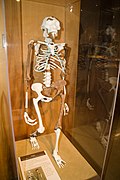 Lucy skeleton reconstruction at the Cleveland Museum of Natural History
 -
 Interactive 3D model of the skeleton reconstruction at the Natural History Museum of Geneva.
 -
Turntable of the skeleton reconstruction at the Natural History Museum of Geneva.


Pelvic girdle
Johanson recovered Lucy's left innominate bone and sacrum. Though the sacrum was remarkably well preserved, the innominate was distorted, leading to two different reconstructions. The first reconstruction had little iliac flare and virtually no anterior wrap, creating an ilium that greatly resembled that of an ape. However, this reconstruction proved to be faulty, as the superior pubic rami would not have been able to connect were the right ilium identical to the left.
A later reconstruction by Tim White showed a broad iliac flare and a definite anterior wrap, indicating that Lucy had an unusually broad inner acetabular distance and unusually long superior pubic rami. Her pubic arch was over 90 degrees and derived; that is, similar to modern human females. Her acetabulum, however, was small and primitive.
Sacrum and spine
While examining Lucy's fossilized remains, it was believed that Lucy's sacrum had five fused elements. The sacrum was found to be in good condition with little damage done. Although the sacrum had five fused elements, the transverse processes of the most caudal element were not seen to connect to the segments craniad to it. This would result in researchers concluding that the sacrum suffered fossil damage which led to the fifth segment not connecting.
Although this was the case, in the mid-2010s studies came out with new theories as to why Lucy's fifth sacral segment is in that shape. Some researchers conclude that Lucy has only four sacral segments. Published in the American Journal of Physical Anthropology,[28] researchers suggest that fossil damage did not shorten the transverse process and that Lucy's sacrum was in this state from the beginning. This specific study points to Lucy's sacrum having four sacral segments which researchers[28] say conforms with the "long-back" model of hominoid vertebral evolution. There are some disagreements in the community about the fifth sacral segment and if fossil damage was enough to change the fifth segment or if it was originally in that state.[29] Discussed in the Journal,[28] researchers conclude that Lucy having only four sacral segments is consistent with other findings related to early Miocene hominoids.

Lucy's back is associated with approximately 9 vertebrae. Although Lucy was found with a relatively intact and well preserved sacrum, she was missing pieces in her spinal column. Lucy's discoverers and later workers had given the vertebrae provisional level assignments to locations within the vertebral column.[30] Interestingly, some vertebrae were in worse conditions than others. Lucy had a worn out upper thoracic neutral arch. Researchers have yet to find a cause as to why this particular vertebrae was in worse condition than the other pieces.[30] While accessing and restructuring Lucy's spinal column, it was noted to have been missing pieces that leave it incomplete. Not including an oddly worn out upper thoracic neutral arch, and the lumbar vertebrae, the other remaining thoracic vertebrae were compiled to form an incomplete formation. The formation was arranged from the sixth thoracic vertebrae (T6) to its caudal end (T12), with the seventh thoracic vertebrae (T7) missing. As of 2015,[update] the continuity differs in the thoracic series between researchers and is being reevaluated.[30] Although there are new studies and reassessments being done,[30] it does not refute previous work or conclusions about Lucy's spine.
Cranial specimens
The cranial evidence recovered from Lucy is far less derived than her postcranium. Her neurocranium is small and primitive, while she possesses more spatulate canines than other apes. The cranial capacity was about 375 to 500 cubic centimeters.
Rib cage and plant-based diet
Australopithecus afarensis seems to have had the same conical rib-cage found in today's non-human great apes (like the chimpanzee and gorilla), which allows room for a large stomach and the longer intestine needed for digesting voluminous plant matter. Fully 60% of the blood supply of non-human apes is used in the digestion process, greatly impeding the development of brain function (which is limited thereby to using about 10% of the circulation). The heavier musculature of the jaws—those muscles operating the intensive masticatory process for chewing plant material—similarly would also limit development of the braincase. During evolution of the human lineage these muscles seem to have weakened with the loss of the myosin gene MYH16, a two base-pair deletion that occurred possibly about 2.4 million years ago.[31]
Other findings
A study of the mandible across a number of specimens of A. afarensis indicated that Lucy's jaw was rather unlike other hominins, having a more gorilla-like appearance.[32] Rak et al. concluded that this morphology arose "independently in gorillas and hominins", and that A. afarensis is "too derived to occupy a position as a common ancestor of both the Homo and robust australopith clades".[33]
Work at the American Museum of Natural History uncovered a possible Theropithecus vertebral fragment that was found mixed in with Lucy's vertebrae, but confirmed the remainder belonged to her.[34]
Death

Lucy's cause of death has not been determined. The specimen does not show the signs of post-mortem bone damage characteristic of animals killed by predators and then scavenged. The only visible damage is a single carnivore tooth mark on the top of her left pubic bone, believed to have occurred at or around the time of death, but which is not necessarily related to her death. Her third molars were erupted and slightly worn and, therefore, it was concluded that she was fully matured with completed skeletal development. There are indications of degenerative disease to her vertebrae that do not necessarily indicate old age. It is believed that she was a mature but young adult when she died.[35]
In 2016 researchers at the University of Texas at Austin suggested that Lucy died after falling from a tall tree.[36][37] Donald Johanson and Tim White disagreed with the suggestions.[38]
Exhibitions
_National_Museum_of_Ethiopia.jpg)
The Lucy skeleton is preserved at the National Museum of Ethiopia in Addis Ababa. A plaster replica is publicly displayed there instead of the original skeleton. A cast of the original skeleton in its reconstructed form is displayed at the Cleveland Museum of Natural History.[39] At the American Museum of Natural History in New York City a diorama presents Australopithecus afarensis and other human predecessors, showing each species and its habitat and explaining the behaviors and capabilities assigned to each. A cast of the skeleton as well as a corpus reconstruction of Lucy is displayed at The Field Museum in Chicago.
US tour
A six-year exhibition tour of the United States was undertaken during 2007–13; it was titled Lucy's Legacy: The Hidden Treasures of Ethiopia and it featured the actual Lucy fossil reconstruction and over 100 artifacts from prehistoric times to the present. The tour was organized by the Houston Museum of Natural Science and was approved by the Ethiopian government and the U.S. State Department.[40] A portion of the proceeds from the tour was designated to modernizing Ethiopia's museums.
There was controversy in advance of the tour over concerns about the fragility of the specimens, with various experts including paleoanthropologist Owen Lovejoy and anthropologist and conservationist Richard Leakey publicly stating their opposition, while discoverer Don Johanson, despite concerns for the possibility of damage, felt the tour would raise awareness of human origins studies. The Smithsonian Institution, Cleveland Museum of Natural History and other museums declined to host the exhibits.[9][41]
The Houston Museum made arrangements for exhibiting at ten other museums, including the Pacific Science Center in Seattle.[9] In September 2008, between the exhibits in Houston and Seattle, the skeletal assembly was taken to the University of Texas at Austin for 10 days to perform high-resolution CT scans of the fossils.[42]
Lucy was exhibited at the Discovery Times Square Exposition in New York City from June until October 2009.[43] In New York, the exhibition included Ida (Plate B), the other half of the recently announced Darwinius masilae fossil.[44] She was also exhibited in Mexico at the Mexico Museum of Anthropology until its return to Ethiopia in May 2013.
Ethiopia celebrated the return of Lucy in May 2013.[45]
See also
- Ardi – more complete skeleton of earlier hominin species
- Dawn of Humanity – 2015 PBS documentary
- List of human evolution fossils
- Prehistoric Autopsy – 2012 BBC documentary
- Selam (Australopithecus) – young female A. afarensis fossil from Ethiopia
- Lucy (spacecraft) – the NASA mission launched in 2021 to study Trojan asteroids described as fossils of the early solar system.
References
- ^ a b Johanson & Wong 2009, p. 8.
- ^ a b Johanson & Wong 2009, p. 9.
- ^ a b "Lucy's Story". Institute of Human Origins. Retrieved February 15, 2014.
- ^ Hadar entry in Encyclopædia (2008).
- ^ Tomkins, Stephen (1998). The Origins of Humankind. Cambridge University Press. p. 136. ISBN 978-0-521-46676-9.
- ^ Klein, Joanna (November 30, 2016). "Study Suggests 3.2 Million-Year-Old Lucy Spent a Lot of Time in Trees". New York Times. Retrieved November 30, 2016.
- ^ Ruff, Christopher B.; Burgess, M. Loring; Ketcham, Richard A.; Kappelman, John (2016). "Limb Bone Structural Proportions and Locomotor Behavior in A.L. 288-1". PLOS ONE. 11 (11): e0166095. Bibcode:2016PLoSO..1166095R. doi:10.1371/journal.pone.0166095. PMC 5130205. PMID 27902687.
- ^ Johanson & Wong 2009, pp. 7–8.
- ^ a b c Jim Kennett (August 31, 2007). "Bloomberg.com: Canada". Lucy's Ancient Bones Visit Houston Museum as Scientists Fret. Retrieved September 11, 2007.
- ^ a b WGBH (2001). "Backgrounder to 'Finding Lucy'". Evolution library. PBS.
- ^ Johanson & Edey 1981, pp. 154–158
- ^ "Lucy's Knee Joint. Letter from Donald Johanson". Institute of Human Origins. August 8, 1989.
- ^ Johanson & Edey 1981, pp. 159–163
- ^ Johanson & Wong 2009, p. 4.
- ^ Johanson & Wong 2009, p. 5.
- ^ Johanson & Wong 2009, p. 6.
- ^ Johanson & Wong 2009, p. 7.
- ^ Johanson & Edey 1981, pp. 20–21
- ^ a b Johanson & Edey 1981, p. 18
- ^ Jungers, William L. (June 1988). "Lucy's length: Stature reconstruction in Australopithecus afarensis (A.L.288-1) with implications for other small-bodied hominids". American Journal of Physical Anthropology. 76 (2): 227–231. doi:10.1002/ajpa.1330760211. PMID 3137822.
- ^ Johanson & Edey 1981, pp. 20–22, 184–185
- ^ "Mother of man – 3.2 million years ago". BBC Home. September 17, 2014. Retrieved October 10, 2008.
- ^ Gibbons, Ann (October 1, 2009). "Ancient Skeleton May Rewrite Earliest Chapter of Human Evolution". Science Now. Retrieved April 22, 2013.
- ^ Walter, Robert C. (1994). "Age of Lucy and the First Family". Geology. 22 (January): 6–10. Bibcode:1994Geo....22....6W. doi:10.1130/0091-7613(1994)022<0006:AOLATF>2.3.CO;2.
- ^ Stern Jr., J. T.; Susman, R. L. (1983). "The locomotor anatomy of Australopithecus afarensis". American Journal of Physical Anthropology. 60 (3): 279–317. doi:10.1002/ajpa.1330600302. PMID 6405621.
- ^ Lovejoy, C. Owen; McCollum, Melanie A. (October 27, 2010). "Spinopelvic pathways to bipedality: why no hominids ever relied on a bent-hip-bent-knee gait". Philos Trans R Soc Lond B Biol Sci. 365 (1556): 3289–99. doi:10.1098/rstb.2010.0112. PMC 2981964. PMID 20855303. (Introduction)
- ^ Desilva, J. M.; Throckmorton, Z. J. (2010). Rosenberg, Karen (ed.). "Lucy's Flat Feet: The Relationship between the Ankle and Rearfoot Arching in Early Hominins". PLOS ONE. 5 (12): e14432. Bibcode:2010PLoSO...514432D. doi:10.1371/journal.pone.0014432. PMC 3010983. PMID 21203433.
- ^ a b c Machnicki, Allison L.; Lovejoy, C. Owen; Reno, Philip L. (April 21, 2016). "Developmental identity versus typology: Lucy has only four sacral segments". American Journal of Physical Anthropology. 160 (4): 729–739. doi:10.1002/ajpa.22997. ISSN 0002-9483. PMID 27101066.
- ^ Russo, Gabrielle A.; Williams, Scott A. (October 21, 2014). ""Lucy" (A.L. 288-1) had five sacral vertebrae". American Journal of Physical Anthropology. 156 (2): 295–303. doi:10.1002/ajpa.22642. ISSN 0002-9483. PMID 25331588.
- ^ a b c d Meyer, Marc R.; Williams, Scott A.; Smith, Michael P.; Sawyer, Gary J. (August 2015). "Lucy's back: Reassessment of fossils associated with the A.L. 288-1 vertebral column". Journal of Human Evolution. 85: 174–180. doi:10.1016/j.jhevol.2015.05.007. ISSN 0047-2484. PMID 26058822. S2CID 10410978.
- ^ Stedman HH, Kozyak BW, Nelson A, Thesier DM, Su LT, Low DW, Bridges CR, Shrager JB, Minugh-Purvis N, Mitchell MA (March 2004). "Myosin gene mutation correlates with anatomical changes in the human lineage". Nature. 428 (6981): 415–8. Bibcode:2004Natur.428..415S. doi:10.1038/nature02358. PMID 15042088. S2CID 4304466.
- ^ Ferguson, W. W. (1989). "Critique of Australopithecus afarensis as a single species based on dental metrics and morphology". Primates. 30 (4): 561–569. doi:10.1007/BF02380881. S2CID 39160406.
- ^ Rak, Y.; Ginzburg, A.; Geffen, E. (2007). "Gorilla-like anatomy on Australopithecus afarensis mandibles suggests A. afarensis link to robust australopiths". Proceedings of the National Academy of Sciences. 104 (16): 6568–72. Bibcode:2007PNAS..104.6568R. doi:10.1073/pnas.0606454104. PMC 1871826. PMID 17426152.
- ^ "Baboon bone found in famous Lucy skeleton". New Scientist. April 10, 2015. Retrieved January 25, 2019.
- ^ ASU Institute of human origins, Lucy's story
- ^ John Kappelman; Richard A. Ketcham; Stephen Pearce; Lawrence Todd; Wiley Akins; Matthew W. Colbert; Mulugeta Feseha; Jessica A. Maisano; Adrienne Witzel (2016). "Perimortem fractures in Lucy suggest mortality from fall out of tall tree". Nature. 537 (7621): 503–507. Bibcode:2016Natur.537..503K. doi:10.1038/nature19332. PMID 27571283. S2CID 4402700.
- ^ "UT study cracks coldest case: How the most famous human ancestor died". Retrieved August 29, 2016.
- ^ Sample, Ian (August 29, 2016). "Family tree fall: human ancestor Lucy died in arboreal accident, say scientists". The Guardian. Retrieved August 30, 2016.
- ^ "Permanent Exhibits". Archived from the original on March 24, 2013. Retrieved April 22, 2013.
- ^ "Lucy's Legacy: The Hidden Treasures of Ethiopia". Houston Museum of Natural Science. 2008. Archived from the original on June 25, 2013. Retrieved April 22, 2012.
- ^ Stefan Lovgren (November 1, 2006). "'Lucy' Fossil Tour Sparks Controversy Among U.S. Museums". National Geographic News. Archived from the original on November 13, 2006. Retrieved September 11, 2007.
- ^ University of Texas at Austin Office of Public Affairs (February 6, 2009). "Researchers Complete First CT Scan of Ancient Human Ancestor Lucy". University of Texas at Austin. Archived from the original on February 11, 2009. Retrieved February 6, 2009.
- ^ "Lucy's Legacy: The Hidden Treasures of Ethiopia". Houston Museum of Natural Science. 2009. Archived from the original on June 5, 2009. Retrieved June 4, 2009.
- ^ "Famous Fossil to go on display in Times Square". USA Today. June 15, 2009. Retrieved April 22, 2013.
- ^ "'Lucy' comes home: Ethiopia celebrates iconic fossil", Times Live, May 7, 2013, accessed May 4, 2013
Works cited
- Johanson, Donald; Edey, Maitland (1981). Lucy, the Beginnings of Humankind. St Albans: Granada. ISBN 978-0-586-08437-3.
- Johanson, Donald C.; Wong, Kate (2009). Lucy's Legacy: The Quest for Human Origins. Harmony Books. p. 309. ISBN 978-0307396396.
External links

- Meet Lucy: The Famous Early Human
- Cleveland Museum of Natural History
- "Institute of Human Origins". asu.edu. Arizona State University. June 15, 2016.
- "Becoming Human: Paleoanthropology, Evolution, and Human Origins", a documentary hosted by Donald Johanson
- "New Link In Human Evolution Discovered", facial reconstruction of Lucy, an Agence France-Presse photo published by the Taipei Times, May 8, 2006. Accessed September 11, 2007.
- "BBC – Science & Nature – The evolution of man". Mother of man – 3.2 million years ago. Retrieved November 1, 2007.
- "Lucy : American Museum of Natural History". AMNH / Rod Mickens. Retrieved February 19, 2014.
- "PREMOG - Research". How Lucy walked. Primate Evolution & Morphology Group (PREMOG), the Department of Human Anatomy and Cell Biology, the School of Biomedical Sciences at the University of Liverpool. May 18, 2007. Archived from the original on October 25, 2007. Retrieved November 1, 2007.
- Thorpe S.K.S.; Holder R.L.; Crompton R.H. (May 24, 2007). "PREMOG – Supplementry Info". Origin of Human Bipedalism As an Adaptation for Locomotion on Flexible Branches. Primate Evolution & Morphology Group (PREMOG), the Department of Human Anatomy and Cell Biology, the School of Biomedical Sciences at the University of Liverpool. Archived from the original on July 17, 2007. Retrieved November 1, 2007.
Based on computer simulations of the mechanics of motion in fossil human ancestors such as the famous 'Lucy' skeleton, our research group has long argued that early human ancestors would have walked upright, rather than semi-crouched, as the old 'up from the apes' view has suggested But we have not been able to say where such upright walking originated. Now, research on the orangutan, suggests that upright walking may have been a basic element of the lifestyle of the earliest ancestors of modern apes, including humans, which would have been tree-dwelling specialists on ripe fruit, living among the fine branches of tropical forest trees.
- University of Texas's eLucy.org website Enables visitors to view bones and bone casts, and learn more about human origins and evolution. Activities and lessons are provided to encourage additional study.
- National Public Radio "Science Friday" interview with Dr. Donald Johanson titled "Lucy's Legacy" originally aired on March 6, 2009
- Australopithecus afarensis – Science Journal Article
- Israeli researchers: 'Lucy' is not direct ancestor of humans
- Human Timeline (Interactive) – Smithsonian, National Museum of Natural History (August 2016).

