
Gliese 229 (also written as Gl 229 or GJ 229) is a binary system composed of a red dwarf and the first brown dwarf seen by astronomers, 18.8 light years away in the constellation Lepus. The primary component has 58% of the mass of the Sun,[3] 69% of the Sun's radius,[6] and a very low projected rotation velocity of 1 km/s at the stellar equator.[8]
 Gliese 229 A and B | |
| Observation data Epoch J2000 Equinox J2000 | |
|---|---|
| Constellation | Lepus |
| Right ascension | 06h 10m 34.61494s[1] |
| Declination | −21° 51′ 52.6564″[1] |
| Apparent magnitude (V) | 8.14 |
| Characteristics | |
| Evolutionary stage | Main sequence / Brown dwarf |
| Spectral type | M1Ve / T7[2] |
| U−B color index | +1.222[2] |
| B−V color index | +1.478[2] |
| Variable type | Flare star |
| Astrometry | |
| Radial velocity (Rv) | 4.23±0.12[1] km/s |
| Proper motion (μ) | RA: −135.692(11) mas/yr[1] Dec.: −719.178(17) mas/yr[1] |
| Parallax (π) | 173.5740 ± 0.0170 mas[1] |
| Distance | 18.791 ± 0.002 ly (5.7612 ± 0.0006 pc) |
| Absolute magnitude (MV) | 9.326[3] |
| Absolute bolometric magnitude (Mbol) | 7.96[4] |
| Orbit[3][5] | |
| Companion | Gliese 229 B |
| Period (P) | 216.925+10.604 −10.352 yr |
| Semi-major axis (a) | 28.933+1.008 −1.000 AU |
| Eccentricity (e) | 0.853±0.002 |
| Inclination (i) | 5.497+0.153 −0.162° |
| Longitude of the node (Ω) | 145.946+0.306 −0.294° |
| Periastron epoch (T) | 2466912+97 −63 |
| Argument of periastron (ω) (secondary) | 358.285+0.836 −0.846° |
| Semi-amplitude (K1) (primary) | 0.081674+0.001688 −0.001680 km/s |
| Details | |
| A | |
| Mass | 0.579[3] M☉ |
| Radius | 0.69[6] R☉ |
| Luminosity (bolometric) | 0.0430[3] L☉ |
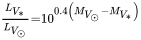
| Luminosity (visual, LV) | 0.0158[nb 1] L☉ |
| Temperature | 3,700[4] K |
| Rotation | 27.3±0.2 d[7] |
| Rotational velocity (v sin i) | 1[8] km/s |
| B | |
| Mass | 60.423+2.339 −2.379[5] MJup |
| Radius | 1.105±0.025[9] RJup |
| Luminosity (bolometric) | ~0.000011 L☉ |
| Surface gravity (log g) | 4.93+0.02 −0.03[9] cgs |
| Temperature | 869+5 −7[9] K |
| Other designations | |
| Database references | |
| SIMBAD | A |
| B | |
  Gliese 229 Location of Gliese 229 in the constellation Lepus | |
The star is known to be a low activity flare star, which means it undergoes random increases in luminosity because of magnetic activity at the surface. The spectrum shows emission lines of calcium in the H and K bands. The emission of X-rays has been detected from the corona of this star.[10] These may be caused by magnetic loops interacting with the gas of the star's outer atmosphere. No large-scale star spot activity has been detected.[2]
The space velocity components of this star are U = +12, V = –11 and W = –12 km/s.[11] The orbit of this star through the Milky Way galaxy has an eccentricity of 0.07 and an orbital inclination of 0.005.[2]
Companions edit
Brown dwarf edit
A substellar companion was discovered in 1994 by Caltech astronomers Kulkarni, Tadashi Nakajima, Keith Matthews, and Rebecca Oppenheimer, and Johns Hopkins scientists Sam Durrance and David Golimowski. It was confirmed in 1995 as Gliese 229B,[12][13] It was the first confirmed brown dwarf. Although too small to sustain hydrogen-burning nuclear fusion as in a main sequence star, with a mass of around 40 to 60 times that of Jupiter (0.06 solar masses),[5][9] it is still too massive to be a planet. As a brown dwarf, its core temperature is high enough to initiate the fusion of deuterium with a proton to form helium-3, but it is thought that it used up all its deuterium fuel long ago.[14] This object has a surface temperature of 950 K.[15]
The most recent parameters for Gliese 229 B as of 2022 come from a combination of data from radial velocity, astrometry, and imaging, showing that it is about 60.4 times the mass of Jupiter, and on an eccentric orbit with a semi-major axis of about 28.9 AU and an orbital period of about 217 years.[5]
Inconsistencies between the measured mass and luminosity of Gliese 229 B suggest that it may in fact be an unresolved binary brown dwarf.[3][16]
Planetary system edit
In March 2014, a super-Neptune mass planet candidate was announced in a much closer-in orbit around GJ 229.[17] Given the proximity to the Sun, the orbit of GJ 229 Ab might be fully characterized by the Gaia space-astrometry mission or via direct imaging. In 2020, a super-Earth mass planet was discovered around GJ 229. GJ 229 Ac orbits the star closer in than GJ 229 Ab, located towards the outer edge but still well inside the star's habitable zone and in that sense similar to Mars in our own Solar System. While considering GJ 229 Ab an unconfirmed candidate, the study estimated a significantly lower minimum mass for it.[18] As of 2022[update], most sources consider both planets to be confirmed.[5][19][20][21]
| Companion (in order from star) |
Mass | Semimajor axis (AU) |
Orbital period (days) |
Eccentricity | Inclination | Radius |
|---|---|---|---|---|---|---|
| c | ≥7.268±1.256 M🜨 | 0.339±0.011 | 121.995±0.161 | 0.19±0.08 | — | — |
| b | ≥8.478±2.033 M🜨 | 0.898±0.031 | 526.115±4.300 | 0.10±0.06 | — | — |
If the planets Gliese 229 Ab & c orbit in the same plane as the brown dwarf Gliese 229 B, their true masses would be significantly greater than their minimum masses, making them both nearly as massive as Saturn.[nb 2]
See also edit
- List of exoplanets discovered in 2014 - Gliese 229 Ab
- List of exoplanets discovered in 2020 - Gliese 229 Ac
References edit
- ^ a b c d e Vallenari, A.; et al. (Gaia collaboration) (2023). "Gaia Data Release 3. Summary of the content and survey properties". Astronomy and Astrophysics. 674: A1. arXiv:2208.00211. Bibcode:2023A&A...674A...1G. doi:10.1051/0004-6361/202243940. S2CID 244398875. Gaia DR3 record for this source at VizieR.
- ^ a b c d e Byrne, P. B.; Doyle, J. G.; Menzies, J. W. (May 1, 1985). "Optical photometry and spectroscopy of the flare star Gliese 229 (=HD42581)". Monthly Notices of the Royal Astronomical Society. 214 (2): 119–130. Bibcode:1985MNRAS.214..119B. doi:10.1093/mnras/214.2.119.
- ^ a b c d e f Brandt, G. Mirek; Dupuy, Trent J.; Li, Yiting; Chen, Minghan; Brandt, Timothy D.; Wong, Tin Long Sunny; Currie, Thayne; Bowler, Brendan P.; Liu, Michael C.; Best, William M. J.; Phillips, Mark W. (2021). "Improved Dynamical Masses for Six Brown Dwarf Companions Using Hipparcos and Gaia EDR3". The Astronomical Journal. 162 (6): 301. arXiv:2109.07525. Bibcode:2021AJ....162..301B. doi:10.3847/1538-3881/ac273e. S2CID 237532125.
- ^ a b Morales, J. C.; Ribas, I.; Jordi, C. (February 2008). "The effect of activity on stellar temperatures and radii". Astronomy and Astrophysics. 478 (2): 507–512. arXiv:0711.3523. Bibcode:2008A&A...478..507M. doi:10.1051/0004-6361:20078324. S2CID 16238033. Data from CDS table J/A+A/478/507.
- ^ a b c d e Feng, Fabo; Butler, R. Paul; et al. (August 2022). "3D Selection of 167 Substellar Companions to Nearby Stars". The Astrophysical Journal Supplement Series. 262 (21): 21. arXiv:2208.12720. Bibcode:2022ApJS..262...21F. doi:10.3847/1538-4365/ac7e57. S2CID 251864022.
- ^ a b White, Stephen M.; Jackson, Peter D.; Kundu, Mukul R. (December 1989). "A VLA survey of nearby flare stars". Astrophysical Journal Supplement Series. 71: 895–904. Bibcode:1989ApJS...71..895W. doi:10.1086/191401.
- ^ Díez Alonso, E.; Caballero, J. A.; Montes, D.; De Cos Juez, F. J.; Dreizler, S.; Dubois, F.; Jeffers, S. V.; Lalitha, S.; Naves, R.; Reiners, A.; Ribas, I.; Vanaverbeke, S.; Amado, P. J.; Béjar, V. J. S.; Cortés-Contreras, M.; Herrero, E.; Hidalgo, D.; Kürster, M.; Logie, L.; Quirrenbach, A.; Rau, S.; Seifert, W.; Schöfer, P.; Tal-Or, L. (2019). "CARMENES input catalogue of M dwarfs. IV. New rotation periods from photometric time series". Astronomy and Astrophysics. 621: A126. arXiv:1810.03338. Bibcode:2019A&A...621A.126D. doi:10.1051/0004-6361/201833316. S2CID 111386691.
- ^ a b Reiners, Ansgar (May 2007). "The narrowest M-dwarf line profiles and the rotation-activity connection at very slow rotation". Astronomy and Astrophysics. 467 (1): 259–268. arXiv:astro-ph/0702634. Bibcode:2007A&A...467..259R. doi:10.1051/0004-6361:20066991. S2CID 8672566.
- ^ a b c d Howe, Alex R.; McElwain, Michael W.; Mandell, Avi M. (2022). "GJ 229B: Solving the Puzzle of the First Known T Dwarf with the APOLLO Retrieval Code". The Astrophysical Journal. 935 (2): 107. arXiv:2203.11706. Bibcode:2022ApJ...935..107H. doi:10.3847/1538-4357/ac5590. S2CID 247597251.
- ^ Schmitt JHMM; Fleming TA; Giampapa MS (September 1995). "The X-Ray View of the Low-Mass Stars in the Solar Neighborhood". Astrophys. J. 450 (9): 392–400. Bibcode:1995ApJ...450..392S. doi:10.1086/176149.
- ^ Gliese, W. (1969). "Catalogue of Nearby Stars". Veröffentlichungen des Astronomischen Rechen-Instituts Heidelberg. 22: 1. Bibcode:1969VeARI..22....1G.
- ^ "Astronomers Announce First Clear Evidence of a Brown Dwarf". Space Telescope Science Institute news release STScI-1995-48. November 29, 1995. Retrieved 24 September 2013.
- ^ Oppenheimer, Ben R. (2014), "Companions of Stars: From Other Stars to Brown Dwarfs to Planets and the Discovery of the First Methane Brown Dwarf", in Joergens, Viki (ed.), 50 Years of Brown Dwarfs - From Prediction to Discovery to Forefront of Research, Astrophysics and Space Science Library, vol. 401, Springer, pp. 81–111, arXiv:1404.4430, doi:10.1007/978-3-319-01162-2_6, ISBN 978-3-319-01162-2, S2CID 118304613
- ^ J. Kelly Beatty; Carolyn Collins Petersen; Andrew Chaikin (1999). The New Solar System. Cambridge University Press.
- ^ Geißler, K.; Chauvin, G.; Sterzik, M. F. (March 2008). "Mid-infrared imaging of brown dwarfs in binary systems". Astronomy and Astrophysics. 480 (1): 193–198. arXiv:0712.1887. Bibcode:2008A&A...480..193G. doi:10.1051/0004-6361:20078229. S2CID 9331798.
- ^ Howe, Alex R.; Mandell, Avi M.; McElwain, Michael W. (June 2023). "Investigating Possible Binarity for GJ 229B". The Astrophysical Journal Letters. 951 (2): L25. arXiv:2306.08450. Bibcode:2023ApJ...951L..25H. doi:10.3847/2041-8213/acdd76.
- ^ Tuomi, Mikko; et al. (2014). "Bayesian search for low-mass planets around nearby M dwarfs – Estimates for occurrence rate based on global detectability statistics". Monthly Notices of the Royal Astronomical Society. 441 (2): 1545. arXiv:1403.0430. Bibcode:2014MNRAS.441.1545T. doi:10.1093/mnras/stu358. S2CID 32965505.
- ^ a b Feng, Fabo; Butler, R. Paul; Shectman, Stephen A.; Crane, Jeffrey D.; Vogt, Steve; Chambers, John; Jones, Hugh R. A.; Wang, Sharon Xuesong; Teske, Johanna K.; Burt, Jenn; Díaz, Matías R.; Thompson, Ian B. (2020). "Search for Nearby Earth Analogs. II. Detection of Five New Planets, Eight Planet Candidates, and Confirmation of Three Planets around Nine Nearby M Dwarfs". The Astrophysical Journal Supplement Series. 246 (1): 11. arXiv:2001.02577. Bibcode:2020ApJS..246...11F. doi:10.3847/1538-4365/ab5e7c. S2CID 210064560.
- ^ "Planet GJ 229 A b". Extrasolar Planets Encyclopaedia. 1995. Retrieved 7 September 2022.
- ^ "GJ 229". NASA Exoplanet Archive. Retrieved 7 September 2022.
- ^ Reylé, Céline; Jardine, Kevin; Fouqué, Pascal; Caballero, Jose A.; Smart, Richard L.; Sozzetti, Alessandro (30 April 2021). "The 10 parsec sample in the Gaia era". Astronomy & Astrophysics. 650: A201. arXiv:2104.14972. Bibcode:2021A&A...650A.201R. doi:10.1051/0004-6361/202140985. S2CID 233476431. Data available at https://gruze.org/10pc/
Notes edit


External links edit
