
The Fiat Punto is a supermini car (B-segment) produced by the Italian manufacturer Fiat from 1993 to 2018, spanning over three generations. The third generation of the car was marketed between 2005 and 2009 as the Grande Punto, and between 2009 and 2012 as the Punto Evo, until the single-word Punto name was reintroduced. As of May 2013[update], nearly nine million units had been sold globally.[1][2]
| Fiat Punto | |
|---|---|
 | |
| Overview | |
| Manufacturer | Fiat Auto (1993–2007) Fiat Group Automobiles (2007–2014) FCA Italy (2014–2018) |
| Production | 1993–2018 |
| Body and chassis | |
| Class | Supermini (B) |
| Body style | 3-door hatchback 5-door hatchback 2-door convertible[nb 1] 3-door van |
| Layout | Front-engine, front-wheel-drive |
| Chronology | |
| Predecessor | Fiat Uno |
| Successor | Fiat Argo (Latin America) |

Production of the first generation Punto was 3.429 million units, second generation 2.96 million units, and third generation 2.67 million units.[3]
First generation (176; 1993) edit
| First generation | |
|---|---|
 Fiat Punto SX Selecta, 1998 | |
| Overview | |
| Model code | 176 |
| Production | 1993–1999 |
| Assembly | Melfi, Basilicata, Italy Mirafiori, Torino, Italy Termini Imerese, Sicily, Italy Tychy, Poland[4] (Fiat Auto Poland) |
| Designer | Giorgetto Giugiaro at Italdesign (hatchback) Bertone (convertible)[5] |
| Body and chassis | |
| Body style | 3-door hatchback 5-door hatchback 2-door convertible 3-door van |
| Related | Fiat Barchetta Fiat Palio Lancia Y |
| Powertrain | |
| Engine | |
| Transmission | 5-speed manual 6-speed manual CVT automatic |
| Dimensions | |
| Wheelbase | 2,450 mm (96.5 in) |
| Length | 3,760 mm (148.0 in) |
| Width | 1,625 mm (64.0 in) |
| Height | 1,450 mm (57.1 in) |
| Curb weight | 830–1,040 kg (1,830–2,290 lb) 1,070 kg (2,360 lb) (cabrio) |


Internally codenamed Project 176, the Punto was announced in September 1993, as a replacement for the aging Fiat Uno, and launched at the end of 1993 or the beginning of 1994, depending on the market. The Fiat Punto was voted European Car of the Year for 1995,[6] defeating rival Volkswagen Polo by only 78 points. The Punto received a mild facelift in 1997.
The official launch of the Punto in the United Kingdom was in October 1993, at the London Motorfair.[7]
The Punto was designed by Giorgetto Giugiaro, and originated as a 1990 design proposal for Renault's project X57, which would become the Renault Clio. When Giugiaro's proposal was not chosen, he took the design to Fiat, who accepted it.[8] Giugiaro was awarded the Compasso d'Oro industrial design award in 1994.[9] The Punto was available as a three-door or five-door hatchback, a two-door cabriolet and a three-door panel van.[10] As the majority of the new Fiat group models, the suspension was all independent, composed of MacPherson struts at the front and trailing arms at the rear.
The entry-level engines in the Punto range were the 1.1 and 1.2 L petrol engines and the 1.7 diesel engine. The 1.2 engine's actual capacity is 1242 cc, available in three versions. The first, was fitted in the Punto ELX 75 and produced 75 PS (55 kW) at 6000 rpm while the second, fitted to Punto ELX 85 produced 86 PS (63 kW) at 6000 rpm.
The third was a 60 PS (44 kW) engine which eventually replaced the 1.1 54 PS (40 kW) engine.

Sporting versions edit
A Sporting model was also available with a 1.6 8v updated 128 SOHC engine, producing 88 hp (66 kW), later replaced in 1997 by the 1.2 16v FIRE engine used in the 85 ELX, and a power drop to 86 hp (64 kW).
GT versions edit
The top of the range model was the 136 PS (100 kW) 1.4 GT, using an evolution of the turbocharged 128 SOHC engine originally found in the Fiat Uno Turbo Mk II, capable of running over 200 km/h (120 mph) and reaching 100 km/h (62 mph) in 7.9 seconds,[11] and came fitted with a five speed manual gearbox.
During the years, the GT was made in three different "series", producing 136 PS (100 kW) (1993–1995), 133 PS (98 kW) (1995–1997), and 130 PS (96 kW) (1997–1999).[12]
Convertible edit
A cabriolet (convertible) version was also available; built by Bertone (rather than at the main Fiat factory), it featured an electric-powered fully retracting roof and was one of the cheapest open-top cars in the world at the time. In Europe, the car was also made with a manual roof.
Available in both ELX and SX trim, initially powered by the 90 PS (66 kW) 1.6 Mpi unit (replaced in 1995 by the 86 hp (64 kW) 1.2 litre 16v unit FIRE). Approximately 55,000 cars were built between April 1994 and June 1999, although the last cars were registered in 2000.
Other versions edit
Particular versions of the first generation Punto were the Punto 6Speed, a 1.1 FIRE Punto 55 with a six-speed gearbox, the Punto Selecta with a CVT type automatic gearbox, and the Punto ED (Economical Drive), a 1.1 Punto whose five-speed gearbox was designed for high fuel efficiency.
Punto Grama 2 Maggiora edit
Maggiora created the Punto Grama 2 by using Lancia Dedra integrale underpinnings.[13]
Engines edit
| Code | Displacement | Type | Power | Torque | Compression |
|---|---|---|---|---|---|
| 1.1 SPI | 1,108 cc | I4 | 54 PS (40.3 kW; 53 hp) at 5500 rpm | 86 N·m (63 lb·ft) at 3250 rpm | 9.6:1 |
| 1.2 SPI | 1,242 cc | I4 | 60 PS (44.8 kW; 60 hp) at 5500 rpm | 98 N·m (72 lb·ft) at 3000 rpm | 9.6:1 |
| 1.2 MPI | 1,242 cc | I4 | 73 PS (54.5 kW; 73 hp) at 5000 rpm | 106 N·m (78 lb·ft) at 4000 rpm | 9.8:1 |
| 1.2 16v | 1,242 cc | I4 | 87 PS (64.2 kW; 84 hp) at 6000 rpm | 113 N·m (83 lb·ft) at 4500 rpm | 10.2:1 |
| 1.4 Turbo | 1,372 cc | I4 | 133–136 PS (98–100 kW; 131–134 hp) at 5750 rpm | 208 N·m (153 lb·ft) at 3000 rpm | 7.9:1 |
| 1.4 Turbo | 1,372 cc | I4 | 130 PS (96 kW; 128 hp) at 5600 rpm | 200 N·m (148 lb·ft) at 3000 rpm | 9.0:1 |
| 1.6 MPI | 1,581 cc | I4 | 90 PS (67.2 kW; 88 hp) at 5750 rpm | 129 N·m (95 lb·ft) at 2750 rpm | 9.5:1 |
| 1.7 Diesel | 1,698 cc | I4 | 57 PS (42.5 kW; 56 hp) at 4500 rpm | 98 N·m (72 lb·ft) at 2500 rpm | 19:1 |
| 1.7 Diesel | 1,698 cc | I4 | 64 PS (47.8 kW; 63 hp) at 4500 rpm | 118 N·m (87 lb·ft) at 2500 rpm | 19:1 |
| 1.7 Diesel | 1,698 cc | I4 | 72 PS (53.7 kW; 70 hp) at 4500 rpm | 137 N·m (101 lb·ft) at 2500 rpm | 19:1 |
Second generation (188; 1999) edit
| Second generation | |
|---|---|
 | |
| Overview | |
| Model code | 188 |
| Also called | Fiat Punto Classic Zastava 10 |
| Production | 1999–2010 (Italy)[14] 2006–2008 (Serbia; Zastava) 2009–2011, 2013 (Serbia; Fiat)[15] |
| Assembly | Melfi, Potenza, Italy Mirafiori, Torino, Italy Termini Imerese, Palermo, Italy Kragujevac, Serbia (Zastava) |
| Body and chassis | |
| Body style | 3-door hatchback 5-door hatchback 3-door van |
| Platform | Fiat B |
| Related | Fiat Idea Lancia Ypsilon Lancia Musa |
| Powertrain | |
| Engine | 1.2 L I4 (petrol) 1.2 L I4 16-valve (petrol) 1.4 L I4 16-valve (petrol) 1.8 L I4 16-valve (petrol) 1.3 L I4 MultiJet (diesel) 1.9 L I4 DS (diesel) 1.9 L I4 JTD (diesel) |
| Transmission | 5-speed manual 6-speed manual (Sporting) 5-speed automated manual (Dualogic) CVT (Speedgear)[16] CVT (Speedgear)[16] |
| Dimensions | |
| Wheelbase | 2,460 mm (96.9 in) |
| Length | 3,800 mm (149.6 in) (3-door, 1999–03) 3,835 mm (151.0 in) (5-door, 1999–03) 3,840 mm (151.2 in) (3-door, 2003–10) 3,865 mm (152.2 in) (5-door, 2003–10) |
| Width | 1,660 mm (65.4 in) |
| Height | 1,480 mm (58.3 in) |
| Curb weight | 860–1,050 kg (1,900–2,310 lb) |


The second generation Punto codenamed Project 188, was launched in September 1999 at the Frankfurt Motor Show. The styling was all-new while retaining the original Punto's distinctive shape and design, while the chassis and interior were completely overhauled, with a new torsion beam rear suspension.
The new Punto also became the first Fiat in decades to carry the original round Fiat badge to celebrate Fiat's centenary.
At the launch event of the hatchback, the Fiat Wish concept car was also presented, which was hardtop convertible version of the Fiat Punto, very similar in styling with the Peugeot 206 CC.[17] The model was conceived by Pininfarina to celebrate the centenary of Fiat.[18][19]
Entry level edit
The 1.1 and 1.4 engines were discontinued due to emissions issues and the entry level models had only a 1.2 petrol unit, with either 8 or 16 valves, giving 60 hp (45 kW) and 80 hp (60 kW) respectively, or a 1.9L diesel, with common rail injection and turbocharger or naturally aspired with mechanical injection.[20]
Sporting versions edit
.jpg)
Two sporty versions were offered. The 1.2 16 valve Sporting model with a six-speed manual, and the 1.8 HGT which could reach almost 130 mph (210 km/h). The 1.2 16V model also has a Speedgear CVT equipped variant (with a sequential manual shift mode consisting of six gears, seven for the Sporting model).
The 1.8 HGT accelerates from 0 to 60 in 8.6 seconds. It was considered a big improvement in handling over the Punto GT. The HGT was also available (in limited numbers) as an "HGT Abarth" which added deeper bumpers, rear spoiler, side skirts, new alloy wheels, and interior trim. The HGT Abarth had no technical improvements over the regular HGT.
Power steering edit
The second generation Punto has also adopted the Dualdrive electric power steering and came with two operation modes, using an electric motor, rather than a hydraulic pump driven by the engine.
This resulted in reduced fuel consumption and less environmental impact. It has a fuel economy of 5.6 L/100 km (50 mpg‑imp; 42 mpg‑US), urban and 3.9 L/100 km (72 mpg‑imp; 60 mpg‑US), extra urban for the 1.9 diesel. The 1.8 petrol does 8.8 L/100 km (32 mpg‑imp; 27 mpg‑US), urban and 5.3 L/100 km (53 mpg‑imp; 44 mpg‑US), extra urban.
Facelift edit


At the beginning of 2003, Fiat celebrated the rollout of the 5,000,000th production Punto. During the same year, the second generation facelift brought further revisions to the platform, including extensive changes to the exterior styling and engines, partly due to changes in pedestrian safety regulations.
The round Fiat badge, found only on the bonnet of second-generation models, was introduced on the tailgate of the second generation facelift. On 1 June 2005, Fiat produced the 6,000,000th Punto at the Melfi plant.[21]
Engine changes included a new 1.4 L 16v engine, alongside the staple 1.2 and 1.2 L 16v variants, and the introduction of two HGT versions, the 1.9 L MultiJet diesel engine and the 1.8 L 16v petrol engine, which could reach almost 130 mph (210 km/h) continued over from the pre-facelift version. There was an introduction also of the 1.3 L common rail diesel MultiJet engine.
Punto Classic edit
Despite the launch of the slightly larger Grande Punto at the end of 2005, the second generation Punto remained in production, marketed as the Punto Classic, and has been sold in many markets in addition to the newer versions. It was launched for the first time in Chile in 2007.[22] It ended production in Italy in November 2010.[23]
Zastava 10 edit

In October 2005, Serbian automotive manufacturer Zastava reached an agreement with Fiat to assemble this version under licence in Kragujevac, Serbia, with the model name Zastava 10. After acquiring a majority stake in Zastava in the autumn of 2008, Fiat continued production of this vehicle under the Fiat Punto Classic name from March 2009.[24]
Production was stopped in middle of 2011,[25] and restarted in 2013, albeit very briefly.[26] It has been available with the 1.2 litre petrol engine and later,[15] also with the 1.3 litre diesel engine, the version of 2013 featured a newer, more modern engine.[27]
Trim levels edit
The Punto was initially released in four different trim levels: S, SX, ELX and HLX,[28] that were later renamed to Actual, Active, Dynamic and Emotion. Three special versions of the three door hatchback were also available: Sporting, HGT and Abarth. The 'Sporting' had a six speed manual gearbox as standard.
The top-level included such features as ABS, front and side airbags, window bags, remote central locking, front power windows, electrical power steering, air conditioning, a trip computer with four functions, CD player, CD changer, alloy rims and fog lamps. Options such as navigation and burglar alarm were also offered.[20]
After the facelift, it also received EBD, ESP with ASR and hill holder, climate control with double zone heating, heated seats,[29] MP3 player and subwoofer (HGT only), rear parking sensors and cruise control as an option.[30] A revised instrument panel with a larger display could now show the instant consumption too.[31]
Engines edit
Four petrol engines with multi-point injection system were available, as well as one indirect injection diesel and three common rail turbocharged diesel engines with intercooler (JTD and MultiJet). The 1.8 16v and the 1.9 MultiJet engines were available only with the three-door version in the HGT trim level.[20]
| Engine | Displacement | Power | Torque | Top speed | 0–100 km/h | Combined consumption | CO2 emissions | Production years | ||
|---|---|---|---|---|---|---|---|---|---|---|
| Petrol engines | ||||||||||
| 1.2-L 8v | 1,242 cc | 44 kW (60 PS; 59 hp) at 5000 rpm | 102 N⋅m (75 lb⋅ft) at 2500 rpm | 155 km/h (96 mph) | 14.3 s | 5.7 L/100 km (50 mpg‑imp) | 136 g/km | 09/1999– 01/2010 | ||
| 1.2-L 16v | 1,242 cc | 59 kW (80 PS; 79 hp) at 5000 rpm | 114 N⋅m (84 lb⋅ft) at 4000 rpm | 172 km/h (107 mph) | 11.4 s | 6.0 L/100 km (47 mpg‑imp) | 142 g/km | 09/1999– 01/2006 | ||
| 1.4-L 16v | 1,368 cc | 70 kW (95 PS; 94 hp) at 5800 rpm | 128 N⋅m (94 lb⋅ft) at 4500 rpm | 178 km/h (111 mph) | 9.9 s | 6.1 L/100 km (46 mpg‑imp) | 145 g/km | 06/2003– 01/2006 | ||
| 1.8-L 16v | 1,747 cc | 96 kW (131 PS; 129 hp) at 6300 rpm | 164 N⋅m (121 lb⋅ft) at 4300 rpm | 205 km/h (127 mph) | 8.6 s | 8.3 L/100 km (34 mpg‑imp) | 197 g/km | 09/1999– 01/2006 | ||
| Diesel engines | ||||||||||
| 1.3-L MultiJet 16v | 1,251 cc | 51 kW (69 PS; 68 hp) at 4000 rpm | 180 N⋅m (133 lb⋅ft) at 1750 rpm | 164 km/h (102 mph) | 13.4 s | 4.5 L/100 km (63 mpg‑imp) | 119 g/km | 06/2003– 01/2006 | ||
| 1.9-L D 8v | 1,910 cc | 44 kW (60 PS; 59 hp) at 4500 rpm | 118 N⋅m (87 lb⋅ft) at 2250 rpm | 155 km/h (96 mph) | 15.0 s | 5.7 L/100 km (50 mpg‑imp) | 150 g/km | 09/1999– 06/2003 | ||
| 1.9-L JTD 8v | 1,910 cc | 59 kW (80 PS; 79 hp) at 3000 rpm[nb 2] | 196 N⋅m (145 lb⋅ft) at 1500 rpm | 170 km/h (106 mph)[nb 3] | 12.2 s | 4.9 L/100 km (58 mpg‑imp) | 130 g/km | 09/1999– 01/2006 | ||
| 1.9-L JTD 8v | 1,910 cc | 63 kW (86 PS; 84 hp) at 3000 rpm[nb 4] | 200 N⋅m (148 lb⋅ft) at 1500 rpm | 173 km/h (107 mph)[nb 5] | 11.5 s | 4.9 L/100 km (58 mpg‑imp) | 130 g/km | 2002– 01/2006 | ||
| 1.9-L MultiJet 8v | 1,910 cc | 74 kW (101 PS; 99 hp) at 4000 rpm | 260 N⋅m (192 lb⋅ft) at 1750 rpm | 185 km/h (115 mph) | 9.6 s | 5.3 L/100 km (53 mpg‑imp) | 140 g/km | 06/2003– 01/2005 | ||
Third generation (199; 2005) edit
| Third generation | |
|---|---|
 | |
| Overview | |
| Model code | 199 |
| Also called | Fiat Grande Punto Fiat Avventura (India, crossover version)[32] Fiat Urban Cross (India, crossover version) |
| Production | 2005–2018 (Europe) 2007–2017 (South America) 2008–2018 (India) |
| Assembly | |
| Designer | Giorgetto Giugiaro at Italdesign |
| Body and chassis | |
| Class | Supermini (B) |
| Body style | 3 and 5-door hatchback 3-door panel van |
| Layout | Front-engine, front-wheel drive |
| Platform | SCCS platform[36] |
| Related | Opel Corsa D Alfa Romeo MiTo Fiat Linea Fiat Fiorino |
| Powertrain | |
| Engine | 0.9 L TwinAir Turbo I2 petrol 1.2 L Fire I4 petrol 1.4 L Fire I4 petrol 1.4 L Fire Flex I4 Flexfuel 1.4 L Fire Turbojet I4 petrol 1.4 L Multiair I4 petrol 1.4 L Multiair Turbojet I4 petrol 1.4 L Fire Natural Power I4 CNG 1.6 L E.torQ I4 Flexfuel 1.8 L E.torQ I4 Flexfuel 1.8 L Ecotec X18XE I4 petrol 1.3 L Multijet I4 diesel 1.6 L Multijet I4 diesel 1.9 L Multijet I4 diesel |
| Transmission | 5-speed manual 6-speed manual 5-speed automated manual |
| Dimensions | |
| Wheelbase | 2,510 mm (98.8 in) |
| Length | 4,030 mm (158.7 in) (2005–2011) 4,065 mm (160.0 in) (2012–2018) |
| Width | 1,687 mm (66.4 in) |
| Height | 1,490 mm (58.7 in) |
| Curb weight | 1,015–1,040 kg (2,238–2,293 lb) |
| Chronology | |
| Predecessor | Fiat Punto |
| Successor | Fiat Argo (South America) |
The Grande Punto, codenamed Project 199, was unveiled at the 2005 Frankfurt Motor Show and went on sale later on that year. Again styled by Giugiaro,[37] the car is based on the Fiat Small platform developed in joint venture with Opel-General Motors.[36]
Whilst the model shares some of its name with the previous Punto, a large number of its components are new, including a new chassis and body shell.
The engines are the Fiat 1.2 8v Fire (65 PS), a new 1.4 8v Fire (77 PS) and the 1.4 16v StarJet (95 PS). Four MultiJet diesel engines are also available: two 1.3 16v units (75 PS (55 kW) and 90 PS (66 kW), the latter with a variable geometry turbocharger) and two 1.9 with 120 PS (88 kW) and 130 PS (96 kW), all of them with diesel particulate filter. The 1.9 diesel was replaced with the new 1.6 MultiJet starting the end of 2008.
All the engines are Euro IV compliant. In 2007, a new 1.4 16v T-Jet turbocharged petrol engine, 120 PS (88 kW), became available. At the 2007 Frankfurt Motor Show, Fiat introduced 155 PS (114 kW) an Abarth version by Abarth & C S.p.A. It was branded as an Abarth rather than Fiat.[38]
The car's nose, headlights and front grille look reminiscent of the Maserati Coupé (both were designed by Giorgetto Giugiaro of ItalDesign).
-
 Rear view (3-door)
 -
 Rear view (5-door)
 -
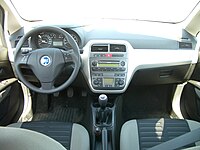 Interior


Other markets edit
In Australia, Fiat introduced the Grande Punto in July 2006, sold only as the Punto; it was the first Fiat to be sold in Australia since 1989. In 2009, the Punto was discontinued in Australia, due to slow sales. The car was reintroduced in 2013 after Fiat began factory distribution in Australia, the car was repriced at a much lower price, that was more in keeping with its rivals. In September 2015, the Punto was once again pulled from the Australian market due to slow sales.[39]
It was launched in Mexico in November 2006. The Grande Punto is placed above the Fiat Palio in the Mexican Fiat car lineup. Initially it was sold with the 1.4 16v StarJet 95 PS (70 kW) engine with six speed manual gearbox in five door Dynamic and three door Sport trims. In December 2007, the 1.4 16v T-Jet 120 PS (88 kW) variant was launched.
The Italian made Grande Punto was launched in Chile and the Dominican Republic in petrol and diesel versions. The Grande Punto also went on sale in South Africa in 2006, replacing the previous generation.
In the rest of South America, the Brazilian built Grande Punto (called only Punto) was launched in August 2007.[40] Codenamed Project 310, it is produced in the factory of Betim, Minas Gerais, Brazil.[41] The chassis is an adaptation of the Fiat Palio, a lower cost compact. Levels of safety were not maintained (airbags and ABS are optional on lower trim levels, and the highest one has only two airbags as standard), but the ride comfort is said to be the same.
The five door version was the only one available in the Brazilian line, and there were no plans for a two-door version (in Brazil, two door vehicles are only accepted for cheaper cars). The engines available at launch were the 85 PS (63 kW) 1.4 Fire 8v and the 115 PS (85 kW) 1.8 Ecotec-Family 1 X18XE engine that comes from GM-Fiat/Powertrain, and later the 1.4 Fire 16v TurboJet, also available for the Linea.
For the model of 2011, there were added the new E.TorQ engines 1.6 16v and 1.8 16v. Produced by Fiat Powertrain Technologies, they were based on the discontinued Tritec engines.[42] All non Turbo petrol models produced in Brazil are flex-fuel.[43]

The Grande Punto was launched in India during the Delhi Auto Expo in January 2008, with sales starting in June 2009. The Punto for the Indian market was manufactured by the Fiat / Tata Motors joint venture Fiat India Automobiles Ltd (FIAL) in a new plant in Ranjangaon, Maharashtra and based on the same 310 project of the Brazilian Punto.
A related sedan car, the Fiat Linea, was launched in the beginning of 2007 to replace the ageing Fiat Marea. It is built on an extended version of the Grande Punto's chassis, with a total length of 4,560 mm (179.5 in), making it part of the superior small family car segment.
Safety edit
The Grande Punto was awarded with five stars in the Euro NCAP crash test for passenger protection, and three stars certification for pedestrian safety.[44] The most powerful engines have electronic stability program and anti slip regulation fitted as standard, and it is an optional extra on some of the lower powered engines.
However, in a later test in December 2017, the car was retested with a zero star rating by Euro NCAP. It scored 51% for its protection of adult occupants, with chest protection for the rear passenger deemed weak and whiplash protection for the front passengers deemed poor. It scored 43% for its protection of child occupants, doing better at protecting the dummy representing an analogue of a six-year-old child than it did at protecting the dummy representing an analogue of a ten-year-old child and with the organisation noting that it was unclear whether or not the front-passenger airbag was activated. It scored 52% for pedestrian protection, mostly doing badly at protecting a struck pedestrian's head but generally doing well at protecting their legs and pelvis. It scored 0% for safety assist features, with the organisation noting that an unplugged-seatbelt warning was only standard equipment for the driver's seat.[45] One of the given reasons for this is the fact that the third generation Punto was launched in 2005, making the car a twelve year old model, whose safety standards were never actually updated.[46]
Abarth Grande Punto (2007–2010) edit
The first car from the newly created (2007) Fiat owned Abarth & C. S.p.A., the Abarth Grande Punto differs significantly from its donor car.
Initially the Abarth Grande Punto was released with a 150 PS (155 PS when using 97 RON fuel) 1.4 turbo engine, but from 2008, there was available an Essesse kit, which could be installed at official Abarth service centres rather than in the factory. Amongst various refinements included uprated brakes and suspension, the Essesse kit provided an uprated power output of 180 hp (134 kW).[47]
-
 Abarth Grande Punto
 -
 Rear view


2009 facelift (Punto Evo) edit
The Punto Evo, a facelift version of the Grande Punto, was presented in September 2009 at the Frankfurt Motor Show. It received a new front end, in addition to revised rear lights, and a new interior. It has two new engines, a 1.3 L second generation Multijet diesel and a 1.4 L petrol engine with the MultiAir technology. It also features a new navigation system integrated to the Blue&Me system called Blue&Me–TomTom.[48]
-
 Fiat Punto Evo
 -
 Rear view
 -
 Interior

_%E2%80%93_Heckansicht,_3._Juli_2011,_Essen.jpg)

Abarth Punto Evo (2010–2015) edit
The Abarth Punto Evo was shown at 2010 Geneva Motor Show. It has a 165 PS (121 kW; 163 hp) 1,368 cc (1.4 L) MultiAir Turbo inline-four engine. The top speed is 213 km/h (132 mph) and acceleration from 0 to 100 km/h (62 mph) takes 7.5 seconds.[49]
A new Esseesse version was released in 2011, which was an optional upgrade that improved performance, with a 0–100 km/h (62 mph) time of 7.3 seconds. The Abarth Punto Evo was discontinued in 2015, after slow sales.
-
 Abarth Punto Evo
 -
 Rear view
.jpg)
_%E2%80%93_Heckansicht,_1._April_2012,_Essen.jpg)
2012 facelift edit
Fiat introduced the 2012 Punto in September 2011 at the Frankfurt Motor Show,[50] as a facelifted version of the Punto Evo that reintroduced the Punto nomenclature (without Grande or Evo). The facelift was consisted of slighter tweaks than changing from Grande Punto to Punto Evo, keeping the revised rear lights and interior of the 2009 Punto Evo, but not on the base 'Pop' trim level which reverted to the older Grande Punto interior.[citation needed]
In October 2014, Top Gear Magazine placed the Punto Pop 1.2 liter 8v 69 on its list of The Worst Cars You Can Buy Right Now, describing the car as "An outclassed elderly supermini that kicks out 126 g/km yet takes 14.4 secs to wheeze to 62 mph, and it costs more than £10k."[51]
Production of the three-door version ended in 2015, leaving only the five-door version available in Europe.
In June 2016, Fiat introduced the new Techno Pack with the 5” touchscreen infotainment system and cruise control.[52][53] Production of the Punto ended on 7 August 2018, with no direct successor being announced. However, it continued to be produced in India for an additional three months before production ended in November of that year.[54][55]
-
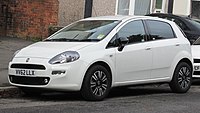 Fiat Punto (second facelift)
 -
 Rear view
.JPG)

2014 Indian facelift (Punto Evo) edit
Fiat India gave the Punto Evo an extensive and exclusive facelift in August 2014. The facelift consisted of large, swept back headlamps, a new grille and chrome inserts, whilst the rear of the car received LED taillamps from its European twin, and the dashboard from the European car.[56] This car also sports an SUV like ground clearance of 185mm for diesel and 195mm for petrol to suit Indian roads.[57] In August 2015, Fiat launched in India the Abarth brand, imported from Poland the Abarth 595 Competizione and the locally produced Abarth Punto, based on the 310-Punto five door.
Indian Abarth Punto come with a 1.4 Turbojet engine with 145 PS (107 kW; 143 hp) and new sport kit for exterior and interior including revised Abarth badge and retuned chassis. Transmission is a five speed manual.[58]
Fiat India launched a crossover version of the Punto Evo called Avventura in India in October 2014. The Avventura was aimed at the market inhabited by the likes of Toyota Etios Cross, Volkswagen CrossPolo and Ford EcoSport.[59]
Production in India ended in November 2018, together with the Abarth and Adventure versions. As a result, Fiat Chrysler Automobiles decided to withdraw the Fiat brand from the Indian market, leaving space to the brand of Jeep.[60]
Punto Van edit
The Punto Van is a compact van designed for the commercial market. It features a petrol 1.2 8v engine, a petrol/CNG 1.2 8v engine, and a diesel 1.3 MultiJet 16v engine.
Engines edit
| Grande Punto | |||||||
|---|---|---|---|---|---|---|---|
| Model | Engine | Displacement | Power | Torque | Acceleration 0–100 km/h (0-62 mph) |
Top speed | Notes |
| Petrol engines | |||||||
| 1.2 8v FIRE | I4 | 1,242 cc | 65 PS (48 kW; 64 hp) at 5500 rpm | 102 N⋅m (75 lb⋅ft) at 3000 rpm | 14.5 s | 155 km/h (96 mph) | |
| 1.4 8v FIRE | 1,368 cc | 77 PS (57 kW; 76 hp) at 6000 rpm | 115 N⋅m (85 lb⋅ft) at 3000 rpm | 13.2 s | 165 km/h (103 mph) | ||
| 1.4 16v StarJet | 95 PS (70 kW; 94 hp) at 6000 rpm | 125 N⋅m (92 lb⋅ft) at 4500 rpm | 11.4 s | 178 km/h (111 mph) | Six speed (2006–2016) | ||
| 1.4 16v T-Jet | 120 PS (88 kW; 118 hp) at 5000 rpm | 206 N⋅m (152 lb⋅ft) at 1750 rpm | 8.9 s | 195 km/h (121 mph) | 2007–2009 | ||
| 155 PS (114 kW; 153 hp) at 5500 rpm | 230 N⋅m (170 lb⋅ft) at 3000 rpm | 8.2 s | 208 km/h (129 mph) | Abarth model, 2007–2010 | |||
| 180 PS (132 kW; 178 hp) at 5750 rpm | 270 N⋅m (199 lb⋅ft) at 2500 rpm[61] | 7.5 s | 216 km/h (134 mph)[61] | Abarth "SS" performance kit, 2008–2018 | |||
| Diesel engines | |||||||
| 1.3 16v MultiJet | I4 | 1,248 cc | 75 PS (55 kW; 74 hp) at 4000 rpm | 190 N⋅m (140 lb⋅ft) at 1750 rpm | 13.6 s | 165 km/h (103 mph) | Five speed |
| 90 PS (66 kW; 89 hp) at 4000 rpm | 200 N⋅m (148 lb⋅ft) at 1750 rpm | 11.9 s | 175 km/h (109 mph) | Six speed | |||
| 1.6 16v MultiJet | 1,598 cc | 120 PS (88 kW; 120 hp) at 3750 rpm | 320 N⋅m (236 lb⋅ft) at 1750 rpm | 9.6 s | 190 km/h (120 mph) | 2008–2018 | |
| 1.9 8v MultiJet | 1,910 cc | 120 PS (88 kW; 118 hp) at 4000 rpm | 280 N⋅m (207 lb⋅ft) at 2000 rpm | 10.0 s | 190 km/h (118 mph) | 2005–2008 | |
| 130 PS (96 kW; 128 hp) at 4000 rpm | 280 N⋅m (207 lb⋅ft) at 2000 rpm | 9.5 s | 200 km/h (124 mph) | 2005–2008 | |||
| Punto Evo | |||||||
| Model | Engine | Displacement | Power | Torque | Acceleration 0–100 km/h (0-62 mph) |
Top speed | Notes |
| Petrol engines | |||||||
| 1.2 8v FIRE | I4 | 1,242 cc | 65 PS (48 kW; 64 hp) at 5500 rpm | 102 N⋅m (75 lb⋅ft) at 3000 rpm | 14.5 s | 155 km/h (96 mph) | |
| 1.2 8v FIRE Euro5 | 69 PS (51 kW; 68 hp) at 5500 rpm | ||||||
| 1.4 8v FIRE Start&Stop | 1,368 cc | 77 PS (57 kW; 76 hp) at 6000 rpm | 115 N⋅m (85 lb⋅ft) at 3250 rpm | 13.2 s | 165 km/h (103 mph) | ||
| 1.4 8v Bipower | 77 PS (57 kW; 76 hp) at 6000 rpm | 115 N⋅m (85 lb⋅ft) at 3000 rpm | 14.9 s | 162 km/h (101 mph) | Petrol | ||
| 70 PS (51 kW; 69 hp) at 6000 rpm | 104 N⋅m (77 lb⋅ft) at 3000 rpm | 16.9 s | 156 km/h (97 mph) | Methane | |||
| 1.4 8v GPL | 77 PS (57 kW; 76 hp) at 6000 rpm | 115 N⋅m (85 lb⋅ft) at 3000 rpm | 13.2 s | 165 km/h (103 mph) | |||
| 1.4 16v MultiAir | 105 PS (77 kW; 104 hp) at 6500 rpm | 130 N⋅m (96 lb⋅ft) at 4000 rpm | 10.8 s | 185 km/h (115 mph) | |||
| 1.4 16v MultiAir Turbo | 135 PS (99 kW; 133 hp) at 5000 rpm | 206 N⋅m (152 lb⋅ft) at 1750 rpm | 8.5 s | 205 km/h (127 mph) | 2009–2018 | ||
| 165 PS (121 kW; 163 hp) at 5500 rpm | 250 N⋅m (184 lb⋅ft) at 2250 rpm | 7.9 s | 213 km/h (132 mph) | Abarth model, 2010–2014 | |||
| 180 PS (132 kW; 178 hp) at 5750 rpm | 270 N⋅m (199 lb⋅ft) at 2500 rpm | 7.5 s | 216 km/h (134 mph) | Abarth "SS" performance kit, 2010–2014[62] | |||
| Diesel engines | |||||||
| 1.3 16v Multijet 75 | I4 | 1,248 cc | 75 PS (55 kW; 74 hp) at 4000 rpm | 190 N⋅m (140 lb⋅ft) at 1500 rpm | 13.6 s | 165 km/h (103 mph) | |
| 1.3 16v Multijet 90 | 90 PS (66 kW; 89 hp) at 4000 rpm | 200 N⋅m (148 lb⋅ft) at 1750 rpm | 11.9 s | 175 km/h (109 mph) | |||
| 1.3 16v Multijet 95 | 95 PS (70 kW; 94 hp) at 4000 rpm | 200 N⋅m (148 lb⋅ft) at 1500 rpm | 11.7 s | 178 km/h (111 mph) | |||
| 1.6 16v Multijet | 1,598 cc | 120 PS (88 kW; 118 hp) at 3750 rpm | 320 N⋅m (236 lb⋅ft) at 1750 rpm | 9.6 s | 193 km/h (120 mph) | ||
| Punto | |||||||
|---|---|---|---|---|---|---|---|
| Model | Engine | Displacement | Power | Torque | Acceleration 0–100 km/h (0-62 mph) |
Top speed | Notes |
| Petrol engines | |||||||
| 0.9 8v TwinAir | I2 | 875 cc | 105 PS (77 kW; 104 hp) at 5500 rpm | 145 N⋅m (107 lb⋅ft) at 2000 rpm | 10.8 s | 184 km/h (114 mph) | |
| Diesel engines | |||||||
| 1.3 16v Multijet 75 | I4 | 1,248 cc | 75 PS (55 kW; 74 hp) at 4000 rpm | 190 N⋅m (140 lb⋅ft) at 1500 rpm | 13.6 s | 165 km/h (103 mph) | |
Source: FiatAutoPress.com[permanent dead link]
Motorsport edit

The Punto has always been popular with amateur racing drivers due to its low cost and the wide availability of spare parts. Numerous competition and homologated versions of the Punto have been produced, such as the Punto Rally, the S1600, and the Punto Abarth.
A new rally car based on the third generation Punto, the Super 2000 Punto Abarth, was unveiled in 2005. It is four-wheel drive and powered by a 2.0 L 16 valve engine capable of producing 280 hp (210 kW). Also, a turbodiesel front wheel drive rally car has been produced, the Fiat Grande Punto R3D.
The Punto was the first diesel car to compete in the Targa Tasmania.[citation needed]
The Punto has won several rally championships, specifically:
- Italian Rally Championship (2003 and 2006)
- European Rally Championship (2006)
- 2006 International Rally Challenge season
A motorsport version of the car can be found in several liveries in the video games Colin McRae Rally 04, Colin McRae: DiRT, Sega Rally Revo and Gran Turismo 6.
Notes edit
See also edit
References edit
- ^ "Fiat Punto: sucesso no Brasil e no mundo". fiatpress.com. Archived from the original on 6 March 2016. Retrieved 2 May 2013.
- ^ "Fiat Punto 2012: the evolution of a best seller". fcapress.com.br. Retrieved 8 May 2013.
- ^ Auto Edizione: Laatste Fiat Punto van de band, einde van een tijdperk | Auto Edizione, access-date: 3. August 2018
- ^ "10 million vehicles produced in the former FSM and Fiat Auto Poland factories -> Авто Новини -> Автопрес 2001". www.auto-press.net.
- ^ Bertone, storia dei modelli Archived 8 February 2014 at the Wayback Machine
- ^ "Rewind to 1995: Fiat Punto". Quicks. Archived from the original on 17 January 2014. Retrieved 14 January 2014.
- ^ "Motor Show 1993: Small cars are rapidly becoming big business: Efficient production boosts choice, writes Martin Derrick". www.independent.co.uk. 19 October 1993. Retrieved 10 October 2017.
- ^ Bonnaud, Christophe (27 October 2020). "Fragments of life: aborted Renault projects (1975-1998)". LIGNES/auto. Retrieved 17 August 2021.
- ^ "1994 - XVII Edizione". adi-design.org (in Italian). Retrieved 12 January 2024.
- ^ "Fiat Punto (1994 - 1999)". RAC. Retrieved 27 December 2012.
- ^ "Fiat Punto GT – wrażenia z jazdy z 1995 r." magazynauto.pl (in Polish). Retrieved 4 February 2024.
- ^ "Punto GT". Puntopower.com. Archived from the original on 18 July 2011. Retrieved 16 August 2007.
- ^ "Punto Grama 2". puntogtturbo.
- ^ "Una Jeep per Mirafiori". Il Sole 24 Ore (in Italian). 27 November 2010. Retrieved 7 July 2011.
Attualmente da Mirafiori escono Fiat Multipla, Punto Classic, Idea, Lancia Musa e Alfa Mito. Entro l'anno le prime due andranno fuori produzione [Currently from Mirafiori are rolling out Fiat Multipla, Punto Classic, Idea, Lancia Musa and Alfa Mito. By the end of the year the first two will go out of production]
- ^ a b "Kragujevac: Workers "expected more"". B92 News. 31 January 2009. Archived from the original on 6 January 2014. Retrieved 15 January 2012.
- ^ a b "Fiat Punto Speedgear" (PDF). The AA. 29 August 2000. Retrieved 5 January 2014.
Called Speedgear, they offer a whole raft of ratios – a veritable cog-fest – through an electronically controlled, continuously variable (CVT) system which, on demand, also doubles as a sequential manual gearbox. The new transmission is available in either the five-door ELX or the three-door Sporting; the former with six stepped ratios in the sequential manual mode, the latter with seven – these being closer spaced.
- ^ "Prototipos Fiat Punto y versiones curiosas" (in Spanish). Club Fiat Punto. Archived from the original on 12 October 2011. Retrieved 5 January 2014.
{{cite web}}: CS1 maint: unfit URL (link) - ^ "Comunicato Stampa: Wish" (PDF) (in Italian). Pininfarina. 18 November 1999. Retrieved 5 January 2014.
- ^ "Timeline" (PDF). Pininfarina. 19 July 2006. Retrieved 5 January 2014.
- ^ a b c "Fiat Punto specifications". Auto-types.com. Archived from the original on 25 March 2014. Retrieved 6 October 2012.
- ^ "News". Italiaspeed.com. 2 June 2005. Retrieved 1 April 2012.
- ^ "El Fiat Punto regresa a Chile" (in Spanish). Autocosmos.cl. 18 October 2007. Retrieved 7 July 2011.[dead link]
- ^ "Auto economiche nuove: Fiat Punto Classic fuori produzione" (in Italian). Auto e Motore. 24 February 2011. Retrieved 13 February 2014.
- ^ "italiaspeed.com". www.italiaspeed.com.
- ^ "::: ekapija - Fiat to restart Punto Classic production in 2013". ekapija.com.
- ^ "Punto Classic is Fiat鈥檚 secret weapon in Serbia - AutoEdizione.com". AutoEdizione.com.
- ^ "Fiat Punto Classic". Fiat Automobile Serbia. Archived from the original on 31 January 2012. Retrieved 15 January 2012.
- ^ "Fiat Punto Mk2 1999-2003 (Proyecto 188)" (in Spanish). Club Fiat Punto. Archived from the original on 12 October 2011. Retrieved 6 October 2012.
- ^ Manual de utilizare. Fiat Romania. 10 May 2005.
- ^ "Catalogo Fiat Punto" (PDF) (in Italian). FiatPunto.com. Archived from the original (PDF) on 9 October 2003. Retrieved 6 October 2012.
- ^ "Fiat Punto owner's manual". Fiat. Retrieved 6 October 2012.
- ^ Bala Subramaniam N (28 October 2014). "Fiat Avventura launched in Chennai at Rs.6.12 lacs; Abarth 500 launch in December". Business Standard. Archived from the original on 28 September 2022. Retrieved 29 October 2014.
- ^ a b "Fiat Group Automobiles" (PDF). FiatGroup.com. Archived from the original (PDF) on 31 March 2010. Retrieved 6 August 2009.
- ^ "Punto Evo fa la sua comparsa a Mirafiori!" (in Italian). PuntoEvoClub.it. 7 October 2009. Archived from the original on 27 March 2010.
- ^ "Fiat launches locally-built Grande Punto in India". Italiaspeed.com. 18 June 2009. Retrieved 6 August 2009.
- ^ a b "Fiat's radical platform plan". Autocar.co.uk. 27 May 2010. Archived from the original on 30 November 2012. Retrieved 30 September 2010.
- ^ "Motor shows". Italiaspeed.com. Retrieved 5 August 2007.
- ^ "Press Files 03/09/2007". FiatAutoPress.com. Archived from the original on 13 August 2007. Retrieved 3 September 2007.
- ^ Beissmann, Tim (16 September 2015). "Fiat Punto joins Panda in Australian exodus". Caradvice.com.au. Retrieved 2 July 2016.
- ^ Fiat Press Brazil: new Fiat Punto launched
- ^ "The Fiat Grande punto will bring new levels of technology to Brazil". Italiaspeed.com. 2 August 2007. Retrieved 5 August 2007.
- ^ "Mineiro com coração paranaense" (in Portuguese). Best Cars Web Site. Retrieved 14 August 2010.
- ^ "The A volta do "foguete de bolso"" (in Portuguese). Best Cars Web Site. Retrieved 14 August 2010.
- ^ "Fiat Punto". EuroNCAP.com. Retrieved 5 August 2007.
- ^ "Fiat Punto". EuroNCAP.com. Retrieved 13 December 2017.
- ^ "Fiat Punto gets Euro NCAP's first ever zero-star rating - Autocar". www.autocar.co.uk.
- ^ "Grande Punto Abarth to be boosted by arrival of "Essesse" kit in early 2008". Italiaspeed.com. 21 September 2007.
- ^ "Fiat to showcase new navigation device developed with TomTom in Frankfurt". Italiaspeed.com. 31 August 2009.
- ^ "Abarth Punto Evo 1.4 MultiAir Turbo 165 HP E5 3P Start&Stop" (PDF). Fiatautopress.com. Archived from the original (PDF) on 6 March 2010. Retrieved 6 March 2010.
- ^ "Fiat Punto 2012" (in Italian). Quattroruote.it. Archived from the original on 29 September 2011. Retrieved 31 August 2011.
- ^ "The Worst Cars You Can Buy Right Now". Top Gear magazine. 9 October 2014. Archived from the original on 5 August 2019. Retrieved 12 October 2014.
- ^ "Fiat Press Gamma 2016". Archived from the original on 21 June 2018. Retrieved 26 September 2022.
- ^ Fiat Punto new diesel Euro 6 and Pack Tecno
- ^ End of production in Melfi
- ^ "Fiat Punto taken off sale after 13 years - Autocar". www.autocar.co.uk.
- ^ "Fiat India launched Punto Evo at INR 4.55 Lakh". CarDekho.com. Retrieved 11 November 2014.
- ^ "New Fiat Punto Evo Review, Test Drive". Autocar India. Retrieved 12 October 2014.
- ^ "Fiat Abarth Punto Evo launched in India". Omniauto.it. Retrieved 2 July 2016.
- ^ "Fiat India launched Avventura at INR 5.99 Lakh". CarDekho.com. Retrieved 11 November 2014.
- ^ "Fiat Punto, Linea to be discontinued from India – Production stopped". rushlane.com. 21 November 2018. Retrieved 14 January 2014.
- ^ a b "Abarth Punto Evo SuperSport 1.4 16v MultiAir 180HP Specs 2012-". Ultimatespecs.com. Retrieved 15 August 2018.
- ^ "Abarth Punto Evo Supersport 2010-2014". abarthpunto.co.uk. Archived from the original on 30 October 2019. Retrieved 26 June 2018.
External links edit
