
In mathematics a Yetter–Drinfeld category is a special type of braided monoidal category. It consists of modules over a Hopf algebra which satisfy some additional axioms.
Definition edit
Let H be a Hopf algebra over a field k. Let denote the coproduct and S the antipode of H. Let V be a vector space over k. Then V is called a (left left) Yetter–Drinfeld module over H if

- is a left H-module, where denotes the left action of H on V,
- is a left H-comodule, where denotes the left coaction of H on V,
- the maps and satisfy the compatibility condition






- for all ,
- where, using Sweedler notation, denotes the twofold coproduct of , and .





Examples edit
- Any left H-module over a cocommutative Hopf algebra H is a Yetter–Drinfeld module with the trivial left coaction .
- The trivial module with , , is a Yetter–Drinfeld module for all Hopf algebras H.
- If H is the group algebra kG of an abelian group G, then Yetter–Drinfeld modules over H are precisely the G-graded G-modules. This means that


- ,
- where each is a G-submodule of V.


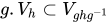
- More generally, if the group G is not abelian, then Yetter–Drinfeld modules over H=kG are G-modules with a G-gradation
- , such that .
- Over the base field all finite-dimensional, irreducible/simple Yetter–Drinfeld modules over a (nonabelian) group H=kG are uniquely given[1] through a conjugacy class together with (character of) an irreducible group representation of the centralizer of some representing :
- As G-module take to be the induced module of :
- (this can be proven easily not to depend on the choice of g)
- To define the G-graduation (comodule) assign any element to the graduation layer:
- It is very custom to directly construct as direct sum of X´s and write down the G-action by choice of a specific set of representatives for the -cosets. From this approach, one often writes
- (this notation emphasizes the graduation , rather than the module structure)

![{\displaystyle [g]\subset G\;}](https://wikimedia.org/api/rest_v1/media/math/render/svg/79166dbd8951714f95046fe260a4c3ea680c8d52)


![{\displaystyle g\in [g]}](https://wikimedia.org/api/rest_v1/media/math/render/svg/d3c0162493aa44a3e82062bf84005ab055e82146)
![{\displaystyle V={\mathcal {O}}_{[g]}^{\chi }={\mathcal {O}}_{[g]}^{X}\qquad V=\bigoplus _{h\in [g]}V_{h}=\bigoplus _{h\in [g]}X}](https://wikimedia.org/api/rest_v1/media/math/render/svg/927d0a7b0333f3595fec77cf4881bd186b8dbea8)
![{\displaystyle {\mathcal {O}}_{[g]}^{\chi }}](https://wikimedia.org/api/rest_v1/media/math/render/svg/f75e21260b9d6abaf7061bfb4ebc9f0d7ccab2b7)


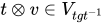


![{\displaystyle h\otimes v\subset [g]\times X\;\;\leftrightarrow \;\;t_{i}\otimes v\in kG\otimes _{kCent(g)}X\qquad {\text{with uniquely}}\;\;h=t_{i}gt_{i}^{-1}}](https://wikimedia.org/api/rest_v1/media/math/render/svg/05573c006f4aa8838da91cb39027a065dd63fcd8)

Braiding edit
Let H be a Hopf algebra with invertible antipode S, and let V, W be Yetter–Drinfeld modules over H. Then the map ,

- is invertible with inverse
- Further, for any three Yetter–Drinfeld modules U, V, W the map c satisfies the braid relation



A monoidal category consisting of Yetter–Drinfeld modules over a Hopf algebra H with bijective antipode is called a Yetter–Drinfeld category. It is a braided monoidal category with the braiding c above. The category of Yetter–Drinfeld modules over a Hopf algebra H with bijective antipode is denoted by .


References edit
- ^ Andruskiewitsch, N.; Grana, M. (1999). "Braided Hopf algebras over non abelian groups". Bol. Acad. Ciencias (Cordoba). 63: 658–691. arXiv:math/9802074. CiteSeerX 10.1.1.237.5330.
- Montgomery, Susan (1993). Hopf algebras and their actions on rings. Regional Conference Series in Mathematics. Vol. 82. Providence, RI: American Mathematical Society. ISBN 0-8218-0738-2. Zbl 0793.16029.