
Talk:Total internal reflection
 | This  level-5 vital article is rated C-class on Wikipedia's content assessment scale. level-5 vital article is rated C-class on Wikipedia's content assessment scale.It is of interest to the following WikiProjects: | ||||||||||||||||||||||||||||||
| |||||||||||||||||||||||||||||||
.jpg)


Untitled edit
- Nice! jimfbleak 13:32 22 May 2003 (UTC)
- Thanks :-) Theresa knott 13:39 22 May 2003 (UTC)
Issues resolved or rendered moot as of 11 April 2019: edit
Possible problem? edit
 Resolved
Extended content
|
|---|
|
Quote from current article:
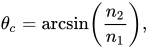
I think that and have been labelled incorrectly here. Surely should be the refractive index of the initial medium, and the angle of the medium which is being entered? Otherwise, how could this situation occur (also quoting from article):
That is to say, how could a situation arise in which is greater than , if we define to be the denser substance (i.e. the one with the larger refractive index)? Also consider that the critical angle at an air-Lucite boundary should be given by sin^-1(1÷1.50), whereas the critical angle at a Lucite-air boundary should be given by sin^-1(1.50÷1) (that is to say, undefined - TIR can't occur on the air side of the boundary). Birchlabs (talk) 18:52, 29 May 2009 (UTC) |



Applications edit
 Done
Done
Extended content
|
|---|
|
total internal reflection is very important in the total internal reflection fluorescence microscope (funnily enough!). Would be nice to put a link in.
|
Small mistake here in the diagram... edit
ResolvedExtended content
|
|---|
|
Dear Theresa,
nice stuff, I used it as a base to create the french version of it, but I noticed that the diagram is slightly off - when you have TIR it means that you go from a less refringent medium to a more refringent one, that is n2 > n1, thus the ray in medium 2 should be farther away from the normal, not closer! If it was not the case how the refracted angle could ever exceed 90 degree :-) Thanks! Your right! thanks, I'll change it.Theresa knott 07:50, 20 Sep 2003 (UTC) A couple of points.
|
Alternative diagram edit
ResolvedExtended content
|
|---|
|
Hands up who thinks this diagram is nicer! :)
|

FTIR in relation to fingerprint scanners edit
ResolvedExtended content
|
|---|
|
I arrived on this page after a redirect on 'Frustrated Total Internal Reflection' because I was looking into how FTIR is used in fingerprint and other touch sensing application. After reading this article I am none the wiser on how they do it so I'm off to search of a more accesible article - perhaps the workings of the fingerprint scanners could be added to the FTIR section as an additional example in the future. -- 17 February 2006 Doctus
 I had added this picture of a glass of water to the article to illustrate frustrated total internal reflection, but it was later removed with no reason given. Would it be useful to have it in the article? Olli Niemitalo (talk) 22:07, 9 January 2012 (UTC)
|
Merger proposal edit
Done
Extended content
|
|---|
|
I have proposed merging in critical angle because that page has no relevance outside of a description of total internal reflection. -- The Photon 04:34, 31 May 2006 (UTC)
|
TIR not limited to optics edit
ResolvedExtended content
|
|---|
|
This article focuses on just the optical spectrum. It should be noted somewhere that TIR applies to electromagnetic waves outside of the optical spectrum, for example radio transmissions experiencing TIR in the ionosphere. ChrisSerrano 14:36, 13 April 2007 (UTC)
|
Turtle picture? edit
Superseded by aquarium and swimming-pool pictures.Extended content
|
|---|
|
Why is there a picture of a turtle to the right? What does it have to do with the article? 165.124.138.210 (talk) 23:46, 22 April 2008 (UTC)
i disagree. It is clearly showing an example of internal reflection. If you think otherwise then submit a proposal for a picture change Metroid476 (talk) 00:17, 11 January 2009 (UTC) I also think the mirror image of the turtle on the water surface is a beautiful example of total internal reflection. Eranus (talk) 13:27, 2 June 2009 (UTC) |
Phase shift on total internal reflection edit
Done
Extended content
|
|---|
|
I added a section on the phase shift of the reflected light under total internal reflection. I would appreciate if someone would better word it. I think it is a very basic subject known for centuries that few people (even graduate optics students) know. I will add later a mathematical description of the phase shift, this is a bit problematic because the actual value depends on definiton. Born and Wolf gives a good treatment of the subject. There is also a good OPN on the subject. I will referance them both at a later stage.Eranus (talk) 13:27, 2 June 2009 (UTC)
|
Applications edit
ResolvedExtended content
|
|---|
|
Where did you find that CSM is the largest user of total internal reflection, and that the government has spent a bunch of money to make sure the campus is invisible from space? I'm pretty sure that's a bunch of BS. —Preceding unsigned comment added by 128.111.119.177 (talk) 18:41, 25 August 2010 (UTC)
|
Absorption in the low-index material? edit
Done: It's called attenuated total reflectance — see end of subsection on frustrated TIR.
Extended content
|
|---|
|
I was recently told that, to a small extent, the optical properties (aside from n) of the low-index material matter. In particular, if the low-index material absorbs the wavelength of interest, you can't expect 100% reflection. The context of the question was "cladding" an unclad glass fiber with epoxy. I was told that this won't work well because a little energy will transfer from the evanescent wave into the epoxy. This seems consistent with the mechanism of total internal reflection microscopy, in which the evanescent wave excites a fluorophore, and with frustrated TIR, in which this article describes photons as tunneling to another high-index material. If the epoxy absorbed by scattering or by fluorescent absorption, it seems correct that a little absorption could happen and that reflection might drop to %99.9 which, for a wave guide, would be a big problem. Could someone comment on this? If true, this page should discuss this. —Ben FrantzDale (talk) 22:47, 13 December 2011 (UTC)
i am not understanding — Preceding unsigned comment added by 49.205.222.52 (talk) 14:54, 5 September 2012 (UTC)
|
"Examples in Everyday Life" edit
ResolvedExtended content
|
|---|
|
"This is different phenomenon from reflection and refraction. Reflection occurs when light goes back in same medium. Refraction occcurs when light travels from different mediums. Here both are not happening. This is due to both and a mixture of both."
This sentence needs to be rewritten and clarified by an editor. — Preceding unsigned comment added by 23.16.126.200 (talk) 22:08, 19 January 2013 (UTC)
|
Tightened wording of example edit
ResolvedExtended content
|
|---|
|
I tightened the wording of the example and inserted the sentence "(and the drain has disappeared!)" This is my interpretation of a hard-to-follow sentence in a previous edit. Is it correct?
Also, does this real-life example always work, or only usually, depending on the typical geometry of a sink and the bottom of a glass? I didn't do any experiments (my understanding is that this would defeat the purpose of Wikipedia). 84.227.237.33 (talk) 14:24, 3 April 2014 (UTC) |
Dispersion edit
Perhaps a brief description of dispersion would be appropriate.
- Done? The "History" section now notes that Newton "pointed out the relationship between TIR and dispersion..." — Gavin R Putland (talk) 12:34, 3 May 2019 (UTC).
Hot-road mirages edit
Musing about a question. Are hot-roadbed mirages an example of total internal reflection? I've seen many examples of mirage explanations, but I've never seen any mention of internal reflection. It seems to me that if the light is bent as it enters the warm air layer, it should only refract. On the other hand, if internal reflection is an issue, then whenever light strikes the hot air layer at more than the Critical angle, it should reflect 100%. Better question: when light strikes a hot air layer, does it split into a refracted beam and a reflected beam? And if the angle is varied, does the refracted beam vanish when the angle exceeds the Critical angle? If so, then all the explanations of mirages I've encountered are extremely misleading if not outright incorrect, since they totally miss the possibility that mirages are an example of TIR. --Wjbeaty 07:06, 30 October 2006 (UTC)
- Consider a so-called "inferior mirage", where the air is hot near the ground, like in the desert or a hot, shimmering road. Model this by assuming that the refractive index is a smooth function of the height above the ground, i.e. take n=n(z) where z is height above the ground. To embody our assumptions, assume n(z)= a for z<z_1, n(z)=b for z>z_2, where 1<a<b, z_1<z_2. The assumption that a is less than b corresponds to having hot air below. Also, to fix ideas, assume that n(z) increases smoothly and monotonically from a to b, i.e. dn/dz>0 for a≤z≤b. So n(z) looks roughly like a step function from a to b.
- Then by solving using Leibniz least time principle (or is that Euler? Lagrange?) a light ray z=z(x) (where x is distance along the road) will have d^2n/dz^2(x)>0 (concave up) in the region where dn/dz>0, i.e. in the slab between z=a and z=b. If the angle of incidence is close enough to horizontal, this will cause it to turn around and go upwards due to refraction.
- If the transition region z_1<z<z_2 is sharp enough, this looks a lot like internal reflection, and in the limit, it will become internal reflection. The critical angle and all phase shifts can be computed by doing this limit process carefully (I assert).
- So there is a continuum of possibilities connecting refraction and reflection. See Mirage#Heat_haze for more clues. 84.227.237.33 (talk) 15:08, 3 April 2014 (UTC)
- Another reference: Refractive_index#Inhomogeneity. 84.227.237.33 (talk) 20:29, 3 April 2014 (UTC)
At the critical angle edit
Light is shown propapagating along the interface when incident at exactly the critical angle. But doesn't this violate the principle of reversibility? Instead, shouldn't the light should be reflected if incident at exactly the critical angle? -- cheers, Michael C. Price talk 07:21, 20 January 2013 (UTC)
 Resolved (I hope), by adding a footnote to the caption and (earlier) by generally referring to the tangential ray as a limiting case. — Gavin R Putland (talk) 06:36, 7 May 2019 (UTC).
Major revision edit
I'm working on a major revision of this article with some requested features, including more citations, details on the phase shift, and the effect of absorption of the evanescent wave. The target date is 31 March 2019 (after which I'll be out of action for a while). — Gavin R Putland (talk) 12:46, 21 March 2019 (UTC).
P.S.: I also mention non-optical examples of TIR.
UPDATE: The new version is live. There are undoubtedly some non-critical inconsistencies in fonts, which I shall fix in due course...
- Done: Some compromises remain, but I think we are past the point of diminishing returns. — Gavin R Putland (talk) 12:52, 12 April 2019 (UTC).
"History" section edit
I intend to add a "History" section in the near future. — Gavin R Putland (talk) 14:32, 12 April 2019 (UTC).
- Done — Gavin R Putland (talk) 13:56, 22 April 2019 (UTC).
Submission on promotion to A-Class edit
I submit that the article Total internal reflection, of which I admit being main author, meets all the criteria for an A-Class article (WP:ACLASS), together with selected criteria for a featured article (WP:FACR), as follows. (P.S.: And for any interested WikiProjects that do not recognize A-Class articles, I hope the following points make it easy to upgrade this one to B Class! — Gavin R Putland (talk) 04:14, 4 June 2019 (UTC).)
"well-written, clear..."
This is the question that other assessors can only settle by reading the article, but: Since the "major revision" of 31 March 2019, the article has received an average of about 750 visitors per day, all of whom were free to correct any textual errors, infelicities, or ambiguities. One of them corrected a typographical error (two interchanged characters).
"complete..."
The reader who wants a high-school-level treatment of the subject, in "wave" and "ray" terms, including the formula for the critical angle in terms of refractive indices, will find it in the lead section. (Update: That formula has since been deleted from the lead, not by me. — Gavin R Putland (talk) 07:30, 5 March 2020 (UTC).)
The reader who wants an undergraduate-level coverage of the same ground, including a derivation of the critical angle in terms of both velocities and refractive indices, plus familiar examples of the phenomenon (described at a more elementary level), will find it in the first three sections.
The scope of the article may be succinctly defined as: subject phenomenon, related phenomena, applications, and history. Within that framework, the selection of more advanced topics has been guided by the internal logic of the subject and by the need to resolve (formerly) outstanding issues on the talk page, with no perceived conflict between the two. As it turns out, the article does not seem to omit any relevant topic covered by Born & Wolf (1970/2002), Feynman (1963–), Hecht (2002/2017), Jenkins & White (1976), or Stratton (1941).
"of a length suitable for the subject..."
The article is admittedly long (about 108kB, of which about 89kB is main matter); but its scope, as we have just noted, can be succinctly defined. The reading burden is minimized by treating more elementary topics earlier. In particular:
- The treatment of the evanescent wave is divided into qualitative and quantitative parts, and only the former precedes the subsection on "Frustrated TIR". One can read to the end of that subsection without meeting a complex number.
- Parenthetical issues are relegated to the "Notes" section.
The evanescent wave, having been introduced in §4.1, is elaborated in §4.3, and the mathematically related matter of phase shifts follows in §4.4. These matters seem too intertwined to be devolved to child articles (and Evanescent wave redirects to the article Evanescent field, whose scope not limited to the TIR case).
Three other "related phenomena", namely attenuated total reflectance, the Goos–Hänchen effect, and the Imbert–Fedorov effect, have their own articles, and their coverage in the present article is accordingly brief.
"appropriately structured..."
The article has 11 sections, including 6 in the main text, 2 of which are divided into 4 subsections each.
"well referenced by a broad array of reliable sources..."
The article (at the time of this submission) has 113 inline citations, some appearing in more than one place, and some citing more than one source. It has 57 sources, including 4 standard textbooks, 11 other academic books (in which category I include Whewell 1857, Whittaker 1910, and Mach 1926), 2 sets of published lectures (Feynman), 4 university websites, 1 university video, 12 refereed papers, 1 refereed encyclopedia article, 3 articles in professional magazines and 1 in a trade magazine, 5 historic papers (Fresnel, Wollaston), 2 historic articles (Thomas Young), 2 historic treatises (Huygens, Newton), 1 historic report (Lloyd, 1834), 1 set of collected works (Fresnel), 1 standard dictionary, 1 website of a trade society, 1 website of a medical practice, and 4 websites with corporate affiliations (3 cited in connection with applications).
"well illustrated..."
The technical sections of the article include 15 captioned figures, cited by number, comprising 6 photographs, 7 diagrams, and 2 graphs. The subsequent "History" section includes 6 portraits, captioned with names and lifetimes. Labeling the portraits as Figs. 16 to 21 would be superfluous.
"with no copyright problems"
All the illustrations are on Wikimedia Commons. All are duly licensed or in the public domain. For those illustrations that represent my derivatives or modifications of others' contributions to Wikimedia Commons, the originals are likewise duly licensed or in the public domain. All the portraits are in the public domain by reason of age.
"minor style issues"?
The most-cited sources are collected in the "Bibliography" and cited Harvard-style in the "References". They can also be cited Harvard-style from the main text if the context requires the author(s) to be named. But this happens in only one case — which could be construed as an inconsistency.
(The remaining criteria are selected from WP:FACR.)
"places the subject in context"
The article not only derives the critical angle as a limiting case of the law of refraction, but also gives the briefest derivation of that law in its most general form. Thus, while the article does not systematically treat anisotropic media, its most general statements hold for the anisotropic case — concerning which further hints are given in the "Notes". (To see how this matter has been handled, search the article for the string "isotropic".)
"neutral"
The subject is not one on which neutrality or lack thereof is likely to be an issue.
Three web pages cited in connection with applications (one cited at the end of the "Frustrated TIR" subsection, and the other two in the "Applications" section) represent commercial interests. While this circumstance is not desirable in itself, it serves to demonstrate that the applications in question are commercially significant.
(Acknowledgment: The "Applications" section is the one in which I owe the most to previous contributors.)
"stable"
Since 31 March 2019, the only non-minor edits by parties other than myself have been vandalism and repair, and the addition of a {{morefootnotes}} template, whose eventual removal (by me) was uncontroversial. My own afterthoughts have slowed to a trickle.
"lead section that... prepares the reader for the detail..."
The lead contains not only the aforesaid "high-school" treatment of the subject, but also an overview of the "related phenomena", one historical note, and a few examples of applications (of pure TIR, not departures therefrom).
"consistent citations"
References to modern papers are formatted using or imitating {{cite journal|mode=cs2|...}}. No attempt has been made to impose this pattern on historic papers, whose provenance tends to be more complicated. Otherwise, care has been taken to format each type of reference or bibliographic entry in a consistent manner.
"images and other media, where appropriate"
The only non-text media included in the article are images. But one of the references (Bowley) is a video, and the three "External links" are all videos.
— Gavin R Putland (talk) 02:01, 21 May 2019 (UTC).
Order of opening paragraph edit
Resolved as far as I dare, in edit of 4 March 2020. — Gavin R Putland (talk) 02:59, 4 March 2020 (UTC).
Since 1 December 2019, editing of the opening paragraph has gone full-circle. If it is thought that the familiar example should be given before the general definition, the version of 1 December 2019 (with a subsequent conversion to lower case) is more compact. — Preceding unsigned comment added by Gavin R Putland (talk • contribs) 01:19, 3 March 2020 (UTC)
- I hadn't noticed the relatively recent 'common case' edit about the fishbowl. That version is reasonable, but I think it's a little too specific to a particular physical object. My purpose was to give general readers an accessible non-technical description of the phenomenon, but in more generic form, displacing the truly forbidding opening sentence I encountered. According to well-defined Wikipedia policy, the lead sections of articles should be comprehensible to the widest possible audience. Certainly, that can present a challenge when writing articles on technical subjects. All too often, unfortunately, such articles begin with excessively technical or jargonized language that makes the very first sentence or two all but incomprehensible to the general reader, and comprehensible only to a much more limited audience of qualified scientists or engineers, who are probably the people who wrote and edited the article in the first place.
- The corollary to the idea of writing the lead (lede) for a general, non-expert readership is to not write it with a readership of fellow experts in mind, or to show off one's advanced education by larding the opening with arcane language found almost exclusively in textbooks and virtually nowhere else. (As you may gather, this issue is a pet peeve of mine.) Anyway, my effort was to make a change that was least likely to offend the expert writers of the article who might revert in a nanosecond, and who, of course, can write circles around me in regard to their understanding of the subject and the use of obscure technical lingo to describe it. The bulk of the introductory section of this article, particularly the 3rd and 4th paragraphs, remains much too technical in my opinion, and should be translated into plain English from the existing textbook-ese. The equation/formula in the 3rd paragraph should be removed completely and placed appropriately in the body; the results (the measurements in degrees) can be retained in the Intro.
- Words and phrases, many of them linked, that can be eliminated from the Intro:
- wavetrain
- wavefront (is there a difference??)
- normal
- propagation speed (to retain this, associate with correct example: air, water)
- isotropic
- lossless
- lossy
- attenuated total reflectance
- transfer of power across the inteface (try: "light passes through the boundary")
- Loading up the Intro with a bunch of wiki-linked jargon obviously will force the general reader to spend far too much time hovering or clicking to learn the terms, and clicking in the resulting definitions to learn what they mean, ad infinitum. Let the reader read the Introduction in plain English, insteading of hovering, hovering, hovering, clicking, clicking, clicking to find out what in blazes the authors are talking about. I wonder if some technically knowledgeable editors use jargon in the Introduction simply because they're worried some other smarty-pants editor will come along and say, 'don't you know the proper terminology--what do mean by using plain English, use this fancy ten-dollar lingo from the advanced physics textbook!
- I frequently find articles like these when doing a google search about one thing or another. My heart sinks when, as often as not, I see the top result is an excerpt from the lead of a Wikipedia article written in the kind of opaque, reader-unfriendly language that characterized the start of this article (and most of remainder of the Intro), instead of the quick, simple explanation I was hoping to find.
- FWIW, here's a successful translation I worked on for an introduction to a technical article. The Intro has grown over time, but still gives a good idea of the kind of reader-friendly result that can be achieved. Note especially the improvement (wholesale revision, actually) to the first sentence in the "Before":
Before After Tidal locking (also called gravitational locking or captured rotation) occurs when the long-term interaction between a pair of co-orbiting astronomical bodies drives the rotation rate of at least one of them into the state where there is no more net transfer of angular momentum between this body (e.g. a planet) and its orbit around the second body (e.g. a star); this condition of "no net transfer" must be satisfied over the course of one orbit around the second body.[1][2] This does not mean that the rotation and spin rates are always perfectly synchronized throughout an orbit, as there can be some back and forth transfer over the course of an orbit. This effect arises from the gravitational gradient (tidal force) between the co-orbiting bodies, acting over a sufficiently long period of time. In the special case where the orbital eccentricity and obliquity are nearly zero, tidal locking results in one hemisphere of the revolving object constantly facing its partner, an effect known as synchronous rotation.[1][2][3] For example, the same side of the Moon always faces the Earth, although there is some libration because the Moon's orbit is not perfectly circular. A tidally locked body in synchronous rotation takes just as long to rotate around its own axis as it does to revolve around its partner.
Usually, only the satellite is tidally locked to the larger body.[4] However, if both the mass difference between the two bodies and the distance between them are relatively small, each may be tidally locked to the other; this is the case for Pluto and Charon.
Tidal locking (also called gravitational locking, captured rotation and spin-orbit locking), in the most well-known case, occurs when an orbiting astronomical body always has the same face toward the object it is orbiting. This is known as synchronous rotation: the tidally locked body takes just as long to rotate around its own axis as it does to revolve around its partner. For example, the same side of the Moon always faces the Earth, although there is some variability because the Moon's orbit is not perfectly circular. Usually, only the satellite is tidally locked to the larger body.[1] However, if both the difference in mass between the two bodies and the distance between them are relatively small, each may be tidally locked to the other; this is the case for Pluto and Charon. The effect arises between two bodies when their gravitational interaction slows a body's rotation until it becomes tidally locked. Over many millions of years, the interaction forces changes to their orbits and rotation rates as a result of energy exchange and heat dissipation. When one of the bodies reaches a state where there is no longer any net change in its rotation rate over the course of a complete orbit, it is said to be tidally locked.[2] The object tends to stay in this state when leaving it would require adding energy back into the system. The object's orbit may migrate over time so as to undo the tidal lock, for example, if a giant planet perturbs the object.
Not every case of tidal locking involves synchronous rotation.[3] With Mercury, for example, this tidally locked planet completes three rotations for every two revolutions around the Sun, a 3:2 spin-orbit resonance. In the special case where an orbit is nearly circular and the body's rotation axis is not significantly tilted, such as the Moon, tidal locking results in the same hemisphere of the revolving object constantly facing its partner.[2][3][4] However, in this case the exact same portion of the body does not always face the partner on all orbits. There can be some shifting due to variations in the locked body's orbital velocity and the inclination of its rotation axis.
- Notice that in the "After", no terms of jargon are present ("libration" is piped from the plain English "variations"). We got rid of the menagerie of linked terms in the "Before": (net transfer of) "angular momentum", "gravitational gradient", "orbital eccentricity", "obliquity". General readers can simply read and understand the Introduction as written without wild-goose-chasing definitions for a collection of buzzwords and phrases. Nerds, geeks* and PhD editors can indulge themselves in the body of articles, but must resist the temptation when writing Introductions. See wp:Jargon and wp:Technical.
- (* with affection)
- DonFB (talk) 06:03, 3 March 2020 (UTC)
Apparent error in "Figure 4" as of this edit edit
The file: https://en.wikipedia.org/wiki/File:Wavefront_refraction_slow_to_fast.svg

As far as I can tell the image inverts the actual refractive speed/angle relationship. Presumably this is due to the accidental swapping of (the rays' angles with the line-normal-to-the-media-interface) for (their angles with the interface itself).
Let me know if you think I'm simply the one who's confused here, but I've spent a good bit of time confirming to myself that indeed the angle of transit should become more nearly perpendicular to the interface when going from a faster (/lower index of refraction) to a slower (/higher index) medium, in accord with the principle of least time etc.
I can't just reidentify "medium 1" as that with the higher speed in the file description and article text (and substitute cosine for sine), given the speed-magnitudes depicted alongside each ray.
I can/will try to eventually edit and replace the image but given my minimal image-editing experience, superseding priorities, and that I'm just now downloading Inkscape for the task, the result will probably be days or weeks forthcoming and somewhat stylistically inconsistent with the article's other graphics. Until then I hesitate to act unilaterally e.g. by delinking the image, just in case I'm somehow still beset with a misconception here.
While the risk of confusing newcomers to the topic is perhaps lowish because the overwhelming bulk of the article including its other images are accurate, it still makes me fret.
Nonetheless many thanks to User:Gavin_R_Putland for the extensive expository work!
Riyuky (talk) 14:29, 22 January 2021 (UTC)
- Riyuky: The red line shows the wavefront, not the ray. The angle between the interface and the wavefront (θ1 or θ2) is the angle between the normal to the interface and the normal to the wavefront. In the special case of an isotropic medium, the latter normal is in the ray direction, so that the angle between the normals is the "angle of incidence" or "angle of refraction"; and if, as here, the wavefront is refracted towards the normal to the interface, the ray is refracted away from it. Medium 1 has the lower speed, and the direction of incidence is from medium 1 to medium 2, i.e. from bottom to top, for consistency with the oft-mentioned example of internal reflection from a water-air surface. I have amended the caption in an attempt to make some of this clearer. — Gavin R Putland (talk) 01:06, 23 January 2021 (UTC).
- Thanks for the clarification! The image does of course make sense in this light. I now realize I had idiosyncratically interpreted the arrows as depicting the relative speeds of constituent spherical wavelets' propagation orthogonal to the plane-waves' directions of travel (as in https://en.wikipedia.org/wiki/File:Refraction_-_Huygens-Fresnel_principle.svg ) to conveniently illustrate those speeds, even though there aren't resulting orthogonal plane-waves. Riyuky (talk) 01:59, 12 February 2021 (UTC)

Featured picture scheduled for POTD edit
Hello! This is to let editors know that the featured picture File:Internal reflection, Anna.jpg, which is used in this article, has been selected as the English Wikipedia's picture of the day (POTD) for September 13, 2021. A preview of the POTD is displayed below and can be edited at Template:POTD/2021-09-13. For the greater benefit of readers, any potential improvements or maintenance that could benefit the quality of this article should be done before its scheduled appearance on the Main Page. If you have any concerns, please place a message at Wikipedia talk:Picture of the day. Thank you! Cwmhiraeth (talk) 12:25, 28 August 2021 (UTC)

|
Total internal reflection is the optical phenomenon in which light waves are completely reflected under certain conditions when they arrive at the boundary between one medium and another. This photograph was taken from near the bottom of the shallow end of a swimming pool. The swimmer has disturbed the water surface above her, scrambling the lower half of her reflection, and distorting the reflection of the ladder. Most of the surface is still calm, giving a clear reflection of the tiled bottom of the pool. The air above the water is not visible except at the top of the frame where the angle of incidence of light waves is less than the critical angle and therefore total internal reflection has not occurred. Photograph credit: Jean-Marc Kuffer
Recently featured:
|