
Common thermodynamic equations and quantities in thermodynamics, using mathematical notation, are as follows:
Definitions edit
Many of the definitions below are also used in the thermodynamics of chemical reactions.
General basic quantities edit
| Quantity (Common Name/s) | (Common) Symbol/s | SI Units | Dimension |
|---|---|---|---|
| Number of molecules | N | dimensionless | dimensionless |
| Number of moles | n | mol | [N] |
| Temperature | T | K | [Θ] |
| Heat Energy | Q, q | J | [M][L]2[T]−2 |
| Latent heat | QL | J | [M][L]2[T]−2 |
General derived quantities edit
| Quantity (Common Name/s) | (Common) Symbol/s | Defining Equation | SI Units | Dimension |
|---|---|---|---|---|
| Thermodynamic beta, Inverse temperature | β | J−1 | [T]2[M]−1[L]−2 | |
| Thermodynamic temperature | τ |
|
J | [M] [L]2 [T]−2 |
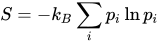
| Entropy | S |
, |
J K−1 | [M][L]2[T]−2 [Θ]−1 |
| Pressure | P |
|
Pa | M L−1T−2 |
| Internal Energy | U | J | [M][L]2[T]−2 | |
| Enthalpy | H | J | [M][L]2[T]−2 | |
| Partition Function | Z | dimensionless | dimensionless | |
| Gibbs free energy | G | J | [M][L]2[T]−2 | |
| Chemical potential (of
component i in a mixture) |
μi |
, where F is not proportional to N because μi depends on pressure. , where G is proportional to N (as long as the molar ratio composition of the system remains the same) because μi depends only on temperature and pressure and composition. |
J | [M][L]2[T]−2 |
| Helmholtz free energy | A, F | J | [M][L]2[T]−2 | |
| Landau potential, Landau Free Energy, Grand potential | Ω, ΦG | J | [M][L]2[T]−2 | |
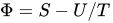
| Massieu Potential, Helmholtz free entropy | Φ | J K−1 | [M][L]2[T]−2 [Θ]−1 | |
| Planck potential, Gibbs free entropy | Ξ | J K−1 | [M][L]2[T]−2 [Θ]−1 |


















Thermal properties of matter edit
| Quantity (common name/s) | (Common) symbol/s | Defining equation | SI units | Dimension |
|---|---|---|---|---|
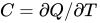
| General heat/thermal capacity | C | J K −1 | [M][L]2[T]−2 [Θ]−1 | |
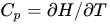
| Heat capacity (isobaric) | Cp | J K −1 | [M][L]2[T]−2 [Θ]−1 | |
| Specific heat capacity (isobaric) | Cmp | J kg−1 K−1 | [L]2[T]−2 [Θ]−1 | |
| Molar specific heat capacity (isobaric) | Cnp | J K −1 mol−1 | [M][L]2[T]−2 [Θ]−1 [N]−1 | |
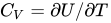
| Heat capacity (isochoric/volumetric) | CV | J K −1 | [M][L]2[T]−2 [Θ]−1 | |
| Specific heat capacity (isochoric) | CmV | J kg−1 K−1 | [L]2[T]−2 [Θ]−1 | |
| Molar specific heat capacity (isochoric) | CnV | J K −1 mol−1 | [M][L]2[T]−2 [Θ]−1 [N]−1 | |
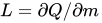
| Specific latent heat | L | J kg−1 | [L]2[T]−2 | |
| Ratio of isobaric to isochoric heat capacity, heat capacity ratio, adiabatic index, Laplace coefficient | γ | dimensionless | dimensionless |





Thermal transfer edit
| Quantity (common name/s) | (Common) symbol/s | Defining equation | SI units | Dimension |
|---|---|---|---|---|
| Temperature gradient | No standard symbol | K m−1 | [Θ][L]−1 | |
| Thermal conduction rate, thermal current, thermal/heat flux, thermal power transfer | P | W = J s−1 | [M] [L]2 [T]−3 | |
| Thermal intensity | I | W m−2 | [M] [T]−3 | |
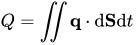
| Thermal/heat flux density (vector analogue of thermal intensity above) | q | W m−2 | [M] [T]−3 |


Equations edit
The equations in this article are classified by subject.
Thermodynamic processes edit
| Physical situation | Equations |
|---|---|
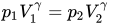
| Isentropic process (adiabatic and reversible) |
For an ideal gas |
| Isothermal process |
For an ideal gas |
| Isobaric process | p1 = p2, p = constant
|
| Isochoric process | V1 = V2, V = constant
|
| Free expansion | |
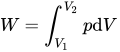
| Work done by an expanding gas | Process
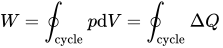
Net Work Done in Cyclic Processes |









Kinetic theory edit
| Physical situation | Nomenclature | Equations |
|---|---|---|
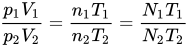
| Ideal gas law |
|
|
| Pressure of an ideal gas |
|


Ideal gas edit
| Quantity | General Equation | Isobaric Δp = 0 |
Isochoric ΔV = 0 |
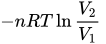
Isothermal ΔT = 0 |
Adiabatic |
|---|---|---|---|---|---|
| Work W |
|
||||
| Heat Capacity C |
(as for real gas) | (for monatomic ideal gas) |
(for monatomic ideal gas) |
||
| Internal Energy ΔU |
|
|
|
| |
| Enthalpy ΔH |
|||||
| Entropy Δs |
[1] |
|
|||
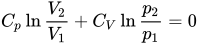
| Constant |




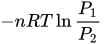






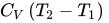



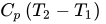


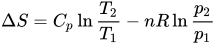




Entropy edit
- , where kB is the Boltzmann constant, and Ω denotes the volume of macrostate in the phase space or otherwise called thermodynamic probability.
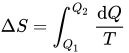
- , for reversible processes only


Statistical physics edit
Below are useful results from the Maxwell–Boltzmann distribution for an ideal gas, and the implications of the Entropy quantity. The distribution is valid for atoms or molecules constituting ideal gases.
| Physical situation | Nomenclature | Equations |
|---|---|---|
| Maxwell–Boltzmann distribution |
K2 is the Modified Bessel function of the second kind. |
Non-relativistic speeds
Relativistic speeds (Maxwell-Jüttner distribution) |
| Entropy Logarithm of the density of states |
|
where: |
| Entropy change |
| |
| Entropic force | ||
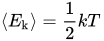
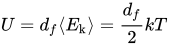
| Equipartition theorem | df = degree of freedom | Average kinetic energy per degree of freedom
Internal energy |







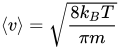
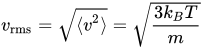
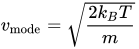
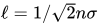
Corollaries of the non-relativistic Maxwell–Boltzmann distribution are below.
| Physical situation | Nomenclature | Equations |
|---|---|---|
| Mean speed | ||
| Root mean square speed | ||
| Modal speed | ||
| Mean free path |
|
Quasi-static and reversible processes edit
For quasi-static and reversible processes, the first law of thermodynamics is:

where δQ is the heat supplied to the system and δW is the work done by the system.
Thermodynamic potentials edit
The following energies are called the thermodynamic potentials,
| Name | Symbol | Formula | Natural variables |
|---|---|---|---|
| Internal energy | |||
| Helmholtz free energy | |||
| Enthalpy | |||
| Gibbs free energy | |||
| Landau potential, or grand potential |
, |

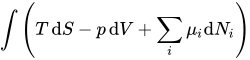





and the corresponding fundamental thermodynamic relations or "master equations"[2] are:
| Potential | Differential |
|---|---|
| Internal energy | |
| Enthalpy | |
| Helmholtz free energy | |
| Gibbs free energy |




Maxwell's relations edit
The four most common Maxwell's relations are:
| Physical situation | Nomenclature | Equations |
|---|---|---|
| Thermodynamic potentials as functions of their natural variables |
|






More relations include the following.
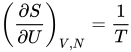
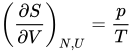
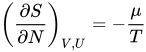
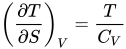
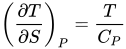
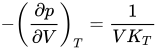
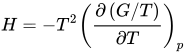
Other differential equations are:
| Name | H | U | G |
|---|---|---|---|
| Gibbs–Helmholtz equation | |||
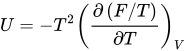
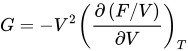

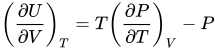
Quantum properties edit
- Indistinguishable Particles
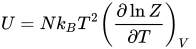

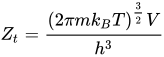
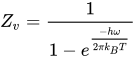
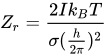
where N is number of particles, h is Planck's constant, I is moment of inertia, and Z is the partition function, in various forms:
| Degree of freedom | Partition function |
|---|---|
| Translation | |
| Vibration | |
| Rotation |
|
Thermal properties of matter edit
| Coefficients | Equation |
|---|---|
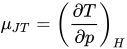
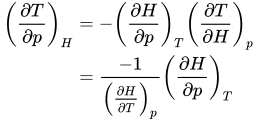
| Joule-Thomson coefficient | |
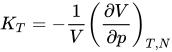
| Compressibility (constant temperature) | |
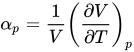
| Coefficient of thermal expansion (constant pressure) | |
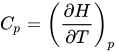
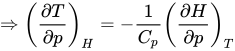
| Heat capacity (constant pressure) | |
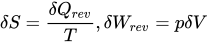
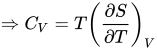
| Heat capacity (constant volume) |


| Derivation of heat capacity (constant pressure) |
|---|
|
Since |

| Derivation of heat capacity (constant volume) |
|---|
|
Since (where δWrev is the work done by the system), |



Thermal transfer edit
| Physical situation | Nomenclature | Equations |
|---|---|---|
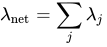
| Net intensity emission/absorption |
|
|
| Internal energy of a substance |
|
|
| Meyer's equation |
|
|
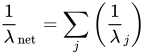
| Effective thermal conductivities |
|
Series
Parallel |



Thermal efficiencies edit
| Physical situation | Nomenclature | Equations |
|---|---|---|
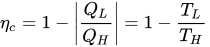
| Thermodynamic engines |
|
Thermodynamic engine:
Carnot engine efficiency: |
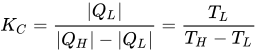
| Refrigeration | K = coefficient of refrigeration performance | Refrigeration performance
Carnot refrigeration performance |


See also edit
- List of thermodynamic properties
- Antoine equation
- Bejan number
- Bowen ratio
- Bridgman's equations
- Clausius–Clapeyron relation
- Departure functions
- Duhem–Margules equation
- Ehrenfest equations
- Gibbs–Helmholtz equation
- Phase rule
- Kopp's law
- Noro–Frenkel law of corresponding states
- Onsager reciprocal relations
- Stefan number
- Thermodynamics
- Timeline of thermodynamics
- Triple product rule
- Exact differential
References edit
- ^ Keenan, Thermodynamics, Wiley, New York, 1947
- ^ Physical chemistry, P.W. Atkins, Oxford University Press, 1978, ISBN 0 19 855148 7
- Atkins, Peter and de Paula, Julio Physical Chemistry, 7th edition, W.H. Freeman and Company, 2002 ISBN 0-7167-3539-3.
- Chapters 1–10, Part 1: "Equilibrium".
- Bridgman, P. W. (1 March 1914). "A Complete Collection of Thermodynamic Formulas". Physical Review. 3 (4). American Physical Society (APS): 273–281. doi:10.1103/physrev.3.273. ISSN 0031-899X.
- Landsberg, Peter T. Thermodynamics and Statistical Mechanics. New York: Dover Publications, Inc., 1990. (reprinted from Oxford University Press, 1978).
- Lewis, G.N., and Randall, M., "Thermodynamics", 2nd Edition, McGraw-Hill Book Company, New York, 1961.
- Reichl, L.E., A Modern Course in Statistical Physics, 2nd edition, New York: John Wiley & Sons, 1998.
- Schroeder, Daniel V. Thermal Physics. San Francisco: Addison Wesley Longman, 2000 ISBN 0-201-38027-7.
- Silbey, Robert J., et al. Physical Chemistry, 4th ed. New Jersey: Wiley, 2004.
- Callen, Herbert B. (1985). Thermodynamics and an Introduction to Themostatistics, 2nd edition, New York: John Wiley & Sons.