
In mathematics, a submersion is a differentiable map between differentiable manifolds whose differential is everywhere surjective. This is a basic concept in differential topology. The notion of a submersion is dual to the notion of an immersion.
Definition edit
Let M and N be differentiable manifolds and be a differentiable map between them. The map f is a submersion at a point if its differential



is a surjective linear map.[1] In this case p is called a regular point of the map f, otherwise, p is a critical point. A point is a regular value of f if all points p in the preimage are regular points. A differentiable map f that is a submersion at each point is called a submersion. Equivalently, f is a submersion if its differential has constant rank equal to the dimension of N.


A word of warning: some authors use the term critical point to describe a point where the rank of the Jacobian matrix of f at p is not maximal.[2] Indeed, this is the more useful notion in singularity theory. If the dimension of M is greater than or equal to the dimension of N then these two notions of critical point coincide. But if the dimension of M is less than the dimension of N, all points are critical according to the definition above (the differential cannot be surjective) but the rank of the Jacobian may still be maximal (if it is equal to dim M). The definition given above is the more commonly used; e.g., in the formulation of Sard's theorem.
Submersion theorem edit
Given a submersion between smooth manifolds of dimensions and , for each there are surjective charts of around , and of around , such that restricts to a submersion which, when expressed in coordinates as , becomes an ordinary orthogonal projection. As an application, for each the corresponding fiber of , denoted can be equipped with the structure of a smooth submanifold of whose dimension is equal to the difference of the dimensions of and .




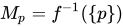
The theorem is a consequence of the inverse function theorem (see Inverse function theorem#Giving a manifold structure).
For example, consider given by The Jacobian matrix is



This has maximal rank at every point except for . Also, the fibers


are empty for , and equal to a point when . Hence we only have a smooth submersion and the subsets are two-dimensional smooth manifolds for .




Examples edit
- Any projection
- Local diffeomorphisms
- Riemannian submersions
- The projection in a smooth vector bundle or a more general smooth fibration. The surjectivity of the differential is a necessary condition for the existence of a local trivialization.

Maps between spheres edit
One large class of examples of submersions are submersions between spheres of higher dimension, such as
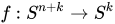
whose fibers have dimension . This is because the fibers (inverse images of elements ) are smooth manifolds of dimension . Then, if we take a path


and take the pullback
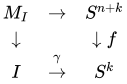
we get an example of a special kind of bordism, called a framed bordism. In fact, the framed cobordism groups are intimately related to the stable homotopy groups.

Families of algebraic varieties edit
Another large class of submersions are given by families of algebraic varieties whose fibers are smooth algebraic varieties. If we consider the underlying manifolds of these varieties, we get smooth manifolds. For example, the Weierstrass family of elliptic curves is a widely studied submersion because it includes many technical complexities used to demonstrate more complex theory, such as intersection homology and perverse sheaves. This family is given by



where is the affine line and is the affine plane. Since we are considering complex varieties, these are equivalently the spaces of the complex line and the complex plane. Note that we should actually remove the points because there are singularities (since there is a double root).


Local normal form edit
If f: M → N is a submersion at p and f(p) = q ∈ N, then there exists an open neighborhood U of p in M, an open neighborhood V of q in N, and local coordinates (x1, …, xm) at p and (x1, …, xn) at q such that f(U) = V, and the map f in these local coordinates is the standard projection

It follows that the full preimage f−1(q) in M of a regular value q in N under a differentiable map f: M → N is either empty or is a differentiable manifold of dimension dim M − dim N, possibly disconnected. This is the content of the regular value theorem (also known as the submersion theorem). In particular, the conclusion holds for all q in N if the map f is a submersion.
Topological manifold submersions edit
Submersions are also well-defined for general topological manifolds.[3] A topological manifold submersion is a continuous surjection f : M → N such that for all p in M, for some continuous charts ψ at p and φ at f(p), the map ψ−1 ∘ f ∘ φ is equal to the projection map from Rm to Rn, where m = dim(M) ≥ n = dim(N).
See also edit
Notes edit
- ^ Crampin & Pirani 1994, p. 243. do Carmo 1994, p. 185. Frankel 1997, p. 181. Gallot, Hulin & Lafontaine 2004, p. 12. Kosinski 2007, p. 27. Lang 1999, p. 27. Sternberg 2012, p. 378.
- ^ Arnold, Gusein-Zade & Varchenko 1985.
- ^ Lang 1999, p. 27.
References edit
- Arnold, Vladimir I.; Gusein-Zade, Sabir M.; Varchenko, Alexander N. (1985). Singularities of Differentiable Maps: Volume 1. Birkhäuser. ISBN 0-8176-3187-9.
- Bruce, James W.; Giblin, Peter J. (1984). Curves and Singularities. Cambridge University Press. ISBN 0-521-42999-4. MR 0774048.
- Crampin, Michael; Pirani, Felix Arnold Edward (1994). Applicable differential geometry. Cambridge, England: Cambridge University Press. ISBN 978-0-521-23190-9.
- do Carmo, Manfredo Perdigao (1994). Riemannian Geometry. ISBN 978-0-8176-3490-2.
- Frankel, Theodore (1997). The Geometry of Physics. Cambridge: Cambridge University Press. ISBN 0-521-38753-1. MR 1481707.
- Gallot, Sylvestre; Hulin, Dominique; Lafontaine, Jacques (2004). Riemannian Geometry (3rd ed.). Berlin, New York: Springer-Verlag. ISBN 978-3-540-20493-0.
- Kosinski, Antoni Albert (2007) [1993]. Differential manifolds. Mineola, New York: Dover Publications. ISBN 978-0-486-46244-8.
- Lang, Serge (1999). Fundamentals of Differential Geometry. Graduate Texts in Mathematics. New York: Springer. ISBN 978-0-387-98593-0.
- Sternberg, Shlomo Zvi (2012). Curvature in Mathematics and Physics. Mineola, New York: Dover Publications. ISBN 978-0-486-47855-5.