
This article needs additional citations for verification. (September 2021) |
Serbian cuisine (Serbian: српска кухиња / srpska kuhinja) is a Balkan cuisine that consists of the culinary methods and traditions of Serbia. Its roots lie in Serbian history, including centuries of cultural contact and influence with the Greeks and the Byzantine Empire, the Ottomans, and Serbia's Balkan neighbours, especially during the existence of Yugoslavia. Historically, Serbian food develops from pastoral customs that involved the keeping of sheep in mountain highlands, in a climate and regional context that favoured animal husbandry over vegetable farming; Serbian food is therefore traditionally richer in animal products and basic grains—corn, wheat and oats—than fresh vegetable dishes. Following the abandonment of widely practiced pastoral lifestyles, Serbian food emerged through the Middle Ages heavily dependent not on lamb or mutton, but on the keeping of pigs for the annual cull and the production of various cured meats, such as sausages, bacon and ham products.
The Serbian government has passed laws banning the production and import of genetically modified foods, a legislative decision which has been applauded by environmentalists but caused a long-running dispute with the World Trade Organization, preventing Serbia from being able to join the WTO.[1][2][3]
Overview edit

.jpg)
National dishes of Serbia include sarma (a mix of ground pork or beef with rice rolled in leaves of cabbage), gibanica (an egg and cheese pie made with filo dough), pljeskavica (a ground beef or pork patty), ćevapi (grilled meat), paprikaš (a soup made of paprika), gulaš (soup of meat and vegetables usually seasoned with paprika and other spices) and Karađorđeva šnicla (a schnitzel). The national drink is rakia (various traditional fruit brandies).
With Serbia being located on the crossroads between East and West, its cuisine has gathered elements from different cooking styles across the Middle East and Europe to develop its own hearty gastronomy with an intricate balance of rich meats, vegetables, breads, cheese, fresh pastries, and desserts. It has much in common with the cuisines of neighboring Balkan countries; its flavors are mild, fresh, and natural. Seasonings are usually salt, black pepper, and paprika, while ingredients are known for being fresh and high-quality. Seasonal food is an important element of Serbian cuisine, thus many dishes are strongly associated with a specific time of the year.
The average Serbian eats three meals a day: breakfast, lunch, and dinner—with lunch being the largest.[4][5] However, traditionally, only lunch and dinner existed, with breakfast being introduced in the second half of the 19th century.[5][6]
A number of foods which are usually bought in the West are often made at home in Serbia. These include rakija, slatko, jam, jelly, and various pickled foods—notably turšija, ajvar, or sausages. The reasons for this range from economical to cultural. Food preparation is a strong part of the Serbian family tradition.
History edit
.jpg)
William, archbishop of Tyre, who visited Constantinople in 1179, described the Serbs:
They are rich in herds and flocks and unusually well supplied with milk, cheese, butter, meat, honey, and wax".[7]
Krušedol monk of the Serbian Orthodox Church Jerotej, wrote the oldest modern Serbian cookbook in 1855.[8]
The first published cookbook in Serbia is The Big Serbian Cookbook (Велики српски кувар), written by Katarina Popović-Midzina in 1877.[9]
The best known Serbian cookbook is Pata's Cookbook (Патин кувар), written by Spasenija Pata Marković in 1907; the book remains in publication even today.[10]
An old Serbian legend says that during the time of the 14th-century Serbian Empire, under the rule of Stefan Uroš IV Dušan, meals in the Serbian palace were eaten with golden spoons and forks. Historians say that medieval Serbian cuisine mainly consisted of milk, dairy, produce, and vegetables. Not a lot of bread was eaten, but when it was, the rich ate bread made from wheat and the poor ate bread made from oats and rye. The only meat consumed was wild game, with cattle reserved for agricultural use.[11]
Meals edit
Breakfast edit
Breakfast in Serbia is an early but hearty meal, rich in calories and carbohydrates, meant to provide one with an abundance of energy to start the day. Bread is frequently served with butter, jam, yogurt, sour cream, or cheese, accompanied by bacon, sausage, salami, eggs, or kajmak. Serbians often stop by a bakery in the morning for fresh pastries such as pogačice, paštete, kifle (which in Serbian usage may or may not be crescent-shaped, and may be sweet, but may also be sprinkled with salt crystals), kiflice, perece, buhtle, pletenice, štapići, zemičke, djevreci, mekike, and uštipci. Other common breakfast dishes include burek, kačamak, and cicvara (types of polenta) and popara, proja (cornbread), and čalabrca. Before breakfast most people usually have a cup of kafa, or espresso, and with the breakfast itself either tea, milk, milk coffee, or chocolate milk is served.
-

-

-

-

-

-
 Kajgana

.jpg)


.jpg)
.jpg)
Appetizers edit
Meza is an assortment of small dishes and appetizers, though, unlike the Middle Eastern meze, it does not usually include cooked dishes, and is therefore more similar to Italian antipasto. A Serbian meza typically includes slices of cured meats and sausages, cheeses, olives, fresh vegetables, and zimnica. Meza is served either to accompany alcoholic drinks or as a starter before a soup on bigger meals.
.jpg)


Soups edit
Soups are eaten as an entrée at almost every lunch. They are considered to be very important for good health. There are two types of soups in Serbian cuisine: thin soups called supa, and thicker soups with roux or eggs called čorba. The most common ones are simple pottages made of beef, offal or poultry with added noodles. Lamb, veal, and fish soups are considered delicacies.
| Type | Image | Serbian Cyrillic | Serbian Latin | Notes |
|---|---|---|---|---|
| Consommé |  |
Домаћа супа | Domaća supa | A simple chicken or beef soup with noodles or dumplings. The most common entrée in home cooking. |
| Veal soup | Телећа чорба | Teleća čorba | ||
| Lamb soup |  |
Јагњећа чорба | Jagnjeća čorba | |
| Fisherman's soup |  |
Рибља чорба | Riblja čorba | A paprika-spiced fish soup, common in the Panonian region. |
| Green soup | Чорба од зеља | Čorba od zelja | ||
| Tomato soup |  |
Парадајз чорба | Paradajz čorba | |
| Cauliflower soup | Чорба од карфиола | Čorba od karfiola | ||
| Egg drop soup | Супа с јајима (супа с дроњцима) | Supa s jajima (supa s dronjcima) |
Main course edit
The main course is most commonly a meat dish. Besides roštilj (barbecue) which is very popular, braising, stewing, and roasting in an oven are the most common cooking methods.
| Type | Image | Serbian Cyrillic | Serbian Latin | Notes |
|---|---|---|---|---|
| Rotisserie |  |
Печење | Pečenje | A whole pig or lamb roasted on a skewer over a fire. |
| Đuveč |  |
Ђувеч | Đuveč | A vegetable dish similar to ratatouille. Either stewed or baked as a casserole. |
| Karađorđeva šnicla |  |
Карађорђева шницла | Karađorđeva šnicla | A breaded rolled steak stuffed with kajmak, sliced ham and cheese. |
| Kavurma | Кавурма | Kavurma | Pig intestines, not to be confused with Turkish kavurma. | |
| Moussaka |  |
Мусака | Musaka | A mince and potato, zucchini or eggplant casserole, common through the Balkans. |
| Mućkalica | .jpg) |
Мућкалица | Mućkalica | A spicy stew of pork, tomatoes, and peppers. Typical of southern Serbia. |
| Goulash |  |
Гулаш | Gulaš | A paprika-spiced meat stew originating in Hungary that is popular throughout Central Europe and the Balkans. |
| Rinflajš | Ринфлајш | Rinflajš | A beef dish from Vojvodina. Similar to Tafelspitz. | |
| Podvarak |  |
Подварак | Podvarak | A fresh cabbage with grape vinegar casserole, usually with meat and other vegetables (tomatoes, aubergines, mushrooms, olives, and legumes. Can be made with sauerkraut, but that is not authentic. Black vinegar can be used. |
| Prebranac |  |
Пребранац | Prebranac | A bean casserole. Called "tavce gravce" in Macedonia |
| Sarma |  |
Сарма | Sarma | Cabbage, chard or vine leaves, stuffed with rice and minced meat. In northern Serbia, cabbage leaves are also used. |
| Sataraš |  |
Сатараш | Sataraš | Bell peppers, tomatoes, onions and condiments. |
| Škembići | Шкембићи | Škembići | A tripe stew. | |
| Beans | .jpg) |
Пасуљ | Pasulj | A bean stew. |
| Stuffed peppers |  |
Пуњене паприке | Punjene paprike | Peppers stuffed with rice and minced meat. |
| Stuffed zucchini |  |
Пуњене тиквице | Punjene tikvice | Zucchini stuffed with rice and minced meat. |
| Peas |  |
Грашак | Grašak | A pea stew. |
| Green beans |  |
Боранија | Boranija | A green bean stew. |
| Noodles with rice | Флекице с рижом | Flekice s rižom | ||
| Vrsnjik |  |
Вршњик | Vrsnjik | Meat and vegetables cooked under a sač. |
Roštilj (barbecue) edit
Grilling is very popular in Serbia. Grilled meats are the primary main course dishes offered in restaurants. They are commonly served as mixed grill on large oval plates. They are often also eaten as fast food. The cities of Leskovac and Novi Pazar are especially famous for their barbecue.
| Type | Image | Serbian Cyrillic | Serbian Latin | Notes |
|---|---|---|---|---|
| Pljeskavica | .JPG) |
Пљескавица | Pljeskavica | A ground pork or beef patty; a national dish. |
| Ćevapi (ćevapi) |  |
Ћевапи (ћевапи) | Ćevapčići (ćevapi) | Ground pork or beef meat sticks; a national dish. |
| Pork loin | Вешалица | Vešalica | Grilled strips of pork loin. | |
| Skewers | .jpg) |
Ражњићи | Ražnjići | Chunks of meat and vegetables grilled on skewers. |
| Sausages | Кобасице | Kobasice | Various sausages, usually with spices |
Bread edit
Bread is a staple of Serbian meals, and it is often treated almost ritually. A traditional Serbian welcoming is to offer the guest with bread and salt; bread also plays an important role in religious rituals. Many Serbs believe that it is sinful to throw away bread regardless of how old it is. Although pasta, rice, potato, and similar side dishes did enter the everyday cuisine over time, many Serbs still eat bread with meals.
In most bakeries and shops, white wheat bread loaves (typically 0.5 kg) are sold. In modern times, black bread and various graham bread variations have regained popularity. In many rural households bread is still baked in cast iron ovens, usually in bigger loaves.
.jpg)


Salads edit
In Serbia, salads are eaten as a side dish with the main course. The simplest of salads consist of sliced lettuce, cabbage, tomato, cucumber or carrot, olives with oil, vinegar, salt, and spices.
| Type | Image | Serbian Cyrillic | Serbian Latin | Description |
|---|---|---|---|---|
| Serbian salad |  |
Српска салата | Srpska salata | Diced tomatoes, cucumbers, and onions with a simple dressing of oil and vinegar. |
| Shopska salad |  |
Шопска салата | Šopska salata | Similar to the above Serbian salad, but topped with white cheese. |
| Greek salad |  |
Грчка салата | Grčka salata | Diced tomatoes, cucumbers and onions, topped with olives and feta cheese, and dressed with olive oil. Originally from Greece, but quite popular in Serbia. |
| Cabbage salad |  |
Купус салата | Kupus salata | Shredded cabbage with a vinegar dressing. |
| Zimnica | .jpg) |
Зимница | Zimnica | Pickled vegetables. |
| Russian salad |  |
Руска салата | Ruska salata | Diced boiled potatoes, carrots, pickles, green peas, eggs and ham, dressed with mayonnaise. |
| Tarator |  |
Тартар | Tartar | Yogurt with cucumber. |
Relishes edit
| Urnebes |  |
Урнебес | Urnebes | A spread made predominantly with crushed white cheese, minced garlic and dry red peppers. |
| Ajvar |  |
Ајвар | Ajvar | A pepper-based condiment made from red bell peppers. It can be mild or spicy. |
| Ljutenica |  |
Љутеница | Ljutenica | A spicy relish. Ingredients include peppers, carrots, eggplant, onion, garlic and tomatoes. It can be smooth or with chunks. Spicier than ajvar. However, different regions and countries have substantially different interpretations of these relishes. |
| Pinđur |  |
Пинђур | Pinđur | Similar to ajvar but generally made with eggplant. In some regions the words are used interchangeably. |
Dairy edit
Dairy products are an important part of the Serbian diet. Fermented products such as sour milk, kajmak, yogurt and pavlaka are common breakfast foods, consumed daily. White cheeses, called sir are much more common in Serbia than yellow cheeses. There are numerous varieties, some of which have been awarded for their quality, such as the white cheese with walnuts from Babine, which won the 2012 "best autochtonic cheese" award.[12] Serbian Pule cheese, made from donkey milk, is the most expensive cheese in the world.[13] Although less common, several yellow cheese are locally produced.
Meat products edit
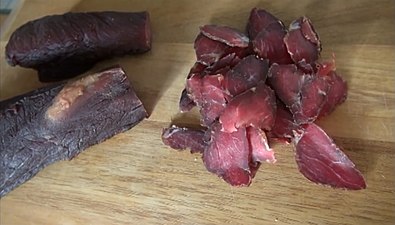
Traditional Serbian meat products are simple ham, bacon, dry ribs, and a kind of pork rinds called čvarci.[5] They are usually produced every autumn or in early winter, during an event called svinjokolj, where pigs are slaughtered and meat is preserved for the winter. Cured meats, bacon, salo, čvarci, sausages such as krvavica, and kulen are produced. Offal and cheaper cuts of meat are utilized as well, and made into processed products such as švargla.
Serbian meat products—especially those which attained protected designation of origin[14] status—include:
Various kinds of sausages and similar more complex meat products were created under Austrian influence in Vojvodina.[5] They include:
- Sausage (kobasica)[5]
- Blood sausage (krvavice)[5]
- Head cheese (švargla)[5]
-

-
 Srem kulen
 -
-

-


.jpg)


Pies edit
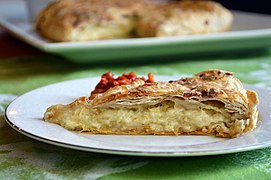
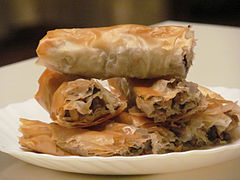
Pies are very popular in Serbia. They are eaten either for breakfast, dinner, or as a snack. They are most commonly made with thin layers of phyllo dough. There are several methods of preparation and numerous types of fillings, both sweet and savory. Serbian pies are usually named after either the preparation method or the filling.
One variety of pie that is not made with phyllo is the štrudla, which, in turn, is not similar to strudel, but rather to a nut roll.
| ↓ Filling | Form → | Ruffled phyllo | Rolled phyllo | Layered phyllo | Rolled dough |
| ↓ Serbian name → | Бурек | Савијача | Штрудла | ||
| white cheese | Пита са сиром/Сирница |  |
|
||
| white cheese and eggs | Гибаница | |
Gibanica |
| |
| meat | Пита с месом | |
|
||
| potatoes | Пита с кромпиром/Кромпируша | |
|
||
| spinach, greens | Пита са зељем/Зељаница | |
|
||
| mushrooms | Пита с печуркама | |
|
||
| sour cherries | Пита са вишњама | |
|
| |
| apples | Пита с јабукама | |
|
| |
| pumpkin | Пита с бундевом/Бундевара | |
| ||
| poppy seeds | Штрудла с маком/Маковњача |
| |||
| walnuts | Штрудла са орасима/Орасница | |
Česnica (in Vojvodina) |
| |
| no filling | |
-
-

-
-

-

-
 Vanilla filling pie
 -
 Egg pie (jaruša)

.jpg)
.jpg)

.jpg)

.jpg)
Sweets and desserts edit

Sweets are served at the end of meals. Sweets and desserts enjoyed in Serbia typically include both Middle Eastern and European ones, as well as some authentically Serbian ones. Besides the ones mentioned here, pies with sweet fruit fillings are also common.
| Type | Image | Serbian Cyrillic | Serbian Latin | Description |
|---|---|---|---|---|
| Plazma cake |  |
Плазма торта | Plazma torta | A cake made with ground Plazma biscuits as the primary ingredient. |
| Vasa's cake |  |
Васина торта | Vasina torta | A walnut and chocolate cake. Amongst the more popular Serbian desserts. |
| Qurabiya | .jpg) |
Гурабија | Gurabija | Shortbread-type biscuit |
| Dobos cake |  |
Добош торта | Doboš torta | A five-layer sponge cake, layered with chocolate buttercream and topped with thin caramel slices. |
| Strudel |  |
штрудла | Štrudla | Type of layered pastry with a filling that is usually sweet, but savoury fillings are also common. |
| Reforma cake |  |
Реформа торта | Reforma torta | A layered cake with chocolate butter-cream filling. |
| Slatko |  |
Слатко | Slatko | A fruit preserve. |
| Ratluk |  |
Ратлук | Ratluk | Turkish delight. |
| Halva |  |
Алва | Alva | Dense flour or nut-based sweet confections. |
| Baklava |  |
Баклава | Baklava | Sweet pastry made from layers of phyllo dough, filled with chopped nuts and sweetened with syrup or honey. |
| Tulumbe |  |
Тулумбе | Tulumbe | A fried batter soaked in syrup. |
| Tufahije | .jpg) |
Туфахије | Tufahije | A dessert made of walnut-stuffed apples stewed in water with sugar. |
| Compote |  |
Компот | Kompot | Kompot is a non-alcoholic sweet beverage, that may be served hot or cold. It is obtained by cooking fruit in a large volume of water, together with sugar or raisins as additional sweeteners. |
| Quince cheese |  |
Китникес | Kitnikes | A sweet, thick jelly made of the pulp of the quince fruit. |
| Knedle |  |
Кнедле са шљивама | Knedle sa šljivama | Boiled potato-dough dumplings filled with plums. Called gomboce in Vojvodina. |
| Krofne |  |
Крофне | Krofne | Airy doughnuts filled with chocolate or jam. |
| Krempita |  |
Кремпита | Krempita | A chantilly and custard cream cake dessert. |
| Orasnice |  |
Ораснице | Orasnice | Walnut cookies. |
| Palačinke |  |
Палачинке | Palačinke | Crêpes. |
| Šampita |  |
Шампита | Šampita | A whipped marshmallow-type dessert with fillo dough crust. |
| Ruske kape |  |
Руске капе | Ruske kape | |
| Vanilla cookies |  |
Ванилице | Vanilice | |
| Uštipci |  |
Уштипци | Uštipci | Doughnut-like fried dough balls. |
| Piškoti |  |
пишкоти | Piškoti | Thin, light, sweet delicate, crispy cookie. |
Ritual food edit
| Type | Image | Serbian Cyrillic | Serbian Latin | Occasion | Description |
|---|---|---|---|---|---|
| Česnica |  |
Чесница | Česnica | Christmas | Plays a central role in a ritual. A coin is put inside it, and it is then rotated and broken into pieces, and each family member takes one. The one who gets the coin is said to have a lucky and blessed following year. |
| Koljivo |  |
Кољиво | Koljivo | Slava | Boiled wheat, almonds/walnuts, and tahini—ritual food during slava. |
| Slavski kolač |  |
Славски колач | Slavski kolač | Slava |
Drinks edit
Non-alcoholic edit
.jpg)
Domestic coffee (or Serbian coffee) is the most commonly consumed non-alcoholic beverage in Serbia. It is mostly prepared at home, rather than bought in coffee shops, and preferably consumed in the company of friends or family. Slatko, ratluk, and raki may be served alongside coffee. The majority of the Serbian population starts a day with a cup of coffee in the morning. Herbal teas are consumed as a medication, rather than a beverage. Yogurt and kefir are commonly consumed dairy beverages. They frequently accompany savory pastries. A beverage made from maize, called boza or kvas, was once popular, but today is rarely consumed.
A number of fruit juice and mineral water brands are produced locally. The Knjaz Milos mineral water is considered a national brand.
Alcoholic edit
Rakija edit

.jpg)
Rakija is a general term for distilled beverages made from fruits. There are numerous varieties, which are usually named after the type of fruit they are made from. Comparatively many people brew their own rakija. Loza, made from grapes, is considered the national drink.
Beer edit
Beer has become recently popular and is enjoyed in Serbia, even outpacing the traditional raki and wine. The largest brewery in the country is Apatinska pivara.
Wine edit
There are nearly 110,000 hectares of vineyards in Serbia, producing about 645,000 tons of grapes annually, with South Serbia producing the most. Because of that, Serbia is internationally recognized as a great wine producer.
-
 Serbian coffee being served
 -
 Various Serbian beer brands
 -


See also edit


References edit
- ^ "Serbia Agriculture". Sputnik News. 20 February 2017. Retrieved 24 June 2018.[permanent dead link]
- ^ "GMO Free Europe". 26 February 2016. Retrieved 24 June 2018.
- ^ "Ljajic: GMO preventing Serbia from joining World Trade Organization". eKapija. Tanjug. 9 February 2017.
- ^ Antonić, Dragomir (2006-07-23). Царство за гибаницу. Politika 33300 (in Serbian). Politika. p. 11.
- ^ a b c d e f g h i j k Nikola Vrzić (December 28, 2000). "Sve srpske kašike" (Windows-1250). NIN (in Serbian). Retrieved 13 June 2012.
- ^ Antonić, Dragomir (2006-07-23). Царство за гибаницу. Politika 33300 (in Serbian). Politika. p. 11.
- ^ William of Tyre, Historia Transmarina 20.4.
- ^ Ilic, Miodrag (2019-03-27). "Prvi srpski kuvar - Srbskij kuvar jeromonaha Jeroteja Draganovića | Recepti i Kuvar online" (in Serbian). Retrieved 2022-11-30.
- ^ Poglaviti majstori svakog krkanluka
- ^ Istorija pisanja kuvara u Srbiji
- ^ "Food « National Tourism Organisation of Serbia". www.serbia.travel. Archived from the original on 2013-04-20. Retrieved 2016-03-17.
- ^ Press Online :: Društvo :: Srpski sir pobedio švajcarski
- ^ "TELEGRAF OTKRIVA: Najskuplji sir na svetu proizvodi se u Srbiji, kilogram košta 1.000 evra! (FOTO)". 29 September 2012.
- ^ a b c d e f g h i Списак ОГП
External links edit


- Nigella.com – English language recipe for Vasa's Torte (traditional birthday cake with origin from Paraćin, Serbia)
- SerbiaTouristGuide.com – includes Serbian recipes