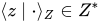
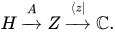
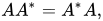
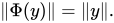
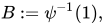
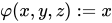
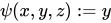
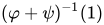
Let be a Hilbert space over a field where is either the real numbers or the complex numbers If (resp. if ) then is called a complex Hilbert space (resp. a real Hilbert space). Every real Hilbert space can be extended to be a dense subset of a unique (up to bijectiveisometry) complex Hilbert space, called its complexification, which is why Hilbert spaces are often automatically assumed to be complex. Real and complex Hilbert spaces have in common many, but by no means all, properties and results/theorems.
This article is intended for both mathematicians and physicists and will describe the theorem for both.
In both mathematics and physics, if a Hilbert space is assumed to be real (that is, if ) then this will usually be made clear. Often in mathematics, and especially in physics, unless indicated otherwise, "Hilbert space" is usually automatically assumed to mean "complex Hilbert space." Depending on the author, in mathematics, "Hilbert space" usually means either (1) a complex Hilbert space, or (2) a real or complex Hilbert space.
Every constant map is always both linear and antilinear. If then the definitions of linear maps and antilinear maps are completely identical. A linear map from a Hilbert space into a Banach space (or more generally, from any Banach space into any topological vector space) is continuous if and only if it is bounded; the same is true of antilinear maps. The inverse of any antilinear (resp. linear) bijection is again an antilinear (resp. linear) bijection. The composition of two antilinear maps is a linear map.
Continuous dual and anti-dual spaces
A functional on is a function whose codomain is the underlying scalar field
Denote by (resp. by the set of all continuous linear (resp. continuous antilinear) functionals on which is called the (continuous) dual space (resp. the (continuous) anti-dual space) of [1]
If then linear functionals on are the same as antilinear functionals and consequently, the same is true for such continuous maps: that is,
One-to-one correspondence between linear and antilinear functionals
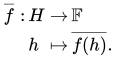
Given any functional the conjugate of is the functional
This assignment is most useful when because if then and the assignment reduces down to the identity map.
The assignment defines an antilinear bijective correspondence from the set of
all functionals (resp. all linear functionals, all continuous linear functionals ) on
onto the set of
all functionals (resp. all antilinear functionals, all continuous antilinear functionals ) on
Mathematics vs. physics notations and definitions of inner productedit
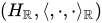
The Hilbert space has an associated inner product valued in 's underlying scalar field that is linear in one coordinate and antilinear in the other (as described in detail below).
If is a complex Hilbert space (meaning, if ), which is very often the case, then which coordinate is antilinear and which is linear becomes a very important technicality.
However, if then the inner product is a symmetric map that is simultaneously linear in each coordinate (that is, bilinear) and antilinear in each coordinate. Consequently, the question of which coordinate is linear and which is antilinear is irrelevant for real Hilbert spaces.
Notation for the inner product
In mathematics, the inner product on a Hilbert space is often denoted by or while in physics, the bra–ket notation or is typically used instead. In this article, these two notations will be related by the equality:
Competing definitions of the inner product
The maps and are assumed to have the following two properties:
The map is linear in its first coordinate; equivalently, the map is linear in its second coordinate. Explicitly, this means that for every fixed the map that is denoted by
and defined by
is a linear functional on
In fact, this linear functional is continuous, so
The map is antilinear in its second coordinate; equivalently, the map is antilinear in its first coordinate. Explicitly, this means that for every fixed the map that is denoted by
and defined by
is an antilinear functional on
In fact, this antilinear functional is continuous, so
In mathematics, the prevailing convention (i.e. the definition of an inner product) is that the inner product is linear in the first coordinate and antilinear in the other coordinate. In physics, the convention/definition is unfortunately the opposite, meaning that the inner product is linear in the second coordinate and antilinear in the other coordinate.
This article will not choose one definition over the other.
Instead, the assumptions made above make it so that the mathematics notation satisfies the mathematical convention/definition for the inner product (that is, linear in the first coordinate and antilinear in the other), while the physics bra–ket notation satisfies the physics convention/definition for the inner product (that is, linear in the second coordinate and antilinear in the other). Consequently, the above two assumptions makes the notation used in each field consistent with that field's convention/definition for which coordinate is linear and which is antilinear.
Canonical norm and inner product on the dual space and anti-dual spaceedit
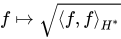
If then is a non-negative real number and the map
defines a canonical norm on that makes into a normed space.[1]
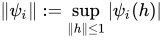
As with all normed spaces, the (continuous) dual space carries a canonical norm, called the dual norm, that is defined by[1]
The canonical norm on the (continuous) anti-dual space denoted by is defined by using this same equation:[1]
This canonical norm on satisfies the parallelogram law, which means that the polarization identity can be used to define a canonical inner product on which this article will denote by the notations
where this inner product turns into a Hilbert space. There are now two ways of defining a norm on the norm induced by this inner product (that is, the norm defined by ) and the usual dual norm (defined as the supremum over the closed unit ball). These norms are the same; explicitly, this means that the following holds for every
As will be described later, the Riesz representation theorem can be used to give an equivalent definition of the canonical norm and the canonical inner product on
The same equations that were used above can also be used to define a norm and inner product on 's anti-dual space[1]
Canonical isometry between the dual and antidual
The complex conjugate of a functional which was defined above, satisfies
for every and every
This says exactly that the canonical antilinear bijection defined by
as well as its inverse are antilinear isometries and consequently also homeomorphisms.
The inner products on the dual space and the anti-dual space denoted respectively by and are related by
and
If then and this canonical map reduces down to the identity map.
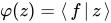
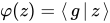
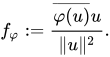
Riesz representation theorem — Let be a Hilbert space whose inner product is linear in its first argument and antilinear in its second argument and let be the corresponding physics notation. For every continuous linear functional there exists a unique vector called the Riesz representation of such that[3]
Importantly for complex Hilbert spaces, is always located in the antilinear coordinate of the inner product.[note 1]
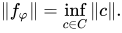
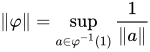
Furthermore, the length of the representation vector is equal to the norm of the functional:
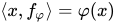
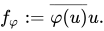
and is the unique vector with
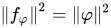
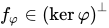
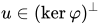
It is also the unique element of minimum norm in ; that is to say, is the unique element of satisfying
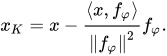
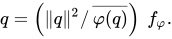
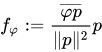
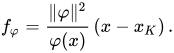
Moreover, any non-zero can be written as
The Riesz representation theorem states that this map is surjective (and thus bijective) when is complete and that its inverse is the bijectiveisometric antilinear isomorphism
Consequently, every continuous linear functional on the Hilbert space can be written uniquely in the form [1] where for every
The assignment can also be viewed as a bijective linear isometry into the anti-dual space of [1] which is the complex conjugate vector space of the continuous dual space
The inner products on and are related by
and similarly,
The set satisfies and so when then can be interpreted as being the affine hyperplane[note 3] that is parallel to the vector subspace and contains
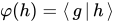
For the physics notation for the functional is the bra where explicitly this means that which complements the ket notation defined by
In the mathematical treatment of quantum mechanics, the theorem can be seen as a justification for the popular bra–ket notation. The theorem says that, every bra has a corresponding ket and the latter is unique.
Historically, the theorem is often attributed simultaneously to Riesz and Fréchet in 1907 (see references).
Fix
Define by which is a linear functional on since is in the linear argument.
By the Cauchy–Schwarz inequality,
which shows that is bounded (equivalently, continuous) and that
It remains to show that
By using in place of it follows that
(the equality holds because is real and non-negative).
Thus that
The proof above did not use the fact that is complete, which shows that the formula for the norm holds more generally for all inner product spaces.
Proof that a Riesz representation of is unique:
Suppose are such that and for all
Then
which shows that is the constant linear functional.
Consequently which implies that
Proof that a vector representing exists:
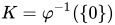
Let
If (or equivalently, if ) then taking completes the proof so assume that and
The continuity of implies that is a closed subspace of (because and is a closed subset of ).
Let
Applying the norm formula that was proved above with shows that
Also, the vector has norm and satisfies
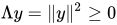
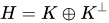
It can now be deduced that is -dimensional when
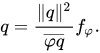
Let be any non-zero vector. Replacing with in the proof above shows that the vector satisfies for every The uniqueness of the (non-zero) vector representing implies that which in turn implies that and Thus every vector in is a scalar multiple of
So in particular, is always real and furthermore, if and only if if and only if
Linear functionals as affine hyperplanes
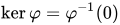
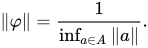
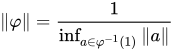
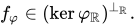
A non-trivial continuous linear functional is often interpreted geometrically by identifying it with the affine hyperplane (the kernel is also often visualized alongside although knowing is enough to reconstruct because if then and otherwise ). In particular, the norm of should somehow be interpretable as the "norm of the hyperplane ". When then the Riesz representation theorem provides such an interpretation of in terms of the affine hyperplane[note 3] as follows: using the notation from the theorem's statement, from it follows that and so implies and thus
This can also be seen by applying the Hilbert projection theorem to and concluding that the global minimum point of the map defined by is
The formulas
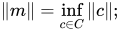
provide the promised interpretation of the linear functional's norm entirely in terms of its associated affine hyperplane (because with this formula, knowing only the set is enough to describe the norm of its associated linear functional). Defining the infimum formula
will also hold when
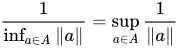
When the supremum is taken in (as is typically assumed), then the supremum of the empty set is but if the supremum is taken in the non-negative reals (which is the image/range of the norm when ) then this supremum is instead in which case the supremum formula will also hold when (although the atypical equality is usually unexpected and so risks causing confusion).
(this is true even if because in this case ).
If is a unit vector satisfying the above condition then the same is true of which is also a unit vector in However, so both these vectors result in the same
Given an orthonormal basis of and a continuous linear functional the vector can be constructed uniquely by
where all but at most countably many will be equal to and where the value of does not actually depend on choice of orthonormal basis (that is, using any other orthonormal basis for will result in the same vector).
If is written as then
and
If the orthonormal basis is a sequence then this becomes
and if is written as then
Example in finite dimensions using matrix transformationsedit
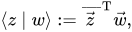
Consider the special case of (where is an integer) with the standard inner product
where are represented as column matrices and with respect to the standard orthonormal basis on (here, is at its th coordinate and everywhere else; as usual, will now be associated with the dual basis) and where denotes the conjugate transpose of
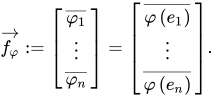
Let be any linear functional and let be the unique scalars such that
where it can be shown that for all
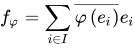
Then the Riesz representation of is the vector
To see why, identify every vector in with the column matrix
so that is identified with
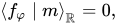
As usual, also identify the linear functional with its transformation matrix, which is the row matrix so that and the function is the assignment where the right hand side is matrix multiplication. Then for all
which shows that satisfies the defining condition of the Riesz representation of
The bijective antilinear isometry defined in the corollary to the Riesz representation theorem is the assignment that sends to the linear functional on defined by
where under the identification of vectors in with column matrices and vector in with row matrices, is just the assignment
As described in the corollary, 's inverse is the antilinear isometry which was just shown above to be:
where in terms of matrices, is the assignment
Thus in terms of matrices, each of and is just the operation of conjugate transposition (although between different spaces of matrices: if is identified with the space of all column (respectively, row) matrices then is identified with the space of all row (respectively, column matrices).
This example used the standard inner product, which is the map but if a different inner product is used, such as where is any Hermitianpositive-definite matrix, or if a different orthonormal basis is used then the transformation matrices, and thus also the above formulas, will be different.
Relationship with the associated real Hilbert spaceedit
Assume that is a complex Hilbert space with inner product
When the Hilbert space is reinterpreted as a real Hilbert space then it will be denoted by where the (real) inner-product on is the real part of 's inner product; that is:
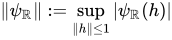
The norm on induced by is equal to the original norm on and the continuous dual space of is the set of all real-valued bounded -linear functionals on (see the article about the polarization identity for additional details about this relationship).
Let and denote the real and imaginary parts of a linear functional so that
The formula expressing a linear functional in terms of its real part is
where for all
It follows that and that if and only if
It can also be shown that where and are the usual operator norms.
In particular, a linear functional is bounded if and only if its real part is bounded.
Representing a functional and its real part
The Riesz representation of a continuous linear function on a complex Hilbert space is equal to the Riesz representation of its real part on its associated real Hilbert space.
Explicitly, let and as above, let be the Riesz representation of obtained in so it is the unique vector that satisfies for all
The real part of is a continuous real linear functional on and so the Riesz representation theorem may be applied to and the associated real Hilbert space to produce its Riesz representation, which will be denoted by
That is, is the unique vector in that satisfies for all
The conclusion is
This follows from the main theorem because and if then
and consequently, if then which shows that
Moreover, being a real number implies that
In other words, in the theorem and constructions above, if is replaced with its real Hilbert space counterpart and if is replaced with then This means that vector obtained by using and the real linear functional is the equal to the vector obtained by using the origin complex Hilbert space and original complex linear functional (with identical norm values as well).
Furthermore, if then is perpendicular to with respect to where the kernel of is be a proper subspace of the kernel of its real part Assume now that
Then because and is a proper subset of The vector subspace has real codimension in while has real codimension in and That is, is perpendicular to with respect to
Canonical injections into the dual and anti-dualedit
Induced linear map into anti-dual
The map defined by placing into the linear coordinate of the inner product and letting the variable vary over the antilinear coordinate results in an antilinear functional:
This map is an element of which is the continuous anti-dual space of
The canonical map from into its anti-dual[1] is the linear operator
which is also an injectiveisometry.[1]
The Fundamental theorem of Hilbert spaces, which is related to Riesz representation theorem, states that this map is surjective (and thus bijective). Consequently, every antilinear functional on can be written (uniquely) in this form.[1]
which is a bijective antilinear isometry that satisfies
Bras
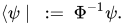
Given a vector let denote the continuous linear functional ; that is,
so that this functional is defined by This map was denoted by earlier in this article.
The assignment is just the isometric antilinear isomorphism which is why holds for all and all scalars
The result of plugging some given into the functional is the scalar which may be denoted by [note 6]
Bra of a linear functional
Given a continuous linear functional let denote the vector ; that is,
The assignment is just the isometric antilinear isomorphism which is why holds for all and all scalars
The defining condition of the vector is the technically correct but unsightly equality
which is why the notation is used in place of With this notation, the defining condition becomes
Kets
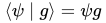
For any given vector the notation is used to denote ; that is,
The assignment is just the identity map which is why holds for all and all scalars
The notation and is used in place of and respectively. As expected, and really is just the scalar
For every the scalar-valued map [note 7] on defined by
is a continuous linear functional on and so by the Riesz representation theorem, there exists a unique vector in denoted by such that or equivalently, such that
The assignment thus induces a function called the adjoint of whose defining condition is
If is finite dimensional with the standard inner product and if is the transformation matrix of with respect to the standard orthonormal basis then 's conjugate transpose is the transformation matrix of the adjoint
It is also possible to define the transpose or algebraic adjoint of which is the map defined by sending a continuous linear functionals to
where the composition is always a continuous linear functional on and it satisfies (this is true more generally, when and are merely normed spaces).[5]
So for example, if then sends the continuous linear functional (defined on by ) to the continuous linear functional (defined on by );[note 7]
using bra-ket notation, this can be written as where the juxtaposition of with on the right hand side denotes function composition:
The adjoint is actually just to the transpose [2] when the Riesz representation theorem is used to identify with and with
Explicitly, the relationship between the adjoint and transpose is:
(Adjoint-transpose)
which can be rewritten as:
Proof
To show that fix
The definition of implies
so it remains to show that If then
as desired.
Alternatively, the value of the left and right hand sides of (Adjoint-transpose) at any given can be rewritten in terms of the inner products as:
so that holds if and only if holds; but the equality on the right holds by definition of
The defining condition of can also be written
if bra-ket notation is used.
Descriptions of self-adjoint, normal, and unitary operatorsedit
Assume and let
Let be a continuous (that is, bounded) linear operator.
Whether or not is self-adjoint, normal, or unitary depends entirely on whether or not satisfies certain defining conditions related to its adjoint, which was shown by (Adjoint-transpose) to essentially be just the transpose
Because the transpose of is a map between continuous linear functionals, these defining conditions can consequently be re-expressed entirely in terms of linear functionals, as the remainder of subsection will now describe in detail.
The linear functionals that are involved are the simplest possible continuous linear functionals on that can be defined entirely in terms of the inner product on and some given vector
Specifically, these are and [note 7] where
A continuous linear operator is called self-adjoint it is equal to its own adjoint; that is, if Using (Adjoint-transpose), this happens if and only if:
where this equality can be rewritten in the following two equivalent forms:
Unraveling notation and definitions produces the following characterization of self-adjoint operators in terms of the aforementioned continuous linear functionals: is self-adjoint if and only if for all the linear functional [note 7] is equal to the linear functional ; that is, if and only if
A continuous linear operator is called normal if which happens if and only if for all
Using (Adjoint-transpose) and unraveling notation and definitions produces[proof 2] the following characterization of normal operators in terms of inner products of continuous linear functionals: is a normal operator if and only if
(Normality functionals)
where the left hand side is also equal to
The left hand side of this characterization involves only linear functionals of the form while the right hand side involves only linear functions of the form (defined as above[note 7]).
So in plain English, characterization (Normality functionals) says that an operator is normal when the inner product of any two linear functions of the first form is equal to the inner product of their second form (using the same vectors for both forms).
In other words, if it happens to be the case (and when is injective or self-adjoint, it is) that the assignment of linear functionals is well-defined (or alternatively, if is well-defined) where ranges over then is a normal operator if and only if this assignment preserves the inner product on
The fact that every self-adjoint bounded linear operator is normal follows readily by direct substitution of into either side of
This same fact also follows immediately from the direct substitution of the equalities (Self-adjointness functionals) into either side of (Normality functionals).
Alternatively, for a complex Hilbert space, the continuous linear operator is a normal operator if and only if for every [2] which happens if and only if
An invertible bounded linear operator is said to be unitary if its inverse is its adjoint:
By using (Adjoint-transpose), this is seen to be equivalent to
Unraveling notation and definitions, it follows that is unitary if and only if
The fact that a bounded invertible linear operator is unitary if and only if (or equivalently, ) produces another (well-known) characterization: an invertible bounded linear map is unitary if and only if
Because is invertible (and so in particular a bijection), this is also true of the transpose This fact also allows the vector in the above characterizations to be replaced with or thereby producing many more equalities. Similarly, can be replaced with or
^If then the inner product will be symmetric so it does not matter which coordinate of the inner product the element is placed into because the same map will result.
But if then except for the constant map, antilinear functionals on are completely distinct from linear functionals on which makes the coordinate that is placed into is very important.
For a non-zero to induce a linear functional (rather than an antilinear functional), must be placed into the antilinear coordinate of the inner product. If it is incorrectly placed into the linear coordinate instead of the antilinear coordinate then the resulting map will be the antilinear map which is not a linear functional on and so it will not be an element of the continuous dual space
^ abThis footnote explains how to define - using only 's operations - addition and scalar multiplication of affine hyperplanes so that these operations correspond to addition and scalar multiplication of linear functionals. Let be any vector space and let denote its algebraic dual space. Let and let and denote the (unique) vector space operations on that make the bijection defined by into a vector space isomorphism. Note that if and only if so is the additive identity of (because this is true of in and is a vector space isomorphism). For every let if and let otherwise; if then so this definition is consistent with the usual definition of the kernel of a linear functional. Say that are parallel if where if and are not empty then this happens if and only if the linear functionals and are non-zero scalar multiples of each other. The vector space operations on the vector space of affine hyperplanes are now described in a way that involves only the vector space operations on ; this results in an interpretation of the vector space operations on the algebraic dual space that is entirely in terms of affine hyperplanes. Fix hyperplanes If is a scalar then Describing the operation in terms of only the sets and is more complicated because by definition, If (respectively, if ) then is equal to (resp. is equal to ) so assume and The hyperplanes and are parallel if and only if there exists some scalar (necessarily non-0) such that in which case this can optionally be subdivided into two cases: if (which happens if and only if the linear functionals and are negatives of each) then while if then Finally, assume now that Then is the unique affine hyperplane containing both and as subsets; explicitly, and To see why this formula for should hold, consider and where and (or alternatively, ). Then by definition, and Now is an affine subspace of codimension in (it is equal to a translation of the -axis ). The same is true of Plotting an --plane cross section (that is, setting constant) of the sets and (each of which will be plotted as a line), the set will then be plotted as the (unique) line passing through the and (which will be plotted as two distinct points) while will be plotted the line through the origin that is parallel to The above formulas for and follow naturally from the plot and they also hold in general.
^Showing that there is a non-zero vector in relies on the continuity of and the Cauchy completeness of This is the only place in the proof in which these properties are used.
^The usual notation for plugging an element into a linear map is and sometimes Replacing with produces or which is unsightly (despite being consistent with the usual notation used with functions). Consequently, the symbol is appended to the end, so that the notation is used instead to denote this value
^ abcdeThe notation denotes the continuous linear functional defined by




































![{\displaystyle {\begin{alignedat}{4}\operatorname {Cong} :\;&&H^{*}&&\;\to \;&{\overline {H}}^{*}\\[0.3ex]&&f&&\;\mapsto \;&{\overline {f}}\\\end{alignedat}}}](https://wikimedia.org/api/rest_v1/media/math/render/svg/eb36a0b08c384fe66f94574963188c0a1dad6df3)


























![{\displaystyle {\begin{alignedat}{4}\Phi :\;&&H&&\;\to \;&H^{*}\\[0.3ex]&&y&&\;\mapsto \;&\langle \,\cdot \,,y\rangle =\langle y|\,\cdot \,\rangle \\\end{alignedat}}}](https://wikimedia.org/api/rest_v1/media/math/render/svg/0e27af5a34637fbf79504e8525a73a7685d4c0d8)
![{\displaystyle {\begin{alignedat}{4}\Phi ^{-1}:\;&&H^{*}&&\;\to \;&H\\[0.3ex]&&\varphi &&\;\mapsto \;&f_{\varphi }\\\end{alignedat}}.}](https://wikimedia.org/api/rest_v1/media/math/render/svg/c7275beb1d1c30539ac8568a3eb02920a56ae97c)



































![{\displaystyle \varphi [(\varphi h)p-(\varphi p)h]~=~\varphi [(\varphi h)p]-\varphi [(\varphi p)h]~=~(\varphi h)\varphi p-(\varphi p)\varphi h=0,}](https://wikimedia.org/api/rest_v1/media/math/render/svg/b0bbf27289eb1fa2e22425b74ff78c3bf25c05e8)
























































![{\displaystyle {\overline {\,{\vec {z}}\,}}^{\operatorname {T} }:=\left[{\overline {z_{1}}},\ldots ,{\overline {z_{n}}}\right]}](https://wikimedia.org/api/rest_v1/media/math/render/svg/22bd4da85e46f1fe1f5a7e0b6abdb1300f468fb4)







![{\displaystyle {\vec {\varphi }}:=\left[\varphi _{1},\ldots ,\varphi _{n}\right]}](https://wikimedia.org/api/rest_v1/media/math/render/svg/147d47a10aa6e42bb6e9d8d0014bcdb1ad0c6e84)



![{\displaystyle \varphi (w)=\varphi _{1}w_{1}+\cdots +\varphi _{n}w_{n}=\left[\varphi _{1},\ldots ,\varphi _{n}\right]{\begin{bmatrix}w_{1}\\\vdots \\w_{n}\end{bmatrix}}={\overline {\begin{bmatrix}{\overline {\varphi _{1}}}\\\vdots \\{\overline {\varphi _{n}}}\end{bmatrix}}}^{\operatorname {T} }{\vec {w}}={\overline {\,{\vec {f_{\varphi }}}\,\,}}^{\operatorname {T} }{\vec {w}}=\left\langle \,\,f_{\varphi }\,\mid \,w\,\right\rangle ,}](https://wikimedia.org/api/rest_v1/media/math/render/svg/99680b4b0812733c07934b441cb0be264bc4468b)






![{\displaystyle {\vec {z}}={\begin{bmatrix}z_{1}\\\vdots \\z_{n}\end{bmatrix}}~\mapsto ~{\overline {\,{\vec {z}}\,}}^{\operatorname {T} }=\left[{\overline {z_{1}}},\ldots ,{\overline {z_{n}}}\right].}](https://wikimedia.org/api/rest_v1/media/math/render/svg/2a23fdc50c15c7972194c18a3ff989ce4fe8f221)




![{\displaystyle {\vec {\varphi }}=\left[\varphi _{1},\ldots ,\varphi _{n}\right]~\mapsto ~{\overline {\,{\vec {\varphi }}\,\,}}^{\operatorname {T} }={\begin{bmatrix}{\overline {\varphi _{1}}}\\\vdots \\{\overline {\varphi _{n}}}\end{bmatrix}}.}](https://wikimedia.org/api/rest_v1/media/math/render/svg/01fd9a7811a1f9ca97c5511f5dac42e49159ecff)
































![{\displaystyle {\begin{alignedat}{4}\operatorname {In} _{H}^{{\overline {H}}^{*}}:\;&&H&&\;\to \;&{\overline {H}}^{*}\\[0.3ex]&&y&&\;\mapsto \;&\langle \,\cdot \mid y\,\rangle =\langle \,y,\cdot \,\rangle \\[0.3ex]\end{alignedat}}}](https://wikimedia.org/api/rest_v1/media/math/render/svg/62715e4539051f8805373fa3099e08644e8577df)



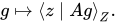
![{\displaystyle {\begin{alignedat}{4}\Phi :\;&&H&&\;\to \;&H^{*}\\[0.3ex]&&g&&\;\mapsto \;&\left\langle \,g\mid \cdot \,\right\rangle _{H}=\left\langle \,\cdot ,g\,\right\rangle _{H}\\\end{alignedat}}}](https://wikimedia.org/api/rest_v1/media/math/render/svg/028e18a1c1d3520d98292b413c114482174776d1)



























![{\displaystyle {\begin{alignedat}{4}\Phi _{H}:\;&&H&&\;\to \;&H^{*}\\[0.3ex]&&g&&\;\mapsto \;&\langle \,g\mid \cdot \,\rangle _{H}\\\end{alignedat}}\quad {\text{ and }}\quad {\begin{alignedat}{4}\Phi _{Z}:\;&&Z&&\;\to \;&Z^{*}\\[0.3ex]&&y&&\;\mapsto \;&\langle \,y\mid \cdot \,\rangle _{Z}\\\end{alignedat}}}](https://wikimedia.org/api/rest_v1/media/math/render/svg/779c55ea574305ef9fcab3fef4790eb65bb7451c)