
Pyrrharctia isabella, the Isabella tiger moth, whose larval form is called the banded woolly bear, woolly bear, or woolly worm, occurs in the United States and southern Canada.[1][2] It was first formally named by James Edward Smith in 1797.
| Isabella tiger moth | |
|---|---|
.jpg)
| |
| Adult | |

| |
| Woolly bear caterpillar | |
Scientific classification 
| |
| Domain: | Eukaryota |
| Kingdom: | Animalia |
| Phylum: | Arthropoda |
| Class: | Insecta |
| Order: | Lepidoptera |
| Superfamily: | Noctuoidea |
| Family: | Erebidae |
| Subfamily: | Arctiinae |
| Genus: | Pyrrharctia |
| Species: | P. isabella
|
| Binomial name | |
| Pyrrharctia isabella (J. E. Smith, 1797)
| |
| Synonyms | |
| |
Description edit
The thirteen-segment larvae are usually covered with brown hair in their mid-regions and black hair in their anterior and posterior areas. In direct sunlight, the brown hair looks bright reddish brown. Adults are generally dull yellowish through orangish and have robust, scaly thoraces; small heads; and bright reddish-orange forelegs. Wings have sparse black spotting.[3]
The isabella tiger moth can be found in many cold and temperate regions. The banded woolly bear larva emerges from the egg in the fall and overwinters in its caterpillar form, by allowing most of its mass to freeze solid. First its heart stops beating, then its gut freezes, then its blood, followed by the rest of the body. It survives being frozen by producing a cryoprotectant in its tissues.[4] This freezing occurs outside of body cells, but not within. In the spring, it thaws.
Larval setae do not inject venom and are not urticant; they do not typically cause irritation, injury, inflammation, or swelling.[5] Handling larvae is discouraged, however, because their sharp, spiny hairs may cause dermatitis in some people.[6]
-
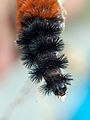 Head of a caterpillar
 -
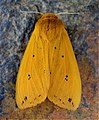 Adult
Adult -
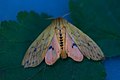 Isabella tiger moth with hindwings
 -
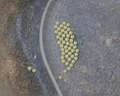 Fresh laid Isabella tiger moth eggs
 -
 Mature Isabella tiger moth eggs


Diet edit
This species is a generalist feeder, consuming many plant species, including herbs and trees.[1] Based on the caterpillars' wide range of food plants, this moth could be found almost anywhere that plants grow.[7]
Related species edit
Singer et al. showed that the larvae of a related moth, Grammia incorrupta (whose larvae are also called "woollybears"), consume alkaloid-laden leaves that help fight off internal parasitic fly larvae. This phenomenon has been proposed to be "the first clear demonstration of self-medication among insects." Within the same family, the larvae of the garden tiger moth (Arctia caja) are also known as woollybear caterpillars and consume an alkaloid diet similar to Grammia incorrupta.[8]
In culture edit
Folklore edit
Canadian and U.S. folklore holds that the relative amounts of brown and black hair on a larva indicate the severity of the coming winter. It is believed that if a Pyrrharctia isabella's brown band is wide, winter weather will be mild, and if the brown band is narrow, the winter will be severe. In a variation of this story, the color of stripes predicts the winter weather, with darker stripes indicating a harsher winter. In reality, hatchlings from the same clutch of eggs can display considerable variation in their color banding, and a larva's brown band tends to widen with age as it molts.[9]
Another version of this belief is that the direction in which a Pyrrharctia isabella crawls indicates the winter weather, with the caterpillar crawling south to escape colder weather. There is no scientific evidence for winter weather prediction by Pyrrharctia isabella.[10]
Woollybear festivals edit
Woollybear festivals are held in several locations in the fall.
- Vermilion, Ohio, in October, begun in 1973, the Woollybear Festival features woollybear costume contests for children and pets and the Woolybear 500 caterpillar races.[11]
- Banner Elk, North Carolina, begun in 1977, features crafts, food, and races. The winning woollybear predicts the winter weather for the following winter.[12]
- Beattyville, Kentucky, begun 1988, called the Woolly Worm Festival, features food, vendors, live music, and a Woolly Worm Race in which people race the woollybear caterpillar up vertical strings.[13][14][15]
- Oil City, Pennsylvania, Woolley Bear Jamboree, begun in 2008, features Oil Valley Vick to predict the winter weather.[16]
- Little Valley, New York, has held a Woolley Bear Weekend [sic] since 2012.[17]
Media edit
The story "Woolly Bear", published in Book 26 (Tramway Engines) of the Rev. W. Awdry's The Railway Series, is so named due to Percy the Small Engine resembling the larval form after becoming covered in hay at the story's conclusion. This story was adapted into an episode of the same name for the second season of Thomas & Friends.
References edit
- ^ a b Robinson, E. & Schmidt, B. C. "Species Details Pyrrharctia isabella". University of Alberta Museums. E.H. Strickland Entomological Museum. Retrieved 8 November 2020.
- ^ "Woolly Worm Festival". Woolly Worm Festival. Retrieved 9 October 2018.
- ^ Beadle, David; Leckie, Seabrooke. (2012). Peterson field guide to moths of northeastern North America. Boston: Houghton Mifflin Harcourt Pub. Company. ISBN 978-0-547-23848-7. OCLC 723141254.
- ^ Layne, Jack R.; Kuharsky, Diane K. (1 March 2000). "Triggering of cryoprotectant synthesis in the woolly bear caterpillar (Pyrrharctia isabella Lepidoptera: Arctiidae)". Journal of Experimental Zoology. 286 (4): 367–371. doi:10.1002/(SICI)1097-010X(20000301)286:4<367::AID-JEZ4>3.0.CO;2-F. PMID 10684559.
- ^ Mullen, Gary Richard; Durden, Lance A. (2002). Medical and Veterinary Entomology. Academic Press. ISBN 0-12-510451-0.[page needed]
- ^ Wagner, David L. (2009). "The Immature Stages: Structure, Function, Behavior, and Ecology". In Conner, William E. (ed.). Tiger Moths and Woolly Bears: Behavior, Ecology, and Evolution of the Arctiidae. Oxford University Press, USA. pp. 31–53. ISBN 978-0-19-532737-3.
- ^ "Isabella Tiger Moth (Woolly Bear; Woolly Worm)". MDC Discover Nature. Archived from the original on 31 March 2016. Retrieved 18 October 2019.
- ^ Singer, Michael S.; Mace, Kevi C.; Bernays, Elizabeth A.; May, Robin Charles (10 March 2009). "Self-Medication as Adaptive Plasticity: Increased Ingestion of Plant Toxins by Parasitized Caterpillars". PLOS ONE. 4 (3): e4796. Bibcode:2009PLoSO...4.4796S. doi:10.1371/journal.pone.0004796. PMC 2652102. PMID 19274098.
- Ed Yong (20 March 2009). "Self-medicating caterpillars use toxic plants to kill parasites". National Geographic.
- ^ Boeckmann, Catherine (28 August 2019). "Woolly Bear Caterpillars and Weather Prediction". Old Farmer's Almana.
- ^ "Woolly Bear Caterpillar - Winter Predictor Or Not?". US Dept of Commerce; National Oceanic and Atmospheric Administration National Weather Service.
- ^ "Woollybear Festival »". vermilionchamber.net. Archived from the original on 20 May 2019. Retrieved 28 September 2018.
- ^ Old Farmer's Almanac. 1999.
- ^ Staff, WLWT Digital (24 October 2019). "Kentucky's prognosticating woolly worm to give its winter forecast". WLWT.
- ^ "Festivals and Events | Welcome to the City of Beattyville, Kentucky". www.beattyville.org.
- ^ "Woolly Worm Festival". Beattyville/Lee County Tourism.
- ^ Robertson, Dan. "Oil Valley Vick & the NWPA Wooly Bear Society". Mystic Outer Rim Society. Archived from the original on 3 March 2016. Retrieved 29 March 2012.
- ^ "Wooly Bear Weekend with Local Manufacturers and Artisans". Cattaraugus County. 24 July 2015. Archived from the original on 1 May 2018. Retrieved 28 September 2018.
External links edit
 Media related to Pyrrharctia isabella at Wikimedia Commons
