Since the lengths of vectors and the angles between them are defined through the inner product, orthogonal transformations preserve lengths of vectors and angles between them. In particular, orthogonal transformations map orthonormal bases to orthonormal bases.
Orthogonal transformations are injective: if then , hence , so the kernel of is trivial.
Orthogonal transformations in two- or three-dimensionalEuclidean space are stiff rotations, reflections, or combinations of a rotation and a reflection (also known as improper rotations). Reflections are transformations that reverse the direction front to back, orthogonal to the mirror plane, like (real-world) mirrors do. The matrices corresponding to proper rotations (without reflection) have a determinant of +1. Transformations with reflection are represented by matrices with a determinant of −1. This allows the concept of rotation and reflection to be generalized to higher dimensions.
In finite-dimensional spaces, the matrix representation (with respect to an orthonormal basis) of an orthogonal transformation is an orthogonal matrix. Its rows are mutually orthogonal vectors with unit norm, so that the rows constitute an orthonormal basis of V. The columns of the matrix form another orthonormal basis of V.
If an orthogonal transformation is invertible (which is always the case when V is finite-dimensional) then its inverse is another orthogonal transformation identical to the transpose of : .
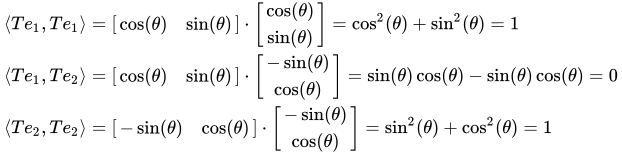
Consider the inner-product space with the standard euclidean inner product and standard basis. Then, the matrix transformation
is orthogonal. To see this, consider
Then,
The previous example can be extended to construct all orthogonal transformations. For example, the following matrices define orthogonal transformations on :