
In mathematics, a real number is said to be simply normal in an integer base b[1] if its infinite sequence of digits is distributed uniformly in the sense that each of the b digit values has the same natural density 1/b. A number is said to be normal in base b if, for every positive integer n, all possible strings n digits long have density b−n.
Intuitively, a number being simply normal means that no digit occurs more frequently than any other. If a number is normal, no finite combination of digits of a given length occurs more frequently than any other combination of the same length. A normal number can be thought of as an infinite sequence of coin flips (binary) or rolls of a die (base 6). Even though there will be sequences such as 10, 100, or more consecutive tails (binary) or fives (base 6) or even 10, 100, or more repetitions of a sequence such as tail-head (two consecutive coin flips) or 6-1 (two consecutive rolls of a die), there will also be equally many of any other sequence of equal length. No digit or sequence is "favored".
A number is said to be normal (sometimes called absolutely normal) if it is normal in all integer bases greater than or equal to 2.
While a general proof can be given that almost all real numbers are normal (meaning that the set of non-normal numbers has Lebesgue measure zero),[2] this proof is not constructive, and only a few specific numbers have been shown to be normal. For example, any Chaitin's constant is normal (and uncomputable). It is widely believed that the (computable) numbers √2, π, and e are normal, but a proof remains elusive.[3]
Definitions edit
Let Σ be a finite alphabet of b-digits, Σω the set of all infinite sequences that may be drawn from that alphabet, and Σ∗ the set of finite sequences, or strings.[4] Let S ∈ Σω be such a sequence. For each a in Σ let NS(a, n) denote the number of times the digit a appears in the first n digits of the sequence S. We say that S is simply normal if the limit
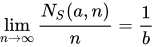
for each a. Now let w be any finite string in Σ∗ and let NS(w, n) be the number of times the string w appears as a substring in the first n digits of the sequence S. (For instance, if S = 01010101..., then NS(010, 8) = 3.) S is normal if, for all finite strings w ∈ Σ∗,
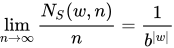
where |w| denotes the length of the string w. In other words, S is normal if all strings of equal length occur with equal asymptotic frequency. For example, in a normal binary sequence (a sequence over the alphabet {0,1}), 0 and 1 each occur with frequency 1⁄2; 00, 01, 10, and 11 each occur with frequency 1⁄4; 000, 001, 010, 011, 100, 101, 110, and 111 each occur with frequency 1⁄8; etc. Roughly speaking, the probability of finding the string w in any given position in S is precisely that expected if the sequence had been produced at random.
Suppose now that b is an integer greater than 1 and x is a real number. Consider the infinite digit sequence expansion Sx, b of x in the base b positional number system (we ignore the decimal point). We say that x is simply normal in base b if the sequence Sx, b is simply normal[5] and that x is normal in base b if the sequence Sx, b is normal.[6] The number x is called a normal number (or sometimes an absolutely normal number) if it is normal in base b for every integer b greater than 1.[7][8]
A given infinite sequence is either normal or not normal, whereas a real number, having a different base-b expansion for each integer b ≥ 2, may be normal in one base but not in another[9][10] (in which case it is not a normal number). For bases r and s with log r / log s rational (so that r = bm and s = bn) every number normal in base r is normal in base s. For bases r and s with log r / log s irrational, there are uncountably many numbers normal in each base but not the other.[10]
A disjunctive sequence is a sequence in which every finite string appears. A normal sequence is disjunctive, but a disjunctive sequence need not be normal. A rich number in base b is one whose expansion in base b is disjunctive:[11] one that is disjunctive to every base is called absolutely disjunctive or is said to be a lexicon. A number normal in base b is rich in base b, but not necessarily conversely. The real number x is rich in base b if and only if the set {x bn mod 1 : n ∈ N} is dense in the unit interval.[11][12]
We defined a number to be simply normal in base b if each individual digit appears with frequency 1⁄b. For a given base b, a number can be simply normal (but not normal or b-dense,[clarification needed]) b-dense (but not simply normal or normal), normal (and thus simply normal and b-dense), or none of these. A number is absolutely non-normal or absolutely abnormal if it is not simply normal in any base.[7][13]
Properties and examples edit
The concept of a normal number was introduced by Émile Borel (1909). Using the Borel–Cantelli lemma, he proved that almost all real numbers are normal, establishing the existence of normal numbers. Wacław Sierpiński (1917) showed that it is possible to specify a particular such number. Becher and Figueira (2002) proved that there is a computable absolutely normal number. Although this construction does not directly give the digits of the numbers constructed, it shows that it is possible in principle to enumerate each digit of a particular normal number.
The set of non-normal numbers, despite being "large" in the sense of being uncountable, is also a null set (as its Lebesgue measure as a subset of the real numbers is zero, so it essentially takes up no space within the real numbers). Also, the non-normal numbers (as well as the normal numbers) are dense in the reals: the set of non-normal numbers between two distinct real numbers is non-empty since it contains every rational number (in fact, it is uncountably infinite[14] and even comeagre). For instance, there are uncountably many numbers whose decimal expansions (in base 3 or higher) do not contain the digit 1, and none of these numbers is normal.
obtained by concatenating the decimal representations of the natural numbers in order, is normal in base 10. Likewise, the different variants of Champernowne's constant (done by performing the same concatenation in other bases) are normal in their respective bases (for example, the base-2 Champernowne constant is normal in base 2), but they have not been proven to be normal in other bases.
obtained by concatenating the prime numbers in base 10, is normal in base 10, as proved by A. H. Copeland and Paul Erdős (1946). More generally, the latter authors proved that the real number represented in base b by the concatenation
where f(n) is the nth prime expressed in base b, is normal in base b. Besicovitch (1935) proved that the number represented by the same expression, with f(n) = n2,
obtained by concatenating the square numbers in base 10, is normal in base 10. Harold Davenport and Erdős (1952) proved that the number represented by the same expression, with f being any non-constant polynomial whose values on the positive integers are positive integers, expressed in base 10, is normal in base 10.
Nakai and Shiokawa (1992) proved that if f(x) is any non-constant polynomial with real coefficients such that f(x) > 0 for all x > 0, then the real number represented by the concatenation
where [f(n)] is the integer part of f(n) expressed in base b, is normal in base b. (This result includes as special cases all of the above-mentioned results of Champernowne, Besicovitch, and Davenport & Erdős.) The authors also show that the same result holds even more generally when f is any function of the form
where the αs and βs are real numbers with β > β1 > β2 > ... > βd ≥ 0, and f(x) > 0 for all x > 0.
Bailey and Crandall (2002) show an explicit uncountably infinite class of b-normal numbers by perturbing Stoneham numbers.
It has been an elusive goal to prove the normality of numbers that are not artificially constructed. While √2, π, ln(2), and e are strongly conjectured to be normal, it is still not known whether they are normal or not. It has not even been proven that all digits actually occur infinitely many times in the decimal expansions of those constants (for example, in the case of π, the popular claim "every string of numbers eventually occurs in π" is not known to be true).[15] It has also been conjectured that every irrational algebraic number is absolutely normal (which would imply that √2 is normal), and no counterexamples are known in any base. However, no irrational algebraic number has been proven to be normal in any base.
Martin (2001) gives an example of an irrational number that is absolutely abnormal.[16] Let
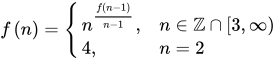

Then α is a Liouville number and is absolutely abnormal.
Non-normal numbers edit
No rational number is normal in any base, since the digit sequences of rational numbers are eventually periodic.
Properties edit
Additional properties of normal numbers include:
- Every non-zero real number is the product of two normal numbers. This follows from the general fact that every number is the product of two numbers from a set if the complement of X has measure 0.
- If x is normal in base b and a ≠ 0 is a rational number, then is also normal in base b.[17]
- If is dense (for every and for all sufficiently large n, ) and are the base-b expansions of the elements of A, then the number , formed by concatenating the elements of A, is normal in base b (Copeland and Erdős 1946). From this it follows that Champernowne's number is normal in base 10 (since the set of all positive integers is obviously dense) and that the Copeland–Erdős constant is normal in base 10 (since the prime number theorem implies that the set of primes is dense).
- A sequence is normal if and only if every block of equal length appears with equal frequency. (A block of length k is a substring of length k appearing at a position in the sequence that is a multiple of k: e.g. the first length-k block in S is S[1..k], the second length-k block is S[k+1..2k], etc.) This was implicit in the work of Ziv and Lempel (1978) and made explicit in the work of Bourke, Hitchcock, and Vinodchandran (2005).
- A number is normal in base b if and only if it is simply normal in base bk for all . This follows from the previous block characterization of normality: Since the nth block of length k in its base b expansion corresponds to the nth digit in its base bk expansion, a number is simply normal in base bk if and only if blocks of length k appear in its base b expansion with equal frequency.
- A number is normal if and only if it is simply normal in every base. This follows from the previous characterization of base b normality.
- A number is b-normal if and only if there exists a set of positive integers where the number is simply normal in bases bm for all [18] No finite set suffices to show that the number is b-normal.
- All normal sequences are closed under finite variations: adding, removing, or changing a finite number of digits in any normal sequence leaves it normal. Similarly, if a finite number of digits are added to, removed from, or changed in any simply normal sequence, the new sequence is still simply normal.








Connection to finite-state machines edit
Agafonov showed an early connection between finite-state machines and normal sequences: every infinite subsequence selected from a normal sequence by a regular language is also normal. In other words, if one runs a finite-state machine on a normal sequence, where each of the finite-state machine's states are labeled either "output" or "no output", and the machine outputs the digit it reads next after entering an "output" state, but does not output the next digit after entering a "no output state", then the sequence it outputs will be normal.[19]
A deeper connection exists with finite-state gamblers (FSGs) and information lossless finite-state compressors (ILFSCs).
- A finite-state gambler (a.k.a. finite-state martingale) is a finite-state machine over a finite alphabet , each of whose states is labelled with percentages of money to bet on each digit in . For instance, for an FSG over the binary alphabet , the current state q bets some percentage of the gambler's money on the bit 0, and the remaining fraction of the gambler's money on the bit 1. The money bet on the digit that comes next in the input (total money times percent bet) is multiplied by , and the rest of the money is lost. After the bit is read, the FSG transitions to the next state according to the input it received. A FSG d succeeds on an infinite sequence S if, starting from $1, it makes unbounded money betting on the sequence; i.e., ifwhere is the amount of money the gambler d has after reading the first n digits of S (see limit superior).
- A finite-state compressor is a finite-state machine with output strings labelling its state transitions, including possibly the empty string. (Since one digit is read from the input sequence for each state transition, it is necessary to be able to output the empty string in order to achieve any compression at all). An information lossless finite-state compressor is a finite-state compressor whose input can be uniquely recovered from its output and final state. In other words, for a finite-state compressor C with state set Q, C is information lossless if the function , mapping the input string of C to the output string and final state of C, is 1–1. Compression techniques such as Huffman coding or Shannon–Fano coding can be implemented with ILFSCs. An ILFSC C compresses an infinite sequence S ifwhere is the number of digits output by C after reading the first n digits of S. The compression ratio (the limit inferior above) can always be made to equal 1 by the 1-state ILFSC that simply copies its input to the output.


![{\displaystyle q_{0}\in [0,1]}](https://wikimedia.org/api/rest_v1/media/math/render/svg/67c29ce857c1053b377d28bf71d6b88a173fe869)


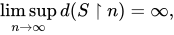


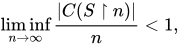

Schnorr and Stimm showed that no FSG can succeed on any normal sequence, and Bourke, Hitchcock and Vinodchandran showed the converse. Therefore:
Ziv and Lempel showed:
(they actually showed that the sequence's optimal compression ratio over all ILFSCs is exactly its entropy rate, a quantitative measure of its deviation from normality, which is 1 exactly when the sequence is normal). Since the LZ compression algorithm compresses asymptotically as well as any ILFSC, this means that the LZ compression algorithm can compress any non-normal sequence.[20]
These characterizations of normal sequences can be interpreted to mean that "normal" = "finite-state random"; i.e., the normal sequences are precisely those that appear random to any finite-state machine. Compare this with the algorithmically random sequences, which are those infinite sequences that appear random to any algorithm (and in fact have similar gambling and compression characterizations with Turing machines replacing finite-state machines).
Connection to equidistributed sequences edit
A number x is normal in base b if and only if the sequence is equidistributed modulo 1,[21][22] or equivalently, using Weyl's criterion, if and only if


This connection leads to the terminology that x is normal in base β for any real number β if and only if the sequence is equidistributed modulo 1.[22]

Notes edit
- ^ The only bases considered here are natural numbers greater than 1
- ^ Beck 2009.
- ^ Bailey & Crandall 2002.
- ^ ω is the smallest infinite ordinal number; ∗ is the Kleene star.
- ^ Bugeaud 2012, p. 78.
- ^ Bugeaud 2012, p. 79.
- ^ a b Bugeaud 2012, p. 102.
- ^ Adamczewski & Bugeaud 2010, p. 413.
- ^ Cassels 1959.
- ^ a b Schmidt 1960.
- ^ a b Bugeaud 2012, p. 92.
- ^ x bn mod 1 denotes the fractional part of x bn.
- ^ Martin 2001.
- ^ Billingsley 2012.
- ^ Bailey et al. 2012.
- ^ Bugeaud 2012, p. 113.
- ^ Wall 1949.
- ^ Long 1957.
- ^ Agafonov 1968.
- ^ Ziv & Lempel 1978.
- ^ Bugeaud 2012, p. 89.
- ^ a b Everest et al. 2003, p. 127.
See also edit
References edit
- Adamczewski, Boris; Bugeaud, Yann (2010), "8. Transcendence and diophantine approximation", in Berthé, Valérie; Rigo, Michael (eds.), Combinatorics, automata, and number theory, Encyclopedia of Mathematics and its Applications, vol. 135, Cambridge: Cambridge University Press, pp. 410–451, ISBN 978-0-521-51597-9, Zbl 1271.11073
- Agafonov, V. N. (1968), "Normal sequences and finite automata", Soviet Mathematics - Doklady, 9: 324–325, Zbl 0242.94040
- Bailey, David H.; Borwein, Jonathan M.; Calude, Cristian S.; Dinneen, Michael J.; Dumitrescu, Monica; Yee, Alex (2012), "An Empirical Approach to the Normality of π", Experimental Mathematics, 21 (4): 375–384, doi:10.1080/10586458.2012.665333, hdl:2292/10566, S2CID 17273684
- Bailey, D. H.; Crandall, R. E. (2002), "Random generators and normal numbers" (PDF), Experimental Mathematics, 11 (4): 527–546, doi:10.1080/10586458.2002.10504704, S2CID 8944421
- Becher, V.; Figueira, S. (2002), "An example of a computable absolutely normal number" (PDF), Theoretical Computer Science, 270 (1–2): 947–958, doi:10.1016/S0304-3975(01)00170-0, hdl:20.500.12110/paper_03043975_v270_n1-2_p947_Becher
- Beck, József (2009), Inevitable Randomness in Discrete Mathematics (illustrated ed.), American Mathematical Soc., p. 13, ISBN 978-0-8218-4756-5
- Besicovitch, A. S. (1935), "The asymptotic distribution of the numerals in the decimal representation of the squares of the natural numbers", Mathematische Zeitschrift, 39: 146–156, doi:10.1007/BF01201350, S2CID 123025145
- Billingsley, Patrick (2012), Probability and measure (Anniversary ed.), Hoboken, N.J.: Wiley, p. 15, ISBN 9781118122372, OCLC 780289503
- Borel, E. (1909), "Les probabilités dénombrables et leurs applications arithmétiques", Rendiconti del Circolo Matematico di Palermo, 27: 247–271, doi:10.1007/BF03019651, S2CID 184479669
- Bourke, C.; Hitchcock, J. M.; Vinodchandran, N. V. (2005), "Entropy rates and finite-state dimension", Theoretical Computer Science, 349 (3): 392–406, CiteSeerX 10.1.1.101.7244, doi:10.1016/j.tcs.2005.09.040
- Bugeaud, Yann (2012), Distribution modulo one and Diophantine approximation, Cambridge Tracts in Mathematics, vol. 193, Cambridge: Cambridge University Press, ISBN 978-0-521-11169-0, Zbl 1260.11001
- Cassels, J. W. S. (1959), "On a problem of Steinhaus about normal numbers", Colloquium Mathematicum, 7: 95–101, doi:10.4064/cm-7-1-95-101
- Champernowne, D. G. (1933), "The construction of decimals normal in the scale of ten", Journal of the London Mathematical Society, 8 (4): 254–260, doi:10.1112/jlms/s1-8.4.254
- Copeland, A. H.; Erdős, P. (1946), "Note on normal numbers", Bulletin of the American Mathematical Society, 52 (10): 857–860, doi:10.1090/S0002-9904-1946-08657-7
- Davenport, H.; Erdős, P. (1952), "Note on normal decimals", Canadian Journal of Mathematics, 4: 58–63, doi:10.4153/CJM-1952-005-3, S2CID 14621341
- Everest, Graham; van der Poorten, Alf; Shparlinski, Igor; Ward, Thomas (2003), Recurrence sequences, Mathematical Surveys and Monographs, vol. 104, Providence, RI: American Mathematical Society, ISBN 0-8218-3387-1, Zbl 1033.11006
- Long, C. T. (1957), "Note on normal numbers", Pacific Journal of Mathematics, 7 (2): 1163–1165, doi:10.2140/pjm.1957.7.1163, Zbl 0080.03604
- Martin, Greg (2001), "Absolutely abnormal numbers", American Mathematical Monthly, 108 (8): 746–754, arXiv:math/0006089, doi:10.2307/2695618, JSTOR 2695618, Zbl 1036.11035
- Murty, Maruti Ram (2007), Problems in analytic number theory (2 ed.), Springer, ISBN 978-0-387-72349-5
- Nakai, Y.; Shiokawa, I. (1992), "Discrepancy estimates for a class of normal numbers", Acta Arithmetica, 62 (3): 271–284, doi:10.4064/aa-62-3-271-284
- Schmidt, W. (1960), "On normal numbers", Pacific Journal of Mathematics, 10 (2): 661–672, doi:10.2140/pjm.1960.10.661
- Schnorr, C. P.; Stimm, H. (1972), "Endliche Automaten und Zufallsfolgen", Acta Informatica, 1 (4): 345–359, doi:10.1007/BF00289514, S2CID 31943843
- Sierpiński, W. (1917), "Démonstration élémentaire d'un théorème de M. Borel sur les nombres absolutment normaux et détermination effective d'un tel nombre", Bulletin de la Société Mathématique de France, 45: 125–132, doi:10.24033/bsmf.977
- Wall, D. D. (1949), Normal Numbers, Ph.D. thesis, Berkeley, California: University of California
- Ziv, J.; Lempel, A. (1978), "Compression of individual sequences via variable-rate coding", IEEE Transactions on Information Theory, 24 (5): 530–536, doi:10.1109/TIT.1978.1055934, hdl:10338.dmlcz/142945
Further reading edit
- Bailey, D. H.; Crandall, R. E. (2001), "On the random character of fundamental constant expansions" (PDF), Experimental Mathematics, 10 (2): 175–190, doi:10.1080/10586458.2001.10504441, S2CID 2694690, archived from the original (PDF) on 2008-11-23
- Bailey, D. H.; Misiurewicz, M. (2006), "A strong hot spot theorem", Proceedings of the American Mathematical Society, 134 (9): 2495–2501, doi:10.1090/S0002-9939-06-08551-0
- Calude, C. (1994), "Borel normality and algorithmic randomness", in Rozenberg, G.; Salomaa, Arto (eds.), Developments in Language Theory: At the Crossroads of Mathematics, Computer Science and Biology, World Scientific, Singapore, pp. 113–119
- Calude, C.S.; Zamfirescu, T. (1999), "Most numbers obey no probability laws", Publicationes Mathematicae Debrecen, 54 (Supplement): 619–623
- Dajani, Karma; Kraaikamp, Cor (2002), Ergodic theory of numbers, Carus Mathematical Monographs, vol. 29, Washington, DC: Mathematical Association of America, ISBN 0-88385-034-6, Zbl 1033.11040
- Harman, Glyn (2002), "One hundred years of normal numbers", in Bennett, M. A.; Berndt, B.C.; Boston, N.; Diamond, H.G.; Hildebrand, A.J.; Philipp, W. (eds.), Surveys in number theory: Papers from the millennial conference on number theory, Natick, MA: A K Peters, pp. 57–74, ISBN 1-56881-162-4, Zbl 1062.11052
- Khoshnevisan, Davar (2006), "Normal numbers are normal" (PDF), Clay Mathematics Institute Annual Report 2006: 15, continued pp. 27–31
- Quéfflec, Martine (2006), "Old and new results on normality", in Denteneer, Dee; den Hollander, F.; Verbitskiy, E. (eds.), Dynamics & Stochastics: Festschrift in honor of M. S. Keane, IMS Lecture Notes – Monograph Series, vol. 48, Beachwood, Ohio: Institute of Mathematical Statistics, pp. 225–236, arXiv:math.DS/0608249, doi:10.1214/074921706000000248, ISBN 0-940600-64-1, Zbl 1130.11041