
Nepenthes mirabilis (/nɪˈpɛnθiːz mɪˈræbɪlɪs/; from Latin mirabilis "wonderful"), or the common swamp pitcher-plant[13] and tropical pitcher plant,[14] is a carnivorous plant species. By far the most widespread of all Nepenthes, its range covers continental Southeast Asia and all major islands of the Malay Archipelago (minus the Lesser Sunda Islands and northern Philippines), stretching from China in the north to Australia in the south.[15] The species exhibits great variability throughout its range. One of the more notable varieties, N. mirabilis var. echinostoma, is endemic to Brunei and Sarawak and possesses an extremely wide peristome.[16]
| Nepenthes mirabilis | |
|---|---|
.jpg)
| |
| An upper pitcher of Nepenthes mirabilis | |
Scientific classification 
| |
| Kingdom: | Plantae |
| Clade: | Tracheophytes |
| Clade: | Angiosperms |
| Clade: | Eudicots |
| Order: | Caryophyllales |
| Family: | Nepenthaceae |
| Genus: | Nepenthes |
| Species: | N. mirabilis
|
| Binomial name | |
| Nepenthes mirabilis | |

| |
| Distribution of N. mirabilis. | |
| Synonyms | |
| |
The conservation status of N. mirabilis is listed as Least Concern on the IUCN Red List.[1] In Hong Kong, it is a protected species under Forestry Regulations Cap. 96A.
According to Matthew Jebb and Martin Cheek, the pitchers of N. mirabilis are used as toy phallocrypts in New Guinea.
Distribution edit
Nepenthes mirabilis has by far the widest distribution of any Nepenthes species and is known from the following countries and regions: Australia (Cape York Peninsula), Borneo, Cambodia, Caroline Islands (Palau and Yap), China (Guangdong Province, Hainan,[17][18] Hong Kong, and Macau), D'Entrecasteaux Islands, Java, Laos, Louisiade Archipelago, Maluku Islands, Myanmar, New Guinea, Peninsular Malaysia, Philippines (Dinagat and Mindanao), Sulawesi, Sumatra, Thailand, and Vietnam.[15][19][20][21][22][23][24][25] It has also been recorded from many smaller islands, including Babi, Bangka, Banyak Islands, Batu Islands, Bengkalis, Enggano, Ko Lanta, Ko Tarutao, Langkawi, Mendol, Mentawai Islands (North Pagai, Siberut, Sipura, and South Pagai), Meranti Islands (Padang, Rangsang, and Tebing Tinggi), Nias, Penang, Phuket, Riau Islands (Lingga Islands and Riau Archipelago), Rupat,[26] Tawi-Tawi,[27] and possibly Wowoni.[28]
Taxonomy edit
Nepenthes mirabilis is closely related to N. rowaniae, N. tenax and N. parvula, the only three Nepenthes species endemic to Australia.
| Character | N. mirabilis | N. rowaniae |
|---|---|---|
| Morphology of leaf blade | Acute to rounded | Contracted towards the apex, then continuing along the tendril as a narrow, acute, extension |
| Insertion of tendril to leaf blade | Simple | Peltate |
| Pitcher wings | Simple, bearing multicellular fringe elements | Often flattened at front, forming a T-shape in XS, multicellular fringe elements often present |
| Leaf blade texture | Usually chartaceous | Strongly coriaceous |
| Leaf blade attachment to stem | Simple, or rarely decurrent for ⅓ the length of the internode | Decurrent for at least ½ the length of the internode, usually more |
| Gland density in lower portion of pitcher | 1600-2500 / cm2 | Approximately 3600 / cm2 |
| Position of pitcher hip in upper pitchers | Mid-way, to lower half | Upper quarter |
| Position of pitcher hip in lower pitchers | Lower third to quarter | Immediately beneath peristome |
In his Carnivorous Plant Database, taxonomist Jan Schlauer treats N. kongkandana as a synonym of N. mirabilis.[29]
Infraspecific taxa edit
Across its range, N. mirabilis exhibits great variability in terms of pitcher morphology and colour, and it has the most synonyms of all Nepenthes species.[30] The following forms and varieties of N. mirabilis have been described. With the exception of N. mirabilis var. echinostoma and N. mirabilis var. globosa, these taxa are not considered valid today.
- Nepenthes mirabilis f. anamensis (Hort.Weiner) Hort.Westphal (1991)
- Nepenthes mirabilis var. anamensis Hort.Weiner in sched. (1985) nom.nud.
- Nepenthes mirabilis var. biflora J.H.Adam & Wilcock (1992)
- Nepenthes mirabilis var. echinostoma (Hook.f.) Hort.Slack ex J.H.Adam & Wilcock (1992)
- Nepenthes mirabilis var. globosa M.Catal. (2010)[31]
- Nepenthes mirabilis f. simensis (Hort.Weiner) Hort.Westphal (1991)
- Nepenthes mirabilis var. simensis Hort.Weiner in sched. (1985) nom.nud.
- Nepenthes mirabilis f. smilesii (Hemsl.) Hort.Westphal (2000)
- Nepenthes mirabilis var. smilesii (Hemsl.) Hort.Weiner in sched. (1985)
N. mirabilis var. echinostoma edit

Nepenthes mirabilis var. echinostoma was discovered by Odoardo Beccari in 1865 and described as a species, N. echinostoma, by Joseph Dalton Hooker in 1873.[13] In 1882, Frederick William Burbidge described this unusual variety in The Gardeners' Chronicle as follows:[13][32]
Beccari's singular N. echinostoma (vide Herb. Kew) is a wonderful thing, as yet unintroduced—indeed, I suppose unseen by any save Beccari ! The mouths of the urns remind one of the deflexed teeth of some gigantic moss of the Hypnoid section.
Nepenthes mirabilis var. echinostoma is the only form of this species that occurs in Brunei. It has also been recorded from parts of Sarawak, but appears to be completely absent from Sabah.[13]
N. mirabilis var. globosa edit

.jpg)
.jpg)
Nepenthes mirabilis var. globosa has been recorded from a single undisclosed Andaman Sea island off Phang Nga and from the Thai mainland near the city of Trang.[15][31][33]
This variety was featured on the cover of the January 2006 issue of the Journal of Insectivorous Plant Society, identified as "Nepenthes sp. from Thailand".[34] The name Nepenthes globosa appeared in print in an article by Shigeo Kurata in the July 2007 issue of the Journal of the Insectivorous Plant Society.[9] The same issue also featured an article by Masahiro Tada that referred to the plant as "Nepenthes Viking".[12] Prior to its description by Marcello Catalano in 2010, this taxon was also published under the informal name Nepenthes sp. Phanga Nga in Stewart McPherson's 2009 book, Pitcher Plants of the Old World.[15]
In the horticultural trade, this variety is popularly known as both Nepenthes globosa[15] (/nɪˈpɛnθiːz ɡloʊˈboʊzə/; from Latin: globosus, "globular") and Nepenthes sp. Viking,[15][35] after the resemblance the pitchers bear to the prow of a Viking ship.[36]
Pitcher infauna edit
A great number of infaunal organisms have been found in the pitchers of this species. These include the sarcophagid fly Sarcophaga papuensis and the mite Nepenthacarus warreni, which have both been found in Australian populations of the plant.[37][38] Similarly, the mosquitoes Aedes dybasi and Aedes maehleri reside in the pitchers of N. mirabilis on the islands of Palau and Yap, respectively.[39] Both have unusual life histories and morphological traits associated with this habit.[40][41]
The nematode Baujardia mirabilis has been described from N. mirabilis in Thailand. It is not thought to be accidental; the pitchers of this species appear to be the nematode's natural habitat. The microecosystems in these pitchers were found to be dominated by mosquito larvae, midges, and B. mirabilis. It is speculated that this nematode might have a phoretic relationship with one or more infaunal insect species.[42]
In southern China, tree frogs have been observed in the pitchers of N. mirabilis. The amphibians do not fall prey to the plant, but rather feed on insects that are caught by the pitchers.[43] They are not affected by the acidic digestive juices (which may have a pH as low as 2), likely due to the mucilaginous outer layer of their skin.[44]
The first record of an aquatic fungus living in the pitcher organ of a carnivorous plant came from a specimen of N. mirabilis growing along the Jardine River in Australia. The mycelial fungus was observed as both free-living in the trap's fluid and attached to chitinous insect remains.[45][46]
The pitchers of N. mirabilis have also been found to harbour a complex community of bacteria.[47] These bacterial communities appear to be more diverse than those found in the pitcher fluid of N. ampullaria and sympatric N. gracilis in Peninsular Malaysia.[48] In N. mirabilis their composition can also differ significantly according to pitcher type, something not seen in the other two species.[48]
Natural hybrids edit
Nepenthes mirabilis has the greatest number of known natural hybrids of any species in the genus.[15]
- ? (N. alata × N. merrilliana) × N. mirabilis [=N. × tsangoya][49]
- N. alata × N. mirabilis [=N. × mirabilata][50][51]
- N. ampullaria × N. mirabilis [=N. × kuchingensis, Nepenthes cutinensis][16]
- ? (N. ampullaria × N. rafflesiana) × N. mirabilis [=N. × hookeriana × N. mirabilis][52]
- N. andamana × N. mirabilis[53] (including N. andamana × N. mirabilis var. globosa)[53]
- N. benstonei × N. mirabilis[54]
- N. bicalcarata × N. mirabilis[15] (including N. bicalcarata × N. mirabilis var. echinostoma)[16]
- ? (N. bicalcarata × N. rafflesiana) × N. mirabilis var. echinostoma[16]
- N. gracilis × N. mirabilis [=N. × sharifah-hapsahii, N. × ghazallyana, N. × grabilis, N. neglecta?][15][16][55]
- N. insignis × N. mirabilis[56]
- N. kampotiana × N. mirabilis[53]
- N. kongkandana × N. mirabilis[53]
- N. merrilliana × N. mirabilis[15]
- N. mirabilis × N. northiana[57][58]
- N. mirabilis × N. rafflesiana[16] (including N. mirabilis var. echinostoma × N. rafflesiana)[58]
- N. mirabilis × N. reinwardtiana[58]
- N. mirabilis × N. rowaniae[59]
- N. mirabilis × N. smilesii[60]
- N. mirabilis × N. spathulata[54]
- N. mirabilis × N. sumatrana[15]
- N. mirabilis × N. tenax[15]
- N. mirabilis × N. thorelii[60][61][62][63]
- N. mirabilis × N. tomoriana[15]
-

-
 N. benstonei × N. mirabilis
 -
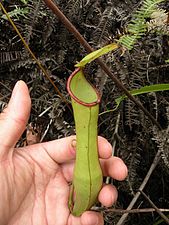
-
 N. mirabilis × N. northiana
 -
 N. mirabilis × N. rafflesiana
 -
 N. mirabilis var. echinostoma × N. rafflesiana
 -
 N. mirabilis × N. sumatrana
 -
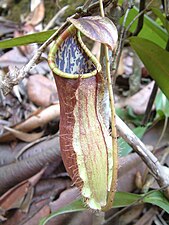 ? N. mirabilis × N. tomoriana


-
 ? N. mirabilis × N. thorelii

Notes edit
- a.^ Nepenthes mirabilis was first described under the Linnaean taxonomic system as Phyllamphora mirabilis by João de Loureiro in 1790. It was then transferred to the genus Nepenthes under the incorrect combination Nepenthes phyllamphora by Carl Ludwig Willdenow in 1805. Most sources[15][16][51][54][64] attribute the earliest publication of the correct binomial—Nepenthes mirabilis—to George Claridge Druce in 1916,[65] despite Jan Schlauer's Carnivorous Plant Database recording a much earlier publication by Rafarin in 1869.[66] Per Article 36.1[67] of the International Code of Nomenclature for algae, fungi and plants, the publication of the name by Rafarin is not valid because Rafarin specifically indicates that N. mirabilis is a synonym of Phyllamphora mirabilis.
References edit
- ^ a b Clarke, C.M. (2014). "Nepenthes mirabilis". IUCN Red List of Threatened Species. 2014: e.T49122515A21844202. doi:10.2305/IUCN.UK.2014-1.RLTS.T49122515A21844202.en. Retrieved 19 November 2021.
- ^ Danser, B.H. 1928. 1. Nepenthes alata Blanco. [pp. 258–262] In: The Nepenthaceae of the Netherlands Indies. Bulletin du Jardin Botanique de Buitenzorg, Série III, 9(3–4): 249–438.
- ^ Cheek, M. & M. Jebb 2013. Typification and redelimitation of Nepenthes alata with notes on the N. alata group, and N. negros sp. nov. from the Philippines. Nordic Journal of Botany 31(5): 616–622. doi:10.1111/j.1756-1051.2012.00099.x
- ^ Clarke, C. & C.C. Lee 2012. A revision of Nepenthes (Nepenthaceae) from Gunung Tahan, Peninsular Malaysia. Archived 2013-10-07 at the Wayback Machine Gardens' Bulletin Singapore 64(1): 33–49.
- ^ Schlauer, J. N.d. Nepenthes alata. Carnivorous Plant Database.
- ^ Bailey, F.M. 1881. On a new species of Nepenthes. The Proceedings of the Linnean Society of New South Wales 5: 185–187.
- ^ a b (in Latin) Hooker, J.D. 1873. Ordo CLXXV bis. Nepenthaceæ. In: A. de Candolle Prodromus Systematis Naturalis Regni Vegetabilis 17: 90–105.
- ^ a b c d (in Latin) Blume, C.L. 1852. Ord. Nepenthaceae. In: Museum Botanicum Lugduno-Batavum, sive stirpium exoticarum novarum vel minus cognitarum ex vivis aut siccis brevis expositio. Tom. II. Nr. 1. E.J. Brill, Lugduni-Batavorum. pp. 5–10.
- ^ a b (in Japanese) Kurata, S. 2007. ネペンテス ・ ノート (XIV) — Nepenthes globosa のネーミングについて. Journal of Insectivorous Plant Society 58(3): 76.
- ^ Macfarlane, J.M. 1908. Nepenthaceae. In: A. Engler. Das Pflanzenreich IV, III, Heft 36: 1–91.
- ^ (in French) Teysmann, M.J.E. 1859. Énumération des plantes envoyées de Java au jardin botanique de l'Université de Leide. Annales d'horticulture et de botanique, ou Flore des jardins du royaume des Pays-Bas, et histoire des plantes cultivées les plus intéressantes des possessions néerlandaises aux Indes orientales, de l'Amérique et du Japon 2: 133–142.
- ^ a b (in Japanese) Tada, M. 2007. 日本における Nepenthes Viking の渡来と現状について. Journal of Insectivorous Plant Society 58(3): 75.
- ^ a b c d Phillipps, A. & A. Lamb 1996. Pitcher-Plants of Borneo. Natural History Publications (Borneo), Kota Kinabalu.
- ^ http://florawww.eeb.uconn.edu/200900010.html UConn Plant Biodiversity Conservatory and Research Core
- ^ a b c d e f g h i j k l m n McPherson, S.R. 2009. Pitcher Plants of the Old World. 2 volumes. Redfern Natural History Productions, Poole.
- ^ a b c d e f g Clarke, C.M. 1997. Nepenthes of Borneo. Natural History Publications (Borneo), Kota Kinabalu.
- ^ Nepenthes mirabilis. Flora of China.
- ^ (in Chinese) Yang G., Huang S., Xu S. & Gao Y. 2006. 海南岛野生猪笼草资源调查及其营养成分分析. [The investigation and study on the germplasm resources and growth of the wild common Nepenthes in Hainan.] Chinese Agricultural Science Bulletin 22(11): 440–442. Abstract Archived 2021-03-25 at the Wayback Machine
- ^ Slack, A. 1979. Nepenthes mirabilis. In: Carnivorous Plants. Ebury Press, London. pp. 79–80.
- ^ McPherson, S.R. & V.B. Amoroso 2011. Field Guide to the Pitcher Plants of the Philippines. Redfern Natural History Productions, Poole.
- ^ McPherson, S.R. & A. Robinson 2012. Field Guide to the Pitcher Plants of Borneo. Redfern Natural History Productions, Poole.
- ^ McPherson, S.R. & A. Robinson 2012. Field Guide to the Pitcher Plants of Sulawesi. Redfern Natural History Productions, Poole.
- ^ McPherson, S.R. & A. Robinson 2012. Field Guide to the Pitcher Plants of Peninsular Malaysia and Indochina. Redfern Natural History Productions, Poole.
- ^ McPherson, S.R. & A. Robinson 2012. Field Guide to the Pitcher Plants of Australia and New Guinea. Redfern Natural History Productions, Poole.
- ^ McPherson, S.R. & A. Robinson 2012. Field Guide to the Pitcher Plants of Sumatra and Java. Redfern Natural History Productions, Poole.
- ^ Clarke, C.M. 2001. Appendix C: Distribution Maps. In: Nepenthes of Sumatra and Peninsular Malaysia. Natural History Publications (Borneo), Kota Kinabalu. pp. 299–307.
- ^ Cheek, M. & M. Jebb 2013. Recircumscription of the Nepenthes alata group (Caryophyllales: Nepenthaceae), in the Philippines, with four new species. European Journal of Taxonomy 69: 1–23. doi:10.5852/ejt.2013.69
- ^ (in Indonesian) Sunarti, S., A. Hidayat & Rugayah 2008. Keanekaragaman tumbuhan di hutan Pegunungan Waworete, Kecamatan Wawonii Timur, Pulau Wawonii, Sulawesi Tenggara. [Plants diversity at the mountain forest of Waworete, East Wawonii District, Wawonii Island, Southeast Sulawesi.] Biodiversitas 9(3): 194–198.
- ^ Schlauer, J. N.d. Nepenthes kongkandana Archived 2013-12-28 at the Wayback Machine. Carnivorous Plant Database.
- ^ Catalano, M. 2009. Nepenthes. In: Growing Carnivores — an Italian perspective. Prague. pp. 50–57.
- ^ a b Catalano, M. 2010. "Nepenthes mirabilis var. globosa M. Catal. var. nov" (PDF). In: Nepenthes della Thailandia: Diario di viaggio. Prague. p. 40.
- ^ Burbidge, F.W. 1882. Notes on the new Nepenthes. The Gardeners' Chronicle, new series, 17(420): 56.
- ^ Mey, F.S. 2014. 'Nepenthes of Indochina', my 2010 ICPS lecture now on YouTube. Strange Fruits: A Garden's Chronicle, February 3, 2014.
- ^ (in Japanese) Cover of the January 2006 issue of the Journal of Insectivorous Plant Society. Insectivorous Plant Society.
- ^ Mey, F.S. 2011. Nepenthes mirabilis var. globosa, a popular plant?. Strange Fruits: A Garden's Chronicle, December 24, 2011.
- ^ Guerini, M. 2011. "2010: new species of Carnivorous Plants" (PDF). Associazione Italiana Piante Carnivore.
- ^ Yeates, D.K., H. de Souza Lopes & G.B. Monteith 1989. A commensal sarcophagid (Diptera: Sarcophagidae) in Nepenthes mirabilis (Nepenthaceae) pitchers in Australia. Australian Entomological Magazine 16: 33–39.
- ^ Fashing, N.J. 2002. "Nepenthacarus, a new genus of Histiostomatidae (Acari: Astigmata) inhabiting the pitchers of Nepenthes mirabilis (Lour.) Druce in Far North Queensland, Australia" (PDF). (1.64 MB) Australian Journal of Entomology 41(1): 7–17. doi:10.1046/j.1440-6055.2002.00263.x
- ^ Sota, T. & M. Mogi 2006. Origin of pitcher plant mosquitoes in Aedes (Stegomyia): a molecular phylogenetic analysis using mitochondrial and nuclear gene sequences. Journal of Medical Entomology 43(5): 795–800. doi:10.1603/0022-2585(2006)43[795:OOPPMI2.0.CO;2]
- ^ Bohart, R.M. 1956. "Insects of Micronesia. Diptera: Culicidae" (PDF). Insects Micronesia 12(1): 1–85.
- ^ Mogi, M. 2010. Unusual life history traits of Aedes (Stegomyia) mosquitoes (Diptera: Culicidae) inhabiting Nepenthes pitchers. Annals of the Entomological Society of America 103(4): 618–624. doi:10.1603/AN10028
- ^ Bert, W., I.T. De Ley, R. Van Driessche, H. Segers & P. De Ley 2003. "Baujardia mirabilis gen. n., sp. n. from pitcher plants and its phylogenetic position within Panagrolaimidae (Nematoda: Rhabditida)" (PDF).[permanent dead link] Nematology 5(3): 405–420. doi:10.1163/156854103769224395
- ^ Hua, Y. & H. Li 2005. "Food web and fluid in pitchers of Nepenthes mirabilis in Zhuhai, China" (PDF). Archived from the original (PDF) on 2010-06-12. Retrieved 2008-08-25. Acta Botanica Gallica 152(2): 165–175.
- ^ Hua, Y. & L. Kuizheng 2004. "The Special Relationship Between Nepenthes and Tree Frogs" (PDF). Carnivorous Plant Newsletter 33(1): 23–24.
- ^ Cribbs, A.B. 1987. An aquatic fungus from pitchers of Nepenthes mirabilis. Queensland Naturalist 28: 72–73.
- ^ Schnell, D.E. 1992. Literature Review. Carnivorous Plant Newsletter 21(3): 80–82.
- ^ Yogiara, A. Suwanto & M.T. Suhartono 2006. A complex bacterial community living in pitcher plant fluid. Jurnal Mikrobiologi Indonesia 11(1): 9–14.
- ^ a b Chou, L.Y., C.M. Clarke & G.A. Dykes 2014. Bacterial communities associated with the pitcher fluids of three Nepenthes (Nepenthaceae) pitcher plant species growing in the wild. Archives of Microbiology 196(10): 709–717. doi:10.1007/s00203-014-1011-1
- ^ Lauffenburger, A. 1995. Guide to Nepenthes Hybrids. OmnisTerra.
- ^ Kurata, S. & M. Toyoshima 1972. Philippine species of Nepenthes. The Gardens' Bulletin Singapore 26(1): 155–158. Abstract Archived 2011-07-22 at the Wayback Machine
- ^ a b Cheek, M.R. & M.H.P. Jebb 2001. Nepenthaceae. Flora Malesiana 15: 1–157.
- ^ Lowrie, A. 1983. "Sabah Nepenthes Expeditions 1982 & 1983" (PDF). (1.25 MB) Carnivorous Plant Newsletter 12(4): 88–95.
- ^ a b c d (in Italian) Catalano, M. 2010. Nepenthes della Thailandia: Diario di viaggio. Prague.
- ^ a b c Clarke, C.M. 2001. Nepenthes of Sumatra and Peninsular Malaysia. Natural History Publications (Borneo), Kota Kinabalu.
- ^ Fretwell, S. 2013. Back in Borneo to see giant Nepenthes. Part 2: Mt Tambuyukon and Poring. Victorian Carnivorous Plant Society Journal 108: 6–15.
- ^ Rischer, H. 1995. "Observations on the Nepenthes species of Irian Jaya, Part I: Nepenthes insignis Danser" (PDF). (461 KB) Carnivorous Plant Newsletter 24(3): 75–77.
- ^ Lee, C.C. 2007. Re: The most accessible limestone hill of Bau Archived 2013-12-28 at the Wayback Machine. Carnivorous Plants in the tropics.
- ^ a b c Phillipps, A., A. Lamb & C.C. Lee 2008. Pitcher Plants of Borneo. Second Edition. Natural History Publications (Borneo), Kota Kinabalu.
- ^ Clarke, C.M. & R. Kruger 2005. Nepenthes rowanae (Nepenthaceae), a remarkable species from Cape York, Australia. Carnivorous Plant Newsletter 34(2): 36–41.
- ^ a b Mey, F.S., L.H. Truong, D.V. Dai & A.S. Robinson 2011. Nepenthes thorelii, an emended description and novel ecological data resulting from its rediscovery in Tay Ninh, Vietnam. In: McPherson, S.R. New Nepenthes: Volume One. Redfern Natural History Productions, Poole. pp. 104–131.
- ^ Bednar, B. 1983. "Nepenthes mirabilis variation" (PDF). (111 KB) Carnivorous Plant Newsletter 12(3): 64.
- ^ N. thorelii rediscovered Archived 2012-02-23 at the Wayback Machine. Carnivorous Plants in the tropics.
- ^ Mey, F.S. 2012. Virtual Nepenthes herbarium on "Europeana". Strange Fruits: A Garden's Chronicle, December 19, 2012.
- ^ Danser, B.H. 1928. The Nepenthaceae of the Netherlands Indies. Bulletin du Jardin Botanique de Buitenzorg, Série III, 9(3–4): 249–438.
- ^ Druce, G. 1916. Nepenthes mirabilis. In: Botanical Exchange Club of the British Isles Report 4: 637.
- ^ Schlauer, J. N.d. Nepenthes mirabilis Archived 2013-12-24 at the Wayback Machine. Carnivorous Plant Database.
- ^ Turland, N.J.; et al., eds. (2018). International Code of Nomenclature for algae, fungi, and plants (Shenzhen Code) adopted by the Nineteenth International Botanical Congress Shenzhen, China, July 2017 (electronic ed.). Glashütten: International Association for Plant Taxonomy. Retrieved 2023-09-06..
- Adam, J.H. & C.C. Wilcock 1992. Nepenthes mirabilis (Loureiro) Druce from Borneo. Malayan Nature Journal 46(2): 75–84.
- Bourke, G. & R. Nunn 2012. Nepenthes. In: Australian Carnivorous Plants. Redfern Natural History Productions, Poole. pp. 148–167.
- Clarke, C.M. 2001. A Guide to the Pitcher Plants of Sabah. Natural History Publications (Borneo), Kota Kinabalu.
- Clarke, C.M. 2006. Introduction. In: Danser, B.H. The Nepenthaceae of the Netherlands Indies. Natural History Publications (Borneo), Kota Kinabalu. pp. 1–15.
- Co, L. & W. Suarez 2012. Nepenthaceae. Co's Digital Flora of the Philippines.
- (in German) Gronemeyer, T. 2008. Nepenthes auf den Philippinen – Ein Reisebericht. Das Taublatt 60(1): 15–27.
- Hernawati & P. Akhriadi 2006. A Field Guide to the Nepenthes of Sumatra. PILI-NGO Movement, Bogor.
- Korthals, P.W. 1839. Over het geslacht Nepenthes. In: C.J. Temminck 1839–1842. Verhandelingen over de Natuurlijke Geschiedenis der Nederlandsche overzeesche bezittingen; Kruidkunde. Leiden. pp. 1–44, t. 1–4, 13–15, 20–22.
- Lowrie, A. 1998. Nepenthes mirabilis. In: Carnivorous Plants of Australia. Volume 3. University of Western Australia Press, Nedlands. pp. 276–279.
- Lowrie, A. 2013. Nepenthes mirabilis (Lour.) Druce. In: Carnivorous Plants of Australia Magnum Opus - Volume Three. Redfern Natural History Productions, Poole. pp. 902–905.
- Macfarlane, J.M. 1927. The Philippine species of Nepenthes. The Philippine Journal of Science 33(2): 127–140.
- (in German) McPherson, S. & T. Gronemeyer 2008. Die Nepenthesarten der Philippinen Eine Fotodokumentation. Das Taublatt 60(1): 34–78.
- Nunn, R. & C.N.A. Vu 2016. An account of the Nepenthes species of Vietnam. Carnivorous Plant Newsletter 45(3): 93–101.
- (in Japanese) Oikawa, T. 1992. Nepenthes mirabilis Druce. In: Muyū kusa – Nepenthes (無憂草 – Nepenthes). [The Grief Vanishing.] Parco Co., Japan. pp. 26–29.
- Shivas, R.G. 1984. Pitcher Plants of Peninsular Malaysia & Singapore. Maruzen Asia, Kuala Lumpur.
- Thorogood, C. 2010. The Malaysian Nepenthes: Evolutionary and Taxonomic Perspectives. Nova Science Publishers, New York.
- Nepenthes of Australia[permanent dead link] by Stewart McPherson
Further reading edit
- [Anonymous] 1877. Reports of Societies. Royal Horticultural. The Gardeners' Chronicle 8(197): 441.
- [Anonymous] 2010. Eramet-PT Weda Bay Nickel Exploration and Development ESIA. ERM Indonesia, Jakarta.
- Adam, J.H. 1997. "Prey spectra of Bornean Nepenthes species (Nepenthaceae) in relation to their habitat" (PDF). Pertanika Journal of Tropical Agricultural Science 20(2–3): 121–134.
- Adam, J.H. & C.C. Wilcock 1999. "Palynological study of Bornean Nepenthes (Nepenthaceae)" (PDF). Pertanika Journal of Tropical Agricultural Science 22(1): 1–7.
- Adam, J.H., C.C. Wilcock & M.D. Swaine 1989. Ecology and taxonomy of Bornean Nepenthes. University of Aberdeen Tropical Biology Newsletter 56: 2–4.
- Adam, J.H., C.C. Wilcock & M.D. Swaine 1992. "The ecology and distribution of Bornean Nepenthes" (PDF). Archived from the original (PDF) on 2011-07-22. Journal of Tropical Forest Science 5(1): 13–25.
- Adam, J.H., E.M. Nurulhuda, H. Abdul-Halim, O. Abdul-Rahim, A.H. Hafiza, G.K. Gopir, L.M. Pilik, R. Omar, M.B. Qasim, J. Salimon, S. Abdul-Rahim & M.M. Hanafiah 2005. Pitcher plants recorded from BRIS forest in Jambu Bongkok, Kuala Trengganu, Malaysia. Wetland Science 3(3): 183–189.
- (in Indonesian) Akhriadi, P. 2007. Kajian taksonomi hibrid alami Nepenthes (Nepenthaceae) di Kerinci. Working paper, Andalas University, Padang.
- (in Indonesian) Baloari, G., R. Linda & Mukarlina 2013. Keanekaragaman jenis dan pola distribusi Nepenthes spp di Gunung Semahung Kecamatan Sengah Temila Kabupaten Landak. Protobiont 2(1): 1–6. Abstract
- Bauer, U., C.J. Clemente, T. Renner & W. Federle 2012. Form follows function: morphological diversification and alternative trapping strategies in carnivorous Nepenthes pitcher plants. Journal of Evolutionary Biology 25(1): 90–102. doi:10.1111/j.1420-9101.2011.02406.x
- Beaman, J.H. & C. Anderson 2004. The Plants of Mount Kinabalu: 5. Dicotyledon Families Magnoliaceae to Winteraceae. Natural History Publications (Borneo), Kota Kinabalu.
- Bednar, B.L. 1983. "Nepenthes mirabilis variation" (PDF). (111 KB) Carnivorous Plant Newsletter 12(3): 64.
- Bednar, B.L. 1985. "An unusual mirabilis plant" (PDF). Carnivorous Plant Newsletter 14(4): 91.
- Bednar, B.L. 1985. "Nepenthes ✕ dominii and var. intermedia" (PDF). Carnivorous Plant Newsletter 14(4): 105–106.
- Benz, M.J., E.V. Gorb & S.N. Gorb 2012. Diversity of the slippery zone microstructure in pitchers of nine carnivorous Nepenthes taxa. Arthropod-Plant Interactions 6(1): 147–158. doi:10.1007/s11829-011-9171-2
- Beveridge, N.G.P., C. Rauch, P.J.A. Keßler, R.R. van Vugt & P.C. van Welzen 2013. A new way to identify living species of Nepenthes (Nepenthaceae): more data needed! Carnivorous Plant Newsletter 42(4): 122–128.
- Bonhomme, V., H. Pelloux-Prayer, E. Jousselin, Y. Forterre, J.-J. Labat & L. Gaume 2011. Slippery or sticky? Functional diversity in the trapping strategy of Nepenthes carnivorous plants. New Phytologist 191(2): 545–554. doi:10.1111/j.1469-8137.2011.03696.x
- (in French) Brongniart, A. 1824. Observations sur les genres Cytinus et Nepenthes. Annales des Sciences Naturelles 1: 29–52.
- Buch, F., M. Rott, S. Rottloff, C. Paetz, I. Hilke, M. Raessler & A. Mithöfer 2012. Secreted pitfall-trap fluid of carnivorous Nepenthes plants is unsuitable for microbial growth. Annals of Botany 111(3): 375–383. doi:10.1093/aob/mcs287
- Buch, F., Y. Pauchet, M. Rott & A. Mithöfer 2014. Characterization and heterologous expression of a PR-1 protein from traps of the carnivorous plant Nepenthes mirabilis. Phytochemistry 100: 43–50. doi:10.1016/j.phytochem.2014.01.014
- Burnett, J.B., M. Davies & G. Taylor (eds.) 2003. Flora and Fauna Survey of the Tangguh LNG Site Papua Province, Indonesia. P.T. Hatfindo Prima, Bogor.
- Chaveerach, A., A. Tanomtong, R. Sudmoon & T. Tanee 2006. Genetic diversity among geographically separated populations of Nepenthes mirabilis. Biologia 61(3): 295–298. doi:10.2478/s11756-006-0054-4
- (in Chinese) Chen, J., P. Gao & Z. Gan 2003. 猪笼草的组织培养和快速繁殖. [Tissue culture and rapid propagation of Nepenthes mirabilis]. Plant Physiology Communications 39(1): 40.
- Clarke, C. 1995. Nepenthes mirabilis in Hong Kong. Bulletin of the Australian Carnivorous Plant Society, Inc. 14(2): 7–8.
- Clementi, G. 1843. Sull'aascidio della Nepenthes phyllamphora di Wildenow. Il Cimento 1(13–14): 217–220. doi:10.1007/BF02586236
- (in French) Corker, B. 1991. Germination et viabilité des graines de Nepenthes mirabilis. Dionée 24.
- (in Indonesian) Dinarti, D., U. Sayekti & Y. Alitalia 2009. "Kultur jaringan kantong semar Nepenthes mirabilis" (PDF). Seminar proceedings, Bogor Agricultural University, Bogor.
- Dixon, W.E. 1889. Nepenthes. The Gardeners' Chronicle, series 3, 6(144): 354.
- (in Indonesian) Enjelina, W. 2012. Analisis hibrid alam kantung semar (Nepenthes) di Bukit Taratak Kabupaten Pesisir Selatan Sumatera Barat dengan teknik RAPD. M.Sc. thesis, Andalas University, Padang.
- Fashing, N.J. 2010. "Two novel adaptations for dispersal in the mite family Histiostomatidae (Astigmata)" (PDF). In: M.W. Sabelis & J. Bruin (eds.) Trends in Acarology: Proceedings of the 12th International Congress. Springer Science, Dordrecht. pp. 81–84. doi:10.1007/978-90-481-9837-5
- (in Chinese) Feng, F., H. Li & J. Xie 2002. 猪笼草的组织培养. [Rapid propagation of Nepenthes mirabilis by tissue culture.] Chinese Journal of Tropical Crops 23(2): 62–65.
- (in Chinese) Feng, F., H. Li & J. Xie 2002. 猪笼草的组织培养. [Tissue culture and rapid propagation of Nepenthes mirabilis.] Journal of Southwest Agricultural University 24(3): 268–270.
- Fretwell, S. 2008. Carnivorous plants in Thailand. Victorian Carnivorous Plant Society Inc. 90: 10–13.
- Fretwell, S. 2013. Rarely seen Cp's from the north. Victorian Carnivorous Plant Society Inc. 110: 6–9.
- Grigg, S. 1995. Nepenthes mirabilis. Bulletin of the Australian Carnivorous Plant Society, Inc. 14(3): 4.
- (in Indonesian) Handayani, T. 1999. "Konservasi Nepenthes di kebun raya Indonesia" (PDF). [Conservation of Nepenthes in Indonesian botanic gardens.] In: A. Mardiastuti, I. Sudirman, K.G. Wiryawan, L.I. Sudirman, M.P. Tampubolon, R. Megia & Y. Lestari (eds.) Prosiding II: Seminar Hasil-Hasil Penelitian Bidang Ilmu Hayat. Pusat Antar Universitas Ilmu Hayat IPB, Bogor. pp. 365–372.
- Handayani, T., D. Latifah & Dodo 2005. Diversity and growth behaviour of Nepenthes (pitcher plants) in Tanjung Puting National Park, Central Kalimantan Province. Biodiversitas 6(4): 248–252 . Cover
- Hooker, J.D. 1859. XXXV. On the origin and development of the pitchers of Nepenthes, with an account of some new Bornean plants of that genus. The Transactions of the Linnean Society of London 22(4): 415–424. doi:10.1111/j.1096-3642.1856.tb00113.x
- Jala, A. 2011. "Effects of different light treatments on the germination of Nepenthes mirabilis" (PDF). International Transaction Journal of Engineering, Management, & Applied Sciences & Technologies 2(1): 83–91.
- Kato, M., M. Hotta, R. Tamin & T. Itino 1993. Inter- and intra-specific variation in prey assemblages and inhabitant communities in Nepenthes pitchers in Sumatra. Tropical Zoology 6(1): 11–25. Abstract
- Kitching, R.L. 2000. Food Webs and Container Habitats: The natural history and ecology of phytotelmata. Cambridge University Press, Cambridge.
- Kruger, R. 2001. Nepenthes of Cape York (part 1). Bulletin of the Australian Carnivorous Plant Society 20(3): 13–17.
- Kruger, R. 2001. Nepenthes of Cape York (part 2). Bulletin of the Australian Carnivorous Plant Society 20(4): 6–9.
- Kurup, R., A.J. Johnson, S. Sankar, A.A. Hussain, C.S. Kumar & S. Baby 2013. Fluorescent prey traps in carnivorous plants. Plant Biology 15(3): 611–615. doi:10.1111/j.1438-8677.2012.00709.x
- Lavarack, P.S. 1977. "Notes on Nepenthes mirabilis and other carnivorous plants in Queensland" (PDF). Carnivorous Plant Newsletter 6(3): 49–50.
- Lavarack, P.S. 1981. "Nepenthes mirabilis in Australia" (PDF). Carnivorous Plant Newsletter 10(3): 69–72, 74–76.
- Lee, C.C. 2000. Recent Nepenthes Discoveries. [video] The 3rd Conference of the International Carnivorous Plant Society, San Francisco, USA.
- (in Chinese) Liang, R., J. Xie, X. Chen, Shui, S. Wu & Y. Liu 2005. 猪笼草组织培养育苗技术的研究. [Study on the tissue culture and breeding technology of Nepenthes mirabilis.] Journal of Guangdong Landscape Architecture 28(2): 35–37.
- (in Chinese) Liang, J., Z. Lu, W. Wang, C. Lin, Q. Guo & G. Liang 2008. 猪笼草离体培养及植株再生研究. [Studies on in vitro culture and plant regeneration in Nepenthes mirabilis.] Journal of Southwest China Normal University (Natural Science) 33(3): 95–98.
- (in Indonesian) Lisawati, Y. 2005. Uji aktivitas immunomodulator tumbuhan kantong semar (Nepenthes mirablis. L). Working paper, Andalas University, Padang.
- (in Chinese) Lvqing, Q., F. Feng & H. Li 2003. 猪笼草组培快繁技术的研究. [Tissue culture and rapid propagation of Nepenthes mirabilis.] Journal of Southwest Agricultural University 25(1): 11–13.
- Macfarlane, J.M. 1914. Family XCVI. Nepenthaceæ. [pp. 279–288] In: J.S. Gamble. Materials for a flora of the Malayan Peninsula, No. 24. Journal & Proceedings of the Asiatic Society of Bengal 75(3): 279–391.
- (in Indonesian) Mansur, M. 2001. "Koleksi Nepenthes di Herbarium Bogoriense: prospeknya sebagai tanaman hias" (PDF). Archived from the original (PDF) on 2012-03-19. In: Prosiding Seminar Hari Cinta Puspa dan Satwa Nasional. Lembaga Ilmu Pengetahuan Indonesia, Bogor. pp. 244–253.
- (in Indonesian) Mansur, M. 2007. Keanekaragaman jenis Nepenthes (kantong semar) dataran rendah di Kalimantan Tengah. [Diversity of lowland Nepenthes (kantong semar) in Central Kalimantan.] Berita Biologi 8(5): 335–341. Abstract
- (in Indonesian) Mardhiana, Y. Parto, R. Hayati & D.P. Priadi 2012. Karakteristik dan kemelimpahan Nepenthes di habitat miskin unsur hara. [The characteristics and abundance of Nepenthes of nutrient-poor habitats.] Jurnal Lahan Suboptimal 1(1): 50–56. Abstract
- Masters, M.T. 1872. The cultivated species of Nepenthes. The Gardeners' Chronicle and Agricultural Gazette 1872(16): 540–542.
- Masters, M.T. 1882. New garden plants. Nepenthes Kennedyana. The Gardeners' Chronicle, new series, 17(426): 257.
- Meimberg, H., A. Wistuba, P. Dittrich & G. Heubl 2001. Molecular phylogeny of Nepenthaceae based on cladistic analysis of plastid trnK intron sequence data. Plant Biology 3(2): 164–175. doi:10.1055/s-2001-12897
- (in German) Meimberg, H. 2002. "Molekular-systematische Untersuchungen an den Familien Nepenthaceae und Ancistrocladaceae sowie verwandter Taxa aus der Unterklasse Caryophyllidae s. l." (PDF). Ph.D. thesis, Ludwig Maximilian University of Munich, Munich.
- Meimberg, H. & G. Heubl 2006. Introduction of a nuclear marker for phylogenetic analysis of Nepenthaceae. Plant Biology 8(6): 831–840. doi:10.1055/s-2006-924676
- Meimberg, H., S. Thalhammer, A. Brachmann & G. Heubl 2006. Comparative analysis of a translocated copy of the trnK intron in carnivorous family Nepenthaceae. Molecular Phylogenetics and Evolution 39(2): 478–490. doi:10.1016/j.ympev.2005.11.023
- Merbach, M.A., G. Zizka, B. Fiala, U. Maschwitz & W.E. Booth 2001. Patterns of nectar secretion in five Nepenthes species from Brunei Darussalam, Northwest Borneo, and implications for ant-plant relationships. Flora 196: 153–160.
- Mey, F.S. 2010. "Introduction to the pitcher plants (Nepenthes) of Cambodia" (PDF). Cambodian Journal of Natural History 2010(2): 106–117.
- Mey, F.S. 2012. Under a blazing sun in Vietnam. Strange Fruits: A Garden's Chronicle, December 22, 2012.
- Mithöfer, A. 2011. Carnivorous pitcher plants: insights in an old topic. Phytochemistry 72(13): 1678–1682. doi:10.1016/j.phytochem.2010.11.024
- Moore, D. 1872. On the culture of Nepenthes at Glasnevin. The Gardeners' Chronicle and Agricultural Gazette 1872(11): 359–360.
- Moran, J.A., W.E. Booth & J.K. Charles 1999. "Aspects of pitcher morphology and spectral characteristics of six Bornean Nepenthes pitcher plant species: implications for prey capture" (PDF). Archived from the original (PDF) on 2007-10-25. Annals of Botany 83: 521–528.
- Mullins, J. & M. Jebb 2009. Phylogeny and biogeography of the genus Nepenthes. National Botanic Gardens, Glasnevin.
- (in Indonesian) Murniati, Syamswisna & A. Nurdini 2013. Pembuatan flash card dari hasil inventarisasi Nepenthes di hutan adat desa Teluk Bakung. Jurnal Pendidikan dan Pembelajaran 2(1): [unpaginated; 14 pp.] Abstract
- Normawati, Y. 2002. The effect of stem length on pitcher and inflorescence production in Nepenthes gracilis and Nepenthes mirabilis at Serendah Selangor. B.Sc. Thesis. Universiti Kebangsaan Malaysia.
- Osunkoya, O.O., S.D. Daud & F.L. Wimmer 2008. Longevity, lignin content and construction cost of the assimilatory organs of Nepenthes species. Annals of Botany 102(5): 845–853. doi:10.1093/aob/mcn162
- Pavlovič, A., E. Masarovičová & J. Hudák 2007. Carnivorous syndrome in Asian pitcher plants of the genus Nepenthes. Annals of Botany 100(3): 527–536. doi:10.1093/aob/mcm145
- Renner, T. & C.D. Specht 2011. A sticky situation: assessing adaptations for plant carnivory in the Caryophyllales by means of stochastic character mapping. International Journal of Plant Sciences 172(7): 889–901. doi:10.1086/660882
- Renner, T. & C.D. Specht 2012. Molecular and functional evolution of class I chitinases for plant carnivory in the Caryophyllales. Molecular Biology and Evolution 29(10): 2971–2985. doi:10.1093/molbev/mss106
- Rice, B. 2007. Carnivorous plants with hybrid trapping strategies. Carnivorous Plant Newsletter 36(1): 23–27.
- Ridley, H.N. 1916. Nepenthaceæ. [pp. 139–141] In: I. Report on the botany of the Wollaston Expedition to Dutch New Guinea, 1912–13. The Transactions of the Linnean Society of London, series 2: botany, 9(1): 1–269. doi:10.1111/j.1095-8339.1916.tb00009.x
- Rottloff, S., R. Stieber, H. Maischak, F.G. Turini, G. Heubl & A. Mithöfer 2011. Functional characterization of a class III acid endochitinase from the traps of the carnivorous pitcher plant genus, Nepenthes. Journal of Experimental Botany 62(13): 4639–4647. doi:10.1093/jxb/err173
- Schulze, W., E.D. Schulze, J.S. Pate, A.N. Gillison 1997. The nitrogen supply from soils and insects during growth of the pitcher plants Nepenthes mirabilis, Cephalotus follicularis and Darlingtonia californica. Oecologia 112(4): 464–471. doi:10.1007/s004420050333
- Som, R.M. 1988. Systematic studies on Nepenthes species and hybrids in the Malay Peninsula. Ph.D. thesis. Universiti Kebangsaan Malaysia.
- (in Indonesian) Syamsuardi & R. Tamin 1994. Kajian kekerabatan jenis-jenis Nepenthes di Sumatera Barat.Project report, Andalas University, Padang.
- (in Indonesian) Syamsuardi 1995. Klasifikasi numerik kantong semar (Nepenthes) di Sumatera Barat.[Numerical classification of pitcher plants (Nepenthes) in West Sumatra.] Journal Matematika dan Pengetahuan Alam 4(1): 48–57.
- (in Chinese) Tang L., Ji K., Wang Y. & Chen J. 2010. 猪笼草消化液中蛋白酶的活性初探. [Preliminary study on the activities of protease in digestive juice of pitcher plant.] Genomics and Applied Biology 29(2): 293–297. Abstract Archived 2021-04-18 at the Wayback Machine
- (in Indonesian) Uji, T. 2003. Keanekaragaman dan potensi flora di Cagar Alam Muara Kendawangan, Kalimantan Barat. [Flora diversity and its potential in Muara Kendawangan Nature Reserve, West Kalimantan.] Biodiversitas 4(1): 112–117.
- Wilson, G.W., F. Venter, R.F. Wilson & D. Crayn 2011. Chasing Nepenthes on Cape York, Queensland. Carnivorous Plant Newsletter 40(4): 122–128.
- (in Chinese) Wu T. & Ye C. 2000. 雷州半岛野生猪笼草资源及其栽培利用的研究. [Research on the resources and its culture & utility available of wild Nepenthes mirabilis(Lour.) Druce in Leizhou Peninsular.] Journal of Zhanjiang Normal College 21(2): 15–16. Abstract Archived 2021-03-27 at the Wayback Machine
- (in Chinese) Wu T., Ye C. & Zhang X. 2000. 猪笼草叶的形态解剖结构研究. [Studies on the anatomical structures of the leaf of Nepenthes mirabilis (Lour.) Druce.] Guihaia 20(2): 153–155. Abstract Archived 2021-04-18 at the Wayback Machine
- (in Chinese) Xie, Y., X. Xie, L. Qiu & Y. Huang 2007. 猪笼草组培快繁技术研究. [Tissue culture and rapid propagation of Nepenthes mirabilis.] Guangxi Agricultural Sciences 38(2): 131–132.
- (in Chinese) Xu C. 2003. 猪笼草. [A review in research of Nepenthes.] Chinese Journal of Tropical Agriculture 23(5): 53–59. Abstract Archived 2021-04-18 at the Wayback Machine
- (in Indonesian) Yogiara 2004. "Analisis komunitas bakteri cairan kantung semar (Nepenthes spp.) menggunakan teknik terminal restriction fragment length polymorphism (T-RFLP) dan amplified ribosomul DNA restriction analysis (ARDRA)" (PDF). M.Sc. thesis, Bogor Agricultural University, Bogor.
- Ziemer, R.R. 1988. "Carnivorous plants in Micronesia" (PDF). Carnivorous Plant Newsletter 17(3): 70–73.
- (in Thai) สงขลา / ขนมหม้อข้าวหม้อแกงลิง ขนมไทยภูมิปัญญาชาวบ้าน. [video] 77 NationChannel.
External links edit
