
Jeonju (Korean: 전주, Korean pronunciation: [t͡ɕʌɲ.d͡ʑu], lit. 'Perfect region')[a] is the capital and largest city of North Jeolla Province, South Korea. It is both urban and rural due to the closeness of Wanju County which almost entirely surrounds Jeonju (Wanju County has many residents who work in Jeonju). It is an important tourist center famous for Korean food, historic buildings, sports activities, and innovative festivals.
Jeonju
전주시 | |
|---|---|
| Korean transcription(s) | |
| • Hangul | 전주시 |
| • Hanja | 全州市 |
| • Revised Romanization | Jeonju-si |
| • McCune-Reischauer | Chŏnju-si |
 Flag  Logo | |
 Location in South Korea | |
| Coordinates: 35°49′N 127°09′E / 35.817°N 127.150°E | |
| Country |  South Korea South Korea |
| Region | Honam |
| Administrative divisions | 2 Gu, 40 dong |
| Government | |
| • Type | City government |
| • Mayor | Woo Beom-ki (Democratic) |
| • Council | Jeonju City Council |
| Area | |
| • Total | 206.22 km2 (79.62 sq mi) |
| Population (November, 2022) | |
| • Total | 652,392 |
| • Density | 3,164/km2 (8,190/sq mi) |
| • Dialect | Jeolla |
| Time zone | UTC+9 |
| ZIP codes | 560011-561870 |
| Area Code | +82-63-2xx |
| Website | Official website |


In May 2012, Jeonju was chosen as a Creative City for Gastronomy as part of UNESCO's Creative Cities Network. This honour recognizes the city's traditional home cooking handed down over thousands of years, its active public and private food research, a system of nurturing talented chefs, and its hosting of distinctive food festivals.[1]
Jeonju is a city with over 1,300 years of history and culture. The city has produced many scholars and has a developed publishing industry.[2]
Cityscape edit
- Gallery
-

-
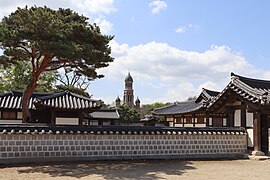 Gyeonggijeon
 -
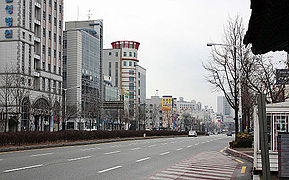 Street of Baekje-Daero (2014)
.jpeg)

Geography and administrative divisions edit

Administrative divisions edit
Jeonju is divided into two wards, Deokjin-gu (덕진구) and Wansan-gu (완산구) that, in turn, are divided into approximately 40 neighborhoods.
Climate edit
Jeonju has a cooler version of a humid subtropical climate (Köppen climate classification Cwa), with winter being warm enough to avoid being classified as an humid continental (Dwa) if the 0 °C isotherm is used.
Jeonju, like all of Korea, has four distinct seasons (spring, summer, fall, and winter). The winters can have a mix of days that are cool to days that are quite cold. The colder days are often influenced by a high pressure front that brings cold air from Siberia.
In the summer, the humidity of Southeast Asia comes over the Korean peninsula from June through September. Temperatures in spring (late April and through May) and fall (after September 25 and through October) are often in the mid-20s°C and with low humidity.
| Climate data for Jeonju (1991–2020 normals, extremes 1918–present) | |||||||||||||
|---|---|---|---|---|---|---|---|---|---|---|---|---|---|
| Month | Jan | Feb | Mar | Apr | May | Jun | Jul | Aug | Sep | Oct | Nov | Dec | Year |
| Record high °C (°F) | 18.3 (64.9) |
22.9 (73.2) |
28.2 (82.8) |
31.2 (88.2) |
35.1 (95.2) |
35.8 (96.4) |
38.6 (101.5) |
38.9 (102.0) |
34.5 (94.1) |
31.5 (88.7) |
28.0 (82.4) |
23.0 (73.4) |
38.9 (102.0) |
| Mean daily maximum °C (°F) | 4.8 (40.6) |
7.5 (45.5) |
13.0 (55.4) |
19.7 (67.5) |
25.0 (77.0) |
28.4 (83.1) |
30.6 (87.1) |
31.3 (88.3) |
27.4 (81.3) |
21.7 (71.1) |
14.4 (57.9) |
7.1 (44.8) |
19.2 (66.6) |
| Daily mean °C (°F) | 0.0 (32.0) |
2.0 (35.6) |
6.8 (44.2) |
12.9 (55.2) |
18.5 (65.3) |
22.8 (73.0) |
26.2 (79.2) |
26.5 (79.7) |
21.9 (71.4) |
15.4 (59.7) |
8.8 (47.8) |
2.2 (36.0) |
13.7 (56.7) |
| Mean daily minimum °C (°F) | −4.3 (24.3) |
−2.8 (27.0) |
1.4 (34.5) |
6.9 (44.4) |
12.7 (54.9) |
18.2 (64.8) |
22.7 (72.9) |
22.9 (73.2) |
17.4 (63.3) |
10.1 (50.2) |
3.9 (39.0) |
−2.1 (28.2) |
8.9 (48.0) |
| Record low °C (°F) | −17.1 (1.2) |
−16.6 (2.1) |
−12.2 (10.0) |
−3.9 (25.0) |
2.2 (36.0) |
8.2 (46.8) |
12.1 (53.8) |
12.5 (54.5) |
4.0 (39.2) |
−2.7 (27.1) |
−8.4 (16.9) |
−15.0 (5.0) |
−17.1 (1.2) |
| Average precipitation mm (inches) | 26.9 (1.06) |
36.8 (1.45) |
53.7 (2.11) |
78.4 (3.09) |
82.8 (3.26) |
159.0 (6.26) |
302.8 (11.92) |
289.6 (11.40) |
128.2 (5.05) |
57.3 (2.26) |
49.8 (1.96) |
34.0 (1.34) |
1,299.3 (51.15) |
| Average precipitation days (≥ 0.1 mm) | 8.3 | 6.9 | 9.4 | 8.7 | 8.9 | 10.3 | 16.0 | 15.0 | 9.3 | 6.6 | 8.9 | 9.0 | 117.3 |
| Average snowy days | 8.3 | 5.0 | 2.3 | 0.2 | 0.0 | 0.0 | 0.0 | 0.0 | 0.0 | 0.0 | 1.4 | 7.2 | 24.4 |
| Average relative humidity (%) | 66.8 | 63.5 | 60.9 | 59.1 | 63.2 | 70.6 | 77.5 | 76.9 | 73.4 | 69.4 | 67.4 | 67.6 | 68.0 |
| Mean monthly sunshine hours | 151.2 | 162.3 | 191.7 | 209.7 | 220.5 | 168.1 | 133.1 | 153.1 | 169.6 | 198.7 | 158.1 | 142.9 | 2,059 |
| Percent possible sunshine | 48.7 | 51.3 | 50.1 | 53.9 | 50.0 | 39.6 | 30.8 | 38.4 | 45.1 | 55.6 | 50.0 | 47.0 | 46.2 |
| Source: Korea Meteorological Administration (percent sunshine 1981–2010)[3][4][5] | |||||||||||||
Demographics edit
| Year | Pop. | ±% |
|---|---|---|
| 1950 | 83,000 | — |
| 1955 | 123,000 | +48.2% |
| 1960 | 182,000 | +48.0% |
| 1965 | 213,000 | +17.0% |
| 1970 | 255,000 | +19.7% |
| 1975 | 308,000 | +20.8% |
| 1980 | 363,000 | +17.9% |
| 1985 | 431,000 | +18.7% |
| 1990 | 511,000 | +18.6% |
| 1995 | 561,000 | +9.8% |
| 2000 | 612,000 | +9.1% |
| 2005 | 623,000 | +1.8% |
| 2010 | 648,000 | +4.0% |
| 2015 | 658,000 | +1.5% |
| 2020 | 663,000 | +0.8% |
History edit
Samguk (1C BC–7C AD) edit
The Baekje kingdom was located in southwestern Korea which included the area Jeonju is now located. It is believed that Jeonju was founded as a market town within Baekje around 57 BC.[6]
Jeonju (along with Baekje in general) was conquered by the kingdom of Silla in 660 AD. It soon became part of the Silla kingdom and in 685, Jeonju became one of the nine chu (a provincial capital of the kingdom). From 889 and onward, peasant revolts (caused from over taxation) became widespread throughout the kingdom and it also spread to Jeonju where it became the headquarters of one of the most powerful rebel leaders of the time, Gyeon Hwon. In 892 (or 900), Gyeon Hwon renamed the city Wansan and established it as the capital of the Later Baekje kingdom. From Wansan, Gyeon Hwon campaigned against Silla which climaxed with the destruction of Geumseong (the capital of the Silla kingdom) and the assassination of King Gyeongae in 927. With the decline of Silla, Gyeon Hwon and Wang Geon (of the Goryeo kingdom) waged battle for control of the peninsula. However, Wang Geon and his forces invaded Later Baekje in 934 and Jeonju surrendered to him in 935.[6]
Goryeo (918–1392) edit
Under Goryeo rule, Jeonju reverted to being a provincial capital and enjoyed relative stability and economic growth. However, in 1182, the city was taken by peasant rebels with the aid of governmental troops stationed there who resented being forced to do heavy labor along slaves. The rebellion was soon suppressed forty days after it began.[6]
Joseon (1392–1897) edit
The Joseon defeated Goryeo and founded a new dynasty in 1392 and took all their possessions including Jeonju. The Joseon considered Jeonju their ancestral home (an ancestor of Yi Seonggye of Joseon may have fled Jeonju after the 1182 peasant revolt). During the Joseon period, Jeonju became the capital of a reorganized Jeolla (one of the eight provinces of the Joseon). In 1413, Jeonju (along with three other cities) was given the honor of safekeeping copies of the Annals of the Joseon Dynasty which still survives extant in the former Confucian academy in Jeonju.[6]
The town was occupied by the Donghak Peasant Revolution in 1894.[7] Jeonju (like the rest of Korea) was then occupied by the Japanese beginning in 1910. The ancient walls of the old city were destroyed by the Japanese authorities with the Pungnammum Gate being the only remnant left today. Jeonju's population grew between 1925 and 1949 when it reached 100,000 inhabitants.[6] Jeonju was given metropolitan status in 1935, and the city was founded in 1949. During the Division of Korea, Jeonju was not in the immediate frontline of the war but by the armistice signing in July 1953, Jeonju (along with many other cities) suffered bombardment and the loss of many male residents who fought during the war.[6]
Today edit
Jeonju was given its modern boundaries and government system in 1963. It has since then industrialized rapidly.[6] Since the Joseon dynasty period, it was a metropolis, but it did not experience industrialization in the 20th century compared to other parts of Korea. It does not have the industrial infrastructure, manufacturing, or heavy industries found in other major Korean cities. Today, traditional tourism and sightseeing is a major industry in the city.
Public services edit
Firefighting edit
Fire stations in Jeonju:[8]
- Seobu 119 Safety Center
- Jeonju Wansan Fire Station
- Kyodong Fire Station
- Jeonju Deokjin Fire Station
Library edit
Libraries in Jeonju:[8]
- Jeonju City Library
- Rainbow Small Library
- Gunji Library
- Geumam Library
- Sinseo-dong Library
- Peace City Library
- A-joong Library
- Ongdalsaem Small Library
- Hyoja library
- Nosongjakeun Library
- Samcheon Public Library
Transportation edit

Many city buses and taxis are available in Jeonju. However, tourists are often advised to walk between points of interest, as many attractions are near each other.[9]
Railways edit
Buses edit
- Jeonbuk Shuttle Bus[10]
Culture edit
Cuisine edit
- Jeonju bibimbap (전주비빔밥), a traditional local food, is well known across South Korea. There are several very popular vegetarian restaurants serving Jeonju style food and pine wine.[11]
- Kongnamul gukbap (콩나물국밥), a rice soup with bean sprouts, which is eaten a lot in winter[12]
- Yukjeon (육전), a kind of pancake that is baked meat with dough[12]
- Memil naengmyeon (메밀냉면)[12]


.jpg)
Attractions edit
- Jeonju International Film Festival usually runs from the end of April to May for one week annually.[13]
- The National Jeonju Museum exhibits ancient relics from the Baekje days.
- There are extensive royal museums, temples, a castle fortress on a hillside, and a well-known paper museum, as well as an annual paper fashion show highlighting the latest styles and traditional Korean clothing made of paper.
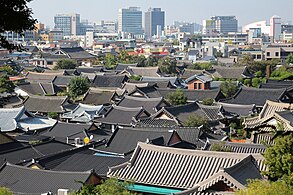
- The Jeonju Hanok Village (Hanok Maeul) is a traditional-style village in the heart of Jeonju, housing over 800 traditional "hanok" style buildings. It contains many traditional tea shops, souvenir shops, and restaurants.[14]
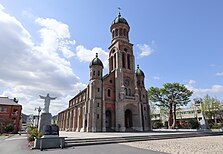
- Jeongdong Catholic Church was built on 1908–1914 by French priest Xavier Baudonet on the site of the Korean Catholic martyrs in 1791 and 1801. This Byzantine and Romanesque church has been designated Korea National Treasure No. 288.
- The Jeonju International Sori Festival was among Songlines' 25 Best International Festivals in 2014.
- The Jeonju International Film Festival draws about 50,000 visitors annually.
- Jeonju is the hometown of the breakdancing crew Last for One, international Battle of the Year champions.
- Gyeonggijeon is a place to enshirine the portrait of Lee Sunggye called the first king of the Chosun dynasty.
The local mountains and parks are popular for outdoor recreation due to its rural location. There are historical sites in the area. The city has a zoo, a park, and the Hanguk Sound and Culture Hall, a large, modern concert complex on the Jeonbuk National University campus.
- Attractions in Jeonju
-
-

-
-
 Gyeonggijeon Shrine


Sports edit

Jeonju hosts K League 1 team Jeonbuk Hyundai Motors. The team's home ground is the Jeonju World Cup Stadium.[15] Jeonju also hosts a semi-professional football team, Jeonju Citizen, which plays in the K4 League. Their home ground is the Jeonju Sports Complex Stadium.
In addition, Jeonju was the home city of the Jeonju KCC Egis, a professional basketball team of the Korean Basketball League, between 2001 and 2023, when they relocated to Busan after the city of Jeonju postponed the construction of a new gymnasium.[16]
Notable people edit
Politician edit
- Han Duck-soo, prime minister
Celebrities edit
- Defconn (born Yoo Dae-joon 1976), rapper and TV personality
- Lee Min-woo (born 1979), singer and member of Shinhwa
- Kim Kyu-jong (born 1987), singer and member of SS501
- Yoon Kyun-sang (born 1987), actor
- Taeyeon (born Kim Tae-yeon 1989), singer and member of Girls' Generation
- Kim Sung-kyu (born 1989), singer and member of Infinite
- Hwasa (born 1995), singer and member of Mamamoo
- Wheein (born 1995), singer and member of Mamamoo
- Choi Yu-jin (born 1996), singer and member of CLC and Kep1er
- Choi Byung-chan (born 1997), singer and member of Victon
- Bae In-hyuk, (born 1998), actor
- Na Jae-min (born 2000), singer and member of NCT
- So Yi-hyun (born 1984), actress
- Lee Yoo-mi (born 1994), actress
Athletes edit
- Lee Chang-ho (born 1975), professional Go player
- Yang Hong-seok, (born 1997), basketball player
_(cropped).png)


Sister cities edit
 San Diego, California, United States
 Suzhou, Jiangsu, China
 Kanazawa, Ishikawa, Japan
 Antalya, Turkey
 Mokpo, South Jeolla, South Korea


See also edit

Notes edit
References edit
- ^ "Jeonju's Gastronomic Greatness Recognized by UNESCO". The Chosun Ilbo. 16 May 2012. Retrieved 23 May 2012.
- ^ "Jeonju, Republic of Korea". UNESCO.
- ^ "Climatological Normals of Korea (1991 ~ 2020)" (PDF) (in Korean). Korea Meteorological Administration. Archived from the original (PDF) on 29 January 2022. Retrieved 4 April 2022.
- ^ 순위값 - 구역별조회 (in Korean). Korea Meteorological Administration. Retrieved 4 April 2022.
- ^ "Climatological Normals of Korea" (PDF). Korea Meteorological Administration. 2011. Archived from the original (PDF) on 7 December 2016. Retrieved 8 December 2016.
- ^ a b c d e f g Schellinger, Paul; Salkin, Robert, eds. (1996). International Dictionary of Historic Places, Volume 5: Asia and Oceania. Chicago: Fitzroy Dearborn Publishers. pp. 195–197. ISBN 1-884964-04-4.
- ^ 신형식 (January 2005). A Brief History of Korea, Volume 1. ISBN 9788973006199.
- ^ a b "Public Services in Jeonju-si, North Jeolla". openalfa.
- ^ "Travel Highlights". visitkorea. Retrieved 7 December 2014. Archived 11 December 2014 at the Wayback Machine
- ^ a b "Transportation Guide | Jeonju". Creatrip.
- ^ "Jeonju bibimbap, the most popular traditional Korean dish among foreigners".
- ^ a b c "9 Best Local Dishes From Jeonju". Expedia.
- ^ "Jeonju Int'l Film Fest to Open This Week". The Chosun Ilbo. 23 April 2012. Retrieved 23 April 2012.
- ^ Jeonju Hanok Village Archived 2013-01-21 at the Wayback Machine. Visitkorea.or.kr. Retrieved on 2013-07-12.
- ^ "Jeonbuk Hyundai Motors". 2016-04-14.
- ^ "KCC Egis leave Jeonju for Busan as stadium woes continue". Korea JoongAng Daily. 31 August 2023. Retrieved 19 October 2023.
External links edit

