
This article needs additional citations for verification. (March 2011) |
In mathematics, the group Hopf algebra of a given group is a certain construct related to the symmetries of group actions. Deformations of group Hopf algebras are foundational in the theory of quantum groups.
Definition
editLet G be a group and k a field. The group Hopf algebra of G over k, denoted kG (or k[G]), is as a set (and a vector space) the free vector space on G over k. As an algebra, its product is defined by linear extension of the group composition in G, with multiplicative unit the identity in G; this product is also known as convolution.
Note that while the group algebra of a finite group can be identified with the space of functions on the group, for an infinite group these are different. The group algebra, consisting of finite sums, corresponds to functions on the group that vanish for cofinitely many points; topologically (using the discrete topology), these are the functions with compact support.
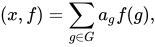
However, the group algebra and – the commutative algebra of functions of G into k – are dual: given an element of the group algebra and a function on the group these pair to give an element of k via which is a well-defined sum because it is finite.
![{\displaystyle k[G]}](https://wikimedia.org/api/rest_v1/media/math/render/svg/4a13dacf8d6ff682a6b5d59e84f93e589cba3fa1)


Hopf algebra structure
editWe give kG the structure of a cocommutative Hopf algebra by defining the coproduct, counit, and antipode to be the linear extensions of the following maps defined on G:[1]
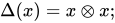


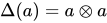
The required Hopf algebra compatibility axioms are easily checked. Notice that , the set of group-like elements of kG (i.e. elements such that and ), is precisely G.



Symmetries of group actions
editLet G be a group and X a topological space. Any action of G on X gives a homomorphism , where F(X) is an appropriate algebra of k-valued functions, such as the Gelfand–Naimark algebra of continuous functions vanishing at infinity. The homomorphism is defined by , with the adjoint defined by





for , and .


This may be described by a linear mapping


where , are the elements of G, and , which has the property that group-like elements in give rise to automorphisms of F(X).




endows F(X) with an important extra structure, described below.

Hopf module algebras and the Hopf smash product
editLet H be a Hopf algebra. A (left) Hopf H-module algebra A is an algebra which is a (left) module over the algebra H such that and


whenever , and in sumless Sweedler notation. When has been defined as in the previous section, this turns F(X) into a left Hopf kG-module algebra, which allows the following construction.



Let H be a Hopf algebra and A a left Hopf H-module algebra. The smash product algebra is the vector space with the product


- ,

and we write for in this context.[2]


In our case, and , and we have


- .

In this case the smash product algebra is also denoted by .


The cyclic homology of Hopf smash products has been computed.[3] However, there the smash product is called a crossed product and denoted - not to be confused with the crossed product derived from -dynamical systems.[4]


References
edit- ^ Montgomery, Susan (1993). Hopf algebras and their actions on rings. Expanded version of ten lectures given at the CBMS Conference on Hopf algebras and their actions on rings, which took place at DePaul University in Chicago, USA, August 10-14, 1992. Regional Conference Series in Mathematics. Vol. 82. Providence, RI: American Mathematical Society. p. 8. ISBN 978-0-8218-0738-5. Zbl 0793.16029.
- ^ Dăscălescu, Sorin; Raianu, Şerban; Van Oystaeyen, Freddy (1998). "Smash (co)products from adjunctions". In Caenepeel, Stefaan; Verschoren, A. (eds.). Rings, Hopf algebras, and Brauer groups. Proceedings of the fourth week on algebra and algebraic geometry, SAGA-4, Antwerp and Brussels, Belgium, September 12–17, 1996. Lect. Notes Pure Appl. Math. Vol. 197. New York, NY: Marcel Dekker. pp. 103–110. ISBN 0824701534. MR 1615813. Zbl 0905.16017.
- ^ Akbarpour, Reza; Khalkhali, Masoud (2003). "Hopf algebra equivariant cyclic homology and cyclic homology of crossed product algebras". Journal für die reine und angewandte Mathematik. 2003 (559): 137–152. arXiv:math/0011248. doi:10.1515/crll.2003.046. MR 1989648. S2CID 16268125.
- ^ Gracia-Bondia, J. et al. Elements of Noncommutative Geometry. Birkhäuser: Boston, 2001. ISBN 0-8176-4124-6.