
In geometry, the folium of Descartes (from Latin folium 'leaf'; named for René Descartes) is an algebraic curve defined by the implicit equation



History edit
The curve was first proposed and studied by René Descartes in 1638.[1] Its claim to fame lies in an incident in the development of calculus. Descartes challenged Pierre de Fermat to find the tangent line to the curve at an arbitrary point since Fermat had recently discovered a method for finding tangent lines. Fermat solved the problem easily, something Descartes was unable to do.[2] Since the invention of calculus, the slope of the tangent line can be found easily using implicit differentiation.[3]
Graphing the curve edit

The folium of Descartes can be expressed in polar coordinates as
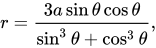
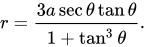
Another technique is to write and solve for and in terms of . This yields the rational parametric equations:[5]


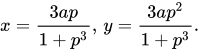
We can see that the parameter is related to the position on the curve as follows:
- corresponds to , : the right, lower, "wing".
- corresponds to , : the left, upper "wing".
- corresponds to , : the loop of the curve.


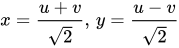
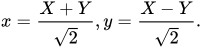
Another way of plotting the function can be derived from symmetry over . The symmetry can be seen directly from its equation (x and y can be interchanged). By applying rotation of 45° CW for example, one can plot the function symmetric over rotated x axis.

This operation is equivalent to a substitution:


Properties edit
It forms a loop in the first quadrant with a double point at the origin and asymptote


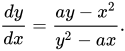
Implicit differentiation gives the formula for the slope of the tangent line to this curve to be[3]

Relationship to the trisectrix of Maclaurin edit

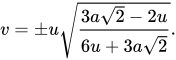
The folium of Descartes is related to the trisectrix of Maclaurin by affine transformation. To see this, start with the equation



If we stretch the curve in the direction by a factor of this becomes



Notes edit
- ^ a b "Folium of Descartes". Encyclopedia of Mathematics. June 5, 2020. Retrieved January 30, 2021.
- ^ Simmons, p. 101
- ^ a b Stewart, James (2012). "Section 3.5: Implicit Differentiation". Calculus: Early Transcendentals. United States of America: Cengage Learning. pp. 209–11. ISBN 978-0-538-49790-9.
- ^ Stewart, James (2012). "Chapter 10: Parametric Equations and Polar Coordinates". Calculus: Early Transcendentals (7th ed.). Cengage Learning. p. 687. ISBN 978-0-538-49790-9.
- ^ "DiffGeom3: Parametrized curves and algebraic curves". N J Wildberger, University of New South Wales. Archived from the original on 2021-12-21. Retrieved 5 September 2013.
References edit
- J. Dennis Lawrence: A catalog of special plane curves, 1972, Dover Publications. ISBN 0-486-60288-5, pp. 106–108
- George F. Simmons: Calculus Gems: Brief Lives and Memorable Mathematics, New York 1992, McGraw-Hill, xiv,355. ISBN 0-07-057566-5; new edition 2007, The Mathematical Association of America (MAA)
External links edit
