This article is about the extreme value theorem in statistics. For the result in calculus, see
extreme value theorem .
In statistics , the Fisher–Tippett–Gnedenko theorem (also the Fisher–Tippett theorem or the extreme value theorem ) is a general result in extreme value theory regarding asymptotic distribution of extreme order statistics . The maximum of a sample of iid random variables after proper renormalization can only converge in distribution to one of only 3 possible distribution families : the Gumbel distribution , the Fréchet distribution , or the Weibull distribution . Credit for the extreme value theorem and its convergence details are given to Fréchet (1927),[1] Fisher and Tippett (1928),[2] Mises (1936),[3] [4] Gnedenko (1943).[5]
The role of the extremal types theorem for maxima is similar to that of central limit theorem for averages, except that the central limit theorem applies to the average of a sample from any distribution with finite variance, while the Fisher–Tippet–Gnedenko theorem only states that if the distribution of a normalized maximum converges, then the limit has to be one of a particular class of distributions. It does not state that the distribution of the normalized maximum does converge.
Statement
edit
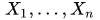
Let
X
1
,
X
2
,
…
,
X
n
{\displaystyle \ X_{1},X_{2},\ldots ,X_{n}\ }
n -sized sample of independent and identically-distributed random variables , each of whose cumulative distribution function is
F
.
{\displaystyle \ F~.}
a
n
>
0
{\displaystyle \ a_{n}>0\ }
b
n
∈
R
{\displaystyle \ b_{n}\in \mathbb {R} \ }
degenerate distribution function:
lim
n
→
∞
P
{
max
{
X
1
,
…
,
X
n
}
−
b
n
a
n
≤
x
}
=
G
(
x
)
,
{\displaystyle \lim _{n\to \infty }{\boldsymbol {\mathcal {P}}}\left\{{\frac {\ \max\{X_{1},\dots ,X_{n}\}-b_{n}\ }{a_{n}}}\leq x\ \right\}=G(x)\ ,}
or equivalently:
lim
n
→
∞
(
F
(
a
n
x
+
b
n
)
)
n
=
G
(
x
)
.
{\displaystyle \lim _{n\to \infty }{\Bigl (}\ F\left(\ a_{n}\ x+b_{n}\ \right){\Bigr )}^{n}=G(x)~.}
In such circumstances, the limiting distribution
G
{\displaystyle \ G\ }
Gumbel , the Fréchet , or the Weibull distribution family .[6]
In other words, if the limit above converges, then up to a linear change of coordinates
G
(
x
)
{\displaystyle G(x)}
[7]
G
γ
(
x
)
=
exp
(
−
(
1
+
γ
x
)
−
1
/
γ
)
{\displaystyle G_{\gamma }(x)=\exp \left(-{\Bigl (}1+\gamma \ x{\Bigr )}^{-1/\gamma }\right)\quad }
γ
≠
0
,
{\displaystyle \quad \gamma \neq 0\ ,}
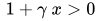
with the non-zero parameter
γ
{\displaystyle \ \gamma \ }
1
+
γ
x
>
0
{\displaystyle \ 1+\gamma \ x>0\ }
x
{\displaystyle \ x\ }
F
{\displaystyle \ F\ }
x
{\displaystyle \ x\ }
F
(
x
)
≠
0
{\displaystyle \ F(x)\neq 0\ }
G
0
(
x
)
=
exp
(
−
exp
(
−
x
)
)
{\displaystyle G_{0}(x)=\exp {\bigl (}\ -\exp(-x)\ {\bigr )}\quad }
γ
=
0
.
{\displaystyle \quad \gamma =0~.}
This is the cumulative distribution function of the generalized extreme value distribution (GEV) with extreme value index
γ
.
{\displaystyle \ \gamma ~.\ }
Conditions of convergence
edit
The Fisher–Tippett–Gnedenko theorem is a statement about the convergence of the limiting distribution
G
(
x
)
,
{\displaystyle \ G(x)\ ,}
G
{\displaystyle \ G\ }
[3] [5] [4] [5]
Let
F
{\displaystyle \ F\ }
X
,
{\displaystyle \ X\ ,}
X
1
,
…
,
X
n
{\displaystyle \ X_{1},\dots ,X_{n}\ }
i.i.d. sample thereof. Also let
x
m
a
x
{\displaystyle \ x_{\mathsf {max}}\ }
x
m
a
x
≡
sup
{
x
∣
F
(
x
)
<
1
}
.
{\displaystyle \ x_{\mathsf {max}}\equiv \sup \ \{\ x\ \mid \ F(x)<1\ \}~.\ }
The limiting distribution of the normalized sample maximum, given by
G
{\displaystyle G}
[7]
Fréchet distribution
(
γ
>
0
)
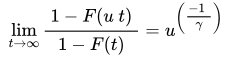
{\displaystyle \ \left(\ \gamma >0\ \right)}
For strictly positive
γ
>
0
,
{\displaystyle \ \gamma >0\ ,}
x
m
a
x
=
∞
{\displaystyle \ x_{\mathsf {max}}=\infty \ }
and
lim
t
→
∞
1
−
F
(
u
t
)
1
−
F
(
t
)
=
u
(
−
1
γ
)
{\displaystyle \ \lim _{t\rightarrow \infty }{\frac {\ 1-F(u\ t)\ }{1-F(t)}}=u^{\left({\tfrac {-1~}{\gamma }}\right)}\ }
u
>
0
.
{\displaystyle \ u>0~.}
In this case, possible sequences that will satisfy the theorem conditions are
b
n
=
0
{\displaystyle b_{n}=0}
and
a
n
=
F
−
1
(
1
−
1
n
)
.
{\displaystyle \ a_{n}={F^{-1}}\!\!\left(1-{\tfrac {1}{\ n\ }}\right)~.}
Strictly positive
γ
{\displaystyle \ \gamma \ }
heavy tailed
Gumbel distribution
(
γ
=
0
)
{\displaystyle \ \left(\ \gamma =0\ \right)}
For trivial
γ
=
0
,
{\displaystyle \ \gamma =0\ ,}
x
m
a
x
{\displaystyle \ x_{\mathsf {max}}\ }
lim
t
→
x
m
a
x
1
−
F
(
t
+
u
g
~
(
t
)
)
1
−
F
(
t
)
=
e
−
u
{\displaystyle \ \lim _{t\rightarrow x_{\mathsf {max}}}{\frac {\ 1-F{\bigl (}\ t+u\ {\tilde {g}}(t)\ {\bigr )}\ }{1-F(t)}}=e^{-u}\ }
u
>
0
{\displaystyle \ u>0\ }
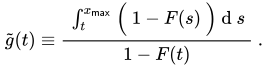
with
g
~
(
t
)
≡
∫
t
x
m
a
x
(
1
−
F
(
s
)
)
d
s
1
−
F
(
t
)
.
{\displaystyle \ {\tilde {g}}(t)\equiv {\frac {\ \int _{t}^{x_{\mathsf {max}}}{\Bigl (}\ 1-F(s)\ {\Bigr )}\ \mathrm {d} \ s\ }{1-F(t)}}~.}
Possible sequences here are
b
n
=
F
−
1
(
1
−
1
n
)
{\displaystyle \ b_{n}={F^{-1}}\!\!\left(\ 1-{\tfrac {1}{\ n\ }}\ \right)\ }
and
a
n
=
g
~
(
F
−
1
(
1
−
1
n
)
)
.
{\displaystyle \ a_{n}={\tilde {g}}{\Bigl (}\;{F^{-1}}\!\!\left(\ 1-{\tfrac {1}{\ n\ }}\ \right)\;{\Bigr )}~.}
Weibull distribution
(
γ
<
0
)
{\displaystyle \ \left(\ \gamma <0\ \right)}
For strictly negative
γ
<
0
{\displaystyle \ \gamma <0\ }
x
m
a
x
<
∞
{\displaystyle \ x_{\mathsf {max}}\ <\infty \quad }
and
lim
t
→
0
+
1
−
F
(
x
m
a
x
−
u
t
)
1
−
F
(
x
m
a
x
−
t
)
=
u
(
−
1
γ
)
{\displaystyle \ \lim _{t\rightarrow 0^{+}}{\frac {\ 1-F\!\left(\ x_{\mathsf {max}}-u\ t\ \right)\ }{1-F(\ x_{\mathsf {max}}-t\ )}}=u^{\left({\tfrac {-1~}{\ \gamma \ }}\right)}\ }
u
>
0
.
{\displaystyle \ u>0~.}
Note that for this case the exponential term
−
1
γ
{\displaystyle \ {\tfrac {-1~}{\ \gamma \ }}\ }
γ
{\displaystyle \ \gamma \ }
Possible sequences here are
b
n
=
x
m
a
x
{\displaystyle \ b_{n}=x_{\mathsf {max}}\ }
and
a
n
=
x
m
a
x
−
F
−
1
(
1
−
1
n
)
.
{\displaystyle \ a_{n}=x_{\mathsf {max}}-{F^{-1}}\!\!\left(\ 1-{\frac {1}{\ n\ }}\ \right)~.}
γ
{\displaystyle \ \gamma \ }
Examples
edit
Fréchet distribution
edit
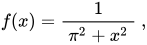
The Cauchy distribution 's density function is:
f
(
x
)
=
1
π
2
+
x
2
,
{\displaystyle f(x)={\frac {1}{\ \pi ^{2}+x^{2}\ }}\ ,}
and its cumulative distribution function is:
F
(
x
)
=
1
2
+
1
π
arctan
(
x
π
)
.
{\displaystyle F(x)={\frac {\ 1\ }{2}}+{\frac {1}{\ \pi \ }}\arctan \left({\frac {x}{\ \pi \ }}\right)~.}
A little bit of calculus show that the right tail's cumulative distribution
1
−
F
(
x
)
{\displaystyle \ 1-F(x)\ }
asymptotic to
1
x
,
{\displaystyle \ {\frac {1}{\ x\ }}\ ,}
ln
F
(
x
)
→
−
1
x
a
s
x
→
∞
,
{\displaystyle \ln F(x)\rightarrow {\frac {-1~}{\ x\ }}\quad {\mathsf {~as~}}\quad x\rightarrow \infty \ ,}
so we have
ln
(
F
(
x
)
n
)
=
n
ln
F
(
x
)
∼
−
−
n
x
.
{\displaystyle \ln \left(\ F(x)^{n}\ \right)=n\ \ln F(x)\sim -{\frac {-n~}{\ x\ }}~.}
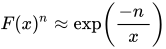
Thus we have
F
(
x
)
n
≈
exp
(
−
n
x
)
{\displaystyle F(x)^{n}\approx \exp \left({\frac {-n~}{\ x\ }}\right)}
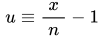
and letting
u
≡
x
n
−
1
{\displaystyle \ u\equiv {\frac {x}{\ n\ }}-1\ }
lim
n
→
∞
(
F
(
n
u
+
n
)
n
)
=
exp
(
−
1
1
+
u
)
=
G
1
(
u
)
{\displaystyle \lim _{n\to \infty }{\Bigl (}\ F(n\ u+n)^{n}\ {\Bigr )}=\exp \left({\tfrac {-1~}{\ 1+u\ }}\right)=G_{1}(u)\ }
for any
u
.
{\displaystyle \ u~.}
n .
Gumbel distribution
edit
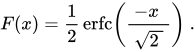
Let us take the normal distribution with cumulative distribution function
F
(
x
)
=
1
2
erfc
(
−
x
2
)
.
{\displaystyle F(x)={\frac {1}{2}}\operatorname {erfc} \left({\frac {-x~}{\ {\sqrt {2\ }}\ }}\right)~.}
We have
ln
F
(
x
)
→
−
exp
(
−
1
2
x
2
)
2
π
x
a
s
x
→
∞
{\displaystyle \ln F(x)\rightarrow -{\frac {\ \exp \left(-{\tfrac {1}{2}}x^{2}\right)\ }{{\sqrt {2\pi \ }}\ x}}\quad {\mathsf {~as~}}\quad x\rightarrow \infty }
and thus
ln
(
F
(
x
)
n
)
=
n
ln
F
(
x
)
→
−
n
exp
(
−
1
2
x
2
)
2
π
x
a
s
x
→
∞
.
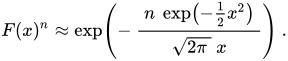
{\displaystyle \ln \left(\ F(x)^{n}\ \right)=n\ln F(x)\rightarrow -{\frac {\ n\exp \left(-{\tfrac {1}{2}}x^{2}\right)\ }{{\sqrt {2\pi \ }}\ x}}\quad {\mathsf {~as~}}\quad x\rightarrow \infty ~.}
Hence we have
F
(
x
)
n
≈
exp
(
−
n
exp
(
−
1
2
x
2
)
2
π
x
)
.
{\displaystyle F(x)^{n}\approx \exp \left(-\ {\frac {\ n\ \exp \left(-{\tfrac {1}{2}}x^{2}\right)\ }{\ {\sqrt {2\pi \ }}\ x\ }}\right)~.}
If we define
c
n
{\displaystyle \ c_{n}\ }
n
exp
(
−
1
2
c
n
2
)
2
π
c
n
=
1
,
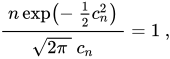
{\displaystyle {\frac {\ n\exp \left(-\ {\tfrac {1}{2}}c_{n}^{2}\right)\ }{\ {\sqrt {2\pi \ }}\ c_{n}\ }}=1\ ,}
then around
x
=
c
n
{\displaystyle \ x=c_{n}\ }
n
exp
(
−
1
2
x
2
)
2
π
x
≈
exp
(
c
n
(
c
n
−
x
)
)
.
{\displaystyle {\frac {\ n\ \exp \left(-\ {\tfrac {1}{2}}x^{2}\right)\ }{{\sqrt {2\pi \ }}\ x}}\approx \exp \left(\ c_{n}\ (c_{n}-x)\ \right)~.}
As
n
{\displaystyle \ n\ }
c
n
(
c
n
−
x
)
{\displaystyle \ c_{n}\ (c_{n}-x)\ }
u
≡
c
n
(
c
n
−
x
)
{\displaystyle \ u\equiv c_{n}\ (c_{n}-x)\ }
lim
n
→
∞
(
F
(
u
c
n
+
c
n
)
n
)
=
exp
(
−
exp
(
−
u
)
)
=
G
0
(
u
)
.
{\displaystyle \lim _{n\to \infty }{\biggl (}\ F\left({\tfrac {u}{~c_{n}\ }}+c_{n}\right)^{n}\ {\biggr )}=\exp \!{\Bigl (}-\exp(-u){\Bigr )}=G_{0}(u)~.}
Equivalently,
lim
n
→
∞
P
(
max
{
X
1
,
…
,
X
n
}
−
c
n
(
u
c
n
)
≤
u
)
=
exp
(
−
exp
(
−
u
)
)
=
G
0
(
u
)
.
{\displaystyle \lim _{n\to \infty }{\boldsymbol {\mathcal {P}}}\ {\Biggl (}{\frac {\ \max\{X_{1},\ \ldots ,\ X_{n}\}-c_{n}\ }{\left({\frac {u}{~c_{n}\ }}\right)}}\leq u{\Biggr )}=\exp \!{\Bigl (}-\exp(-u){\Bigr )}=G_{0}(u)~.}
With this result, we see retrospectively that we need
ln
c
n
≈
ln
ln
n
2
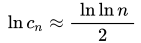
{\displaystyle \ \ln c_{n}\approx {\frac {\ \ln \ln n\ }{2}}\ }
c
n
≈
2
ln
n
,
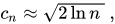
{\displaystyle c_{n}\approx {\sqrt {2\ln n\ }}\ ,}
so the maximum is expected to climb toward infinity ever more slowly.
Weibull distribution
edit
We may take the simplest example, a uniform distribution between 0 and 1 , with cumulative distribution function
F
(
x
)
=
x
{\displaystyle F(x)=x\ }
x value from 0 to 1 .For values of
x
→
1
{\displaystyle \ x\ \rightarrow \ 1\ }
ln
(
F
(
x
)
n
)
=
n
ln
F
(
x
)
→
n
(
1
−
x
)
.
{\displaystyle \ln {\Bigl (}\ F(x)^{n}\ {\Bigr )}=n\ \ln F(x)\ \rightarrow \ n\ (\ 1-x\ )~.}
So for
x
≈
1
{\displaystyle \ x\approx 1\ }
F
(
x
)
n
≈
exp
(
n
−
n
x
)
.
{\displaystyle \ F(x)^{n}\approx \exp(\ n-n\ x\ )~.}
Let
u
≡
1
+
n
(
1
−
x
)
{\displaystyle \ u\equiv 1+n\ (\ 1-x\ )\ }
lim
n
→
∞
(
F
(
u
n
+
1
−
1
n
)
)
n
=
exp
(
−
(
1
−
u
)
)
=
G
−
1
(
u
)
.
{\displaystyle \lim _{n\to \infty }{\Bigl (}\ F\!\left({\tfrac {\ u\ }{n}}+1-{\tfrac {\ 1\ }{n}}\right)\ {\Bigr )}^{n}=\exp \!{\bigl (}\ -(1-u)\ {\bigr )}=G_{-1}(u)~.}
Close examination of that limit shows that the expected maximum approaches 1 in inverse proportion to n .
See also
edit
References
edit
^ Fréchet, M. (1927). "Sur la loi de probabilité de l'écart maximum". Annales de la Société Polonaise de Mathématique . 6 (1): 93–116. ^ Fisher, R.A.; Tippett, L.H.C. (1928). "Limiting forms of the frequency distribution of the largest and smallest member of a sample". Proc. Camb. Phil. Soc . 24 (2): 180–190. Bibcode :1928PCPS...24..180F . doi :10.1017/s0305004100015681 . S2CID 123125823 . ^ a b von Mises, R. (1936). "La distribution de la plus grande de n valeurs" [The distribution of the largest of n values]. Rev. Math. Union Interbalcanique . 1 (in French): 141–160.^ a b Falk, Michael; Marohn, Frank (1993). "von Mises conditions revisited". The Annals of Probability : 1310–1328. ^ a b c Gnedenko, B.V. (1943). "Sur la distribution limite du terme maximum d'une serie aleatoire". Annals of Mathematics 44 (3): 423–453. doi :10.2307/1968974 . JSTOR 1968974 . ^ Mood, A.M. (1950). "5. Order Statistics". Introduction to the theory of statistics . New York, NY: McGraw-Hill. pp. 251–270. ^ a b Haan, Laurens; Ferreira, Ana (2007). Extreme Value Theory: An introduction . Springer.
Further reading
edit