
In mathematics, the (field) norm is a particular mapping defined in field theory, which maps elements of a larger field into a subfield.
Formal definition edit
Let K be a field and L a finite extension (and hence an algebraic extension) of K.
The field L is then a finite-dimensional vector space over K.
Multiplication by α, an element of L,
- ,


is a K-linear transformation of this vector space into itself.
The norm, NL/K(α), is defined as the determinant of this linear transformation.[1]
If L/K is a Galois extension, one may compute the norm of α ∈ L as the product of all the Galois conjugates of α:
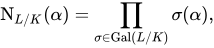
where Gal(L/K) denotes the Galois group of L/K.[2] (Note that there may be a repetition in the terms of the product.)
For a general field extension L/K, and nonzero α in L, let σ1(α), ..., σn(α) be the roots of the minimal polynomial of α over K (roots listed with multiplicity and lying in some extension field of L); then
- .
![{\displaystyle \operatorname {N} _{L/K}(\alpha )=\left(\prod _{j=1}^{n}\sigma _{j}(\alpha )\right)^{[L:K(\alpha )]}}](https://wikimedia.org/api/rest_v1/media/math/render/svg/5456f9055e8974418d998bad0d30ccd5becf8fb4)
If L/K is separable, then each root appears only once in the product (though the exponent, the degree [L:K(α)], may still be greater than 1).
Examples edit
Quadratic field extensions edit
One of the basic examples of norms comes from quadratic field extensions where is a square-free integer.


Then, the multiplication map by on an element is



The element can be represented by the vector

since there is a direct sum decomposition as a -vector space.


The matrix of is then


and the norm is , since it is the determinant of this matrix.

Norm of Q(√2) edit
Consider the number field .

The Galois group of over has order and is generated by the element which sends to . So the norm of is:



The field norm can also be obtained without the Galois group.
Fix a -basis of , say:

- .

Then multiplication by the number sends
- 1 to and
- to .

So the determinant of "multiplying by " is the determinant of the matrix which sends the vector
- (corresponding to the first basis element, i.e., 1) to ,
- (corresponding to the second basis element, i.e., ) to ,


viz.:

The determinant of this matrix is −1.
p-th root field extensions edit
Another easy class of examples comes from field extensions of the form where the prime factorization of contains no -th powers, for a fixed odd prime.
![{\displaystyle \mathbb {Q} ({\sqrt[{p}]{a}})/\mathbb {Q} }](https://wikimedia.org/api/rest_v1/media/math/render/svg/743a7bfda123f7c8e0d5f445f946341c2966c1d2)


The multiplication map by of an element is
![{\displaystyle {\sqrt[{p}]{a}}}](https://wikimedia.org/api/rest_v1/media/math/render/svg/7e801d5cff1bd74c43723f6777d1ff6305089e6f)
![{\displaystyle {\begin{aligned}m_{\sqrt[{p}]{a}}(x)&={\sqrt[{p}]{a}}\cdot (a_{0}+a_{1}{\sqrt[{p}]{a}}+a_{2}{\sqrt[{p}]{a^{2}}}+\cdots +a_{p-1}{\sqrt[{p}]{a^{p-1}}})\\&=a_{0}{\sqrt[{p}]{a}}+a_{1}{\sqrt[{p}]{a^{2}}}+a_{2}{\sqrt[{p}]{a^{3}}}+\cdots +a_{p-1}a\end{aligned}}}](https://wikimedia.org/api/rest_v1/media/math/render/svg/d052faed7af362ce87c839cc9e8b52a2cbe3ba7b)
giving the matrix
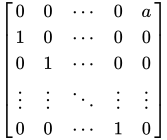
The determinant gives the norm
![{\displaystyle N_{\mathbb {Q} ({\sqrt[{p}]{a}})/\mathbb {Q} }({\sqrt[{p}]{a}})=(-1)^{p-1}a=a.}](https://wikimedia.org/api/rest_v1/media/math/render/svg/ee32203de52e3ba8884cf77c366fbb8aebe53a37)
Complex numbers over the reals edit
The field norm from the complex numbers to the real numbers sends
- x + iy
to
- x2 + y2,
because the Galois group of over has two elements,


- the identity element and
- complex conjugation,
and taking the product yields (x + iy)(x − iy) = x2 + y2.
Finite fields edit
Let L = GF(qn) be a finite extension of a finite field K = GF(q).
Since L/K is a Galois extension, if α is in L, then the norm of α is the product of all the Galois conjugates of α, i.e.[3]

In this setting we have the additional properties,[4]


Properties of the norm edit
Several properties of the norm function hold for any finite extension.[5][6]
Group homomorphism edit
The norm NL/K : L* → K* is a group homomorphism from the multiplicative group of L to the multiplicative group of K, that is

Furthermore, if a in K:
![{\displaystyle \operatorname {N} _{L/K}(a\alpha )=a^{[L:K]}\operatorname {N} _{L/K}(\alpha ){\text{ for all }}\alpha \in L.}](https://wikimedia.org/api/rest_v1/media/math/render/svg/aa3ce405dd38377d155f6a41235dfa929ece66c8)
If a ∈ K then
![{\displaystyle \operatorname {N} _{L/K}(a)=a^{[L:K]}.}](https://wikimedia.org/api/rest_v1/media/math/render/svg/c463368179b2ca3bb4b8c8e1055e4926e8a33e3b)
Composition with field extensions edit
Additionally, the norm behaves well in towers of fields:
if M is a finite extension of L, then the norm from M to K is just the composition of the norm from M to L with the norm from L to K, i.e.

Reduction of the norm edit
The norm of an element in an arbitrary field extension can be reduced to an easier computation if the degree of the field extension is already known. This is
![{\displaystyle N_{L/K}(\alpha )=N_{K(\alpha )/K}(\alpha )^{[L:K(\alpha )]}}](https://wikimedia.org/api/rest_v1/media/math/render/svg/a489f85f9687611ff23b78c3129ed387a1449ae3)
For example, for in the field extension , the norm of is



![{\displaystyle {\begin{aligned}N_{\mathbb {Q} ({\sqrt {2}},\zeta _{3})/\mathbb {Q} }({\sqrt {2}})&=N_{\mathbb {Q} ({\sqrt {2}})/\mathbb {Q} }({\sqrt {2}})^{[\mathbb {Q} ({\sqrt {2}},\zeta _{3}):\mathbb {Q} ({\sqrt {2}})]}\\&=(-2)^{2}\\&=4\end{aligned}}}](https://wikimedia.org/api/rest_v1/media/math/render/svg/1be2c15698576800c264786352ae26f3acd49b2e)
since the degree of the field extension is .


Detection of units edit
For the ring of integers of an algebraic number field , an element is a unit if and only if .


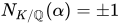
For instance

where
- .

Thus, any number field whose ring of integers contains has it as a unit.

Further properties edit
The norm of an algebraic integer is again an integer, because it is equal (up to sign) to the constant term of the characteristic polynomial.
In algebraic number theory one defines also norms for ideals. This is done in such a way that if I is a nonzero ideal of OK, the ring of integers of the number field K, N(I) is the number of residue classes in – i.e. the cardinality of this finite ring. Hence this ideal norm is always a positive integer.

When I is a principal ideal αOK then N(I) is equal to the absolute value of the norm to Q of α, for α an algebraic integer.
See also edit
Notes edit
- ^ Rotman 2002, p. 940
- ^ Rotman 2002, p. 943
- ^ Lidl & Niederreiter 1997, p. 57
- ^ Mullen & Panario 2013, p. 21
- ^ Roman 2006, p. 151
- ^ a b Oggier. Introduction to Algebraic Number Theory (PDF). p. 15. Archived from the original (PDF) on 2014-10-23. Retrieved 2020-03-28.
References edit
- Lidl, Rudolf; Niederreiter, Harald (1997) [1983], Finite Fields, Encyclopedia of Mathematics and its Applications, vol. 20 (Second ed.), Cambridge University Press, ISBN 0-521-39231-4, Zbl 0866.11069
- Mullen, Gary L.; Panario, Daniel (2013), Handbook of Finite Fields, CRC Press, ISBN 978-1-4398-7378-6
- Roman, Steven (2006), Field theory, Graduate Texts in Mathematics, vol. 158 (Second ed.), Springer, Chapter 8, ISBN 978-0-387-27677-9, Zbl 1172.12001
- Rotman, Joseph J. (2002), Advanced Modern Algebra, Prentice Hall, ISBN 978-0-13-087868-7