Formulas
edit
Richard Feynman observed that:[1]
1
A
B
=
∫
0
1
d
u
[
u
A
+
(
1
−
u
)
B
]
2
{\displaystyle {\frac {1}{AB}}=\int _{0}^{1}{\frac {du}{\left[uA+(1-u)B\right]^{2}}}}
which is valid for any complex numbers A and B as long as 0 is not contained in the line segment connecting A and B. The formula helps to evaluate integrals like:
∫
d
p
A
(
p
)
B
(
p
)
=
∫
d
p
∫
0
1
d
u
[
u
A
(
p
)
+
(
1
−
u
)
B
(
p
)
]
2
=
∫
0
1
d
u
∫
d
p
[
u
A
(
p
)
+
(
1
−
u
)
B
(
p
)
]
2
.
{\displaystyle {\begin{aligned}\int {\frac {dp}{A(p)B(p)}}&=\int dp\int _{0}^{1}{\frac {du}{\left[uA(p)+(1-u)B(p)\right]^{2}}}\\&=\int _{0}^{1}du\int {\frac {dp}{\left[uA(p)+(1-u)B(p)\right]^{2}}}.\end{aligned}}}
If A (p ) and B (p ) are linear functions of p , then the last integral can be evaluated using substitution.
More generally, using the Dirac delta function
δ
{\displaystyle \delta }
[2]
1
A
1
⋯
A
n
=
(
n
−
1
)
!
∫
0
1
d
u
1
⋯
∫
0
1
d
u
n
δ
(
1
−
∑
k
=
1
n
u
k
)
(
∑
k
=
1
n
u
k
A
k
)
n
=
(
n
−
1
)
!
∫
0
1
d
u
1
∫
0
u
1
d
u
2
⋯
∫
0
u
n
−
2
d
u
n
−
1
1
[
A
1
u
n
−
1
+
A
2
(
u
n
−
2
−
u
n
−
1
)
+
⋯
+
A
n
(
1
−
u
1
)
]
n
.
{\displaystyle {\begin{aligned}{\frac {1}{A_{1}\cdots A_{n}}}&=(n-1)!\int _{0}^{1}du_{1}\cdots \int _{0}^{1}du_{n}{\frac {\delta (1-\sum _{k=1}^{n}u_{k})\;}{\left(\sum _{k=1}^{n}u_{k}A_{k}\right)^{n}}}\\&=(n-1)!\int _{0}^{1}du_{1}\int _{0}^{u_{1}}du_{2}\cdots \int _{0}^{u_{n-2}}du_{n-1}{\frac {1}{\left[A_{1}u_{n-1}+A_{2}(u_{n-2}-u_{n-1})+\dots +A_{n}(1-u_{1})\right]^{n}}}.\end{aligned}}}
This formula is valid for any complex numbers A1 ,...,An as long as 0 is not contained in their convex hull .
Even more generally, provided that
Re
(
α
j
)
>
0
{\displaystyle {\text{Re}}(\alpha _{j})>0}
1
≤
j
≤
n
{\displaystyle 1\leq j\leq n}
1
A
1
α
1
⋯
A
n
α
n
=
Γ
(
α
1
+
⋯
+
α
n
)
Γ
(
α
1
)
⋯
Γ
(
α
n
)
∫
0
1
d
u
1
⋯
∫
0
1
d
u
n
δ
(
1
−
∑
k
=
1
n
u
k
)
u
1
α
1
−
1
⋯
u
n
α
n
−
1
(
∑
k
=
1
n
u
k
A
k
)
∑
k
=
1
n
α
k
{\displaystyle {\frac {1}{A_{1}^{\alpha _{1}}\cdots A_{n}^{\alpha _{n}}}}={\frac {\Gamma (\alpha _{1}+\dots +\alpha _{n})}{\Gamma (\alpha _{1})\cdots \Gamma (\alpha _{n})}}\int _{0}^{1}du_{1}\cdots \int _{0}^{1}du_{n}{\frac {\delta (1-\sum _{k=1}^{n}u_{k})\;u_{1}^{\alpha _{1}-1}\cdots u_{n}^{\alpha _{n}-1}}{\left(\sum _{k=1}^{n}u_{k}A_{k}\right)^{\sum _{k=1}^{n}\alpha _{k}}}}}
where the Gamma function
Γ
{\displaystyle \Gamma }
[3]
Derivation
edit
1
A
B
=
1
A
−
B
(
1
B
−
1
A
)
=
1
A
−
B
∫
B
A
d
z
z
2
.
{\displaystyle {\frac {1}{AB}}={\frac {1}{A-B}}\left({\frac {1}{B}}-{\frac {1}{A}}\right)={\frac {1}{A-B}}\int _{B}^{A}{\frac {dz}{z^{2}}}.}
By using the substitution
u
=
(
z
−
B
)
/
(
A
−
B
)
{\displaystyle u=(z-B)/(A-B)}
we have
d
u
=
d
z
/
(
A
−
B
)
{\displaystyle du=dz/(A-B)}
z
=
u
A
+
(
1
−
u
)
B
{\displaystyle z=uA+(1-u)B}
from which we get the desired result
1
A
B
=
∫
0
1
d
u
[
u
A
+
(
1
−
u
)
B
]
2
.
{\displaystyle {\frac {1}{AB}}=\int _{0}^{1}{\frac {du}{\left[uA+(1-u)B\right]^{2}}}.}
In more general cases, derivations can be done very efficiently using the Schwinger parametrization . For example, in order to derive the Feynman parametrized form of
1
A
1
.
.
.
A
n
{\displaystyle {\frac {1}{A_{1}...A_{n}}}}
1
A
i
=
∫
0
∞
d
s
i
e
−
s
i
A
i
for
i
=
1
,
…
,
n
{\displaystyle {\frac {1}{A_{i}}}=\int _{0}^{\infty }ds_{i}\,e^{-s_{i}A_{i}}\ \ {\text{for }}i=1,\ldots ,n}
and rewrite,
1
A
1
⋯
A
n
=
∫
0
∞
d
s
1
⋯
∫
0
∞
d
s
n
exp
(
−
(
s
1
A
1
+
⋯
+
s
n
A
n
)
)
.
{\displaystyle {\frac {1}{A_{1}\cdots A_{n}}}=\int _{0}^{\infty }ds_{1}\cdots \int _{0}^{\infty }ds_{n}\exp \left(-\left(s_{1}A_{1}+\cdots +s_{n}A_{n}\right)\right).}
Then we perform the following change of integration variables,
α
=
s
1
+
.
.
.
+
s
n
,
{\displaystyle \alpha =s_{1}+...+s_{n},}
α
i
=
s
i
s
1
+
⋯
+
s
n
;
i
=
1
,
…
,
n
−
1
,
{\displaystyle \alpha _{i}={\frac {s_{i}}{s_{1}+\cdots +s_{n}}};\ i=1,\ldots ,n-1,}
to obtain,
1
A
1
⋯
A
n
=
∫
0
1
d
α
1
⋯
d
α
n
−
1
∫
0
∞
d
α
α
n
−
1
exp
(
−
α
{
α
1
A
1
+
⋯
+
α
n
−
1
A
n
−
1
+
(
1
−
α
1
−
⋯
−
α
n
−
1
)
A
n
}
)
.
{\displaystyle {\frac {1}{A_{1}\cdots A_{n}}}=\int _{0}^{1}d\alpha _{1}\cdots d\alpha _{n-1}\int _{0}^{\infty }d\alpha \ \alpha ^{n-1}\exp \left(-\alpha \left\{\alpha _{1}A_{1}+\cdots +\alpha _{n-1}A_{n-1}+\left(1-\alpha _{1}-\cdots -\alpha _{n-1}\right)A_{n}\right\}\right).}
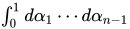
where
∫
0
1
d
α
1
⋯
d
α
n
−
1
{\textstyle \int _{0}^{1}d\alpha _{1}\cdots d\alpha _{n-1}}
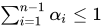
0
≤
α
i
≤
1
{\displaystyle 0\leq \alpha _{i}\leq 1}
∑
i
=
1
n
−
1
α
i
≤
1
{\textstyle \sum _{i=1}^{n-1}\alpha _{i}\leq 1}
The next step is to perform the
α
{\displaystyle \alpha }
∫
0
∞
d
α
α
n
−
1
exp
(
−
α
x
)
=
∂
n
−
1
∂
(
−
x
)
n
−
1
(
∫
0
∞
d
α
exp
(
−
α
x
)
)
=
(
n
−
1
)
!
x
n
.
{\displaystyle \int _{0}^{\infty }d\alpha \ \alpha ^{n-1}\exp(-\alpha x)={\frac {\partial ^{n-1}}{\partial (-x)^{n-1}}}\left(\int _{0}^{\infty }d\alpha \exp(-\alpha x)\right)={\frac {\left(n-1\right)!}{x^{n}}}.}
where we have defined
x
=
α
1
A
1
+
⋯
+
α
n
−
1
A
n
−
1
+
(
1
−
α
1
−
⋯
−
α
n
−
1
)
A
n
.
{\displaystyle x=\alpha _{1}A_{1}+\cdots +\alpha _{n-1}A_{n-1}+\left(1-\alpha _{1}-\cdots -\alpha _{n-1}\right)A_{n}.}
Substituting this result, we get to the penultimate form,
1
A
1
⋯
A
n
=
(
n
−
1
)
!
∫
0
1
d
α
1
⋯
d
α
n
−
1
1
[
α
1
A
1
+
⋯
+
α
n
−
1
A
n
−
1
+
(
1
−
α
1
−
⋯
−
α
n
−
1
)
A
n
]
n
,
{\displaystyle {\frac {1}{A_{1}\cdots A_{n}}}=\left(n-1\right)!\int _{0}^{1}d\alpha _{1}\cdots d\alpha _{n-1}{\frac {1}{[\alpha _{1}A_{1}+\cdots +\alpha _{n-1}A_{n-1}+\left(1-\alpha _{1}-\cdots -\alpha _{n-1}\right)A_{n}]^{n}}},}
and, after introducing an extra integral, we arrive at the final form of the Feynman parametrization, namely,
1
A
1
⋯
A
n
=
(
n
−
1
)
!
∫
0
1
d
α
1
⋯
∫
0
1
d
α
n
δ
(
1
−
α
1
−
⋯
−
α
n
)
[
α
1
A
1
+
⋯
+
α
n
A
n
]
n
.
{\displaystyle {\frac {1}{A_{1}\cdots A_{n}}}=\left(n-1\right)!\int _{0}^{1}d\alpha _{1}\cdots \int _{0}^{1}d\alpha _{n}{\frac {\delta \left(1-\alpha _{1}-\cdots -\alpha _{n}\right)}{[\alpha _{1}A_{1}+\cdots +\alpha _{n}A_{n}]^{n}}}.}
Similarly, in order to derive the Feynman parametrization form of the most general case,
1
A
1
α
1
.
.
.
A
n
α
n
{\textstyle {\frac {1}{A_{1}^{\alpha _{1}}...A_{n}^{\alpha _{n}}}}}
1
A
1
α
1
=
1
(
α
1
−
1
)
!
∫
0
∞
d
s
1
s
1
α
1
−
1
e
−
s
1
A
1
=
1
Γ
(
α
1
)
∂
α
1
−
1
∂
(
−
A
1
)
α
1
−
1
(
∫
0
∞
d
s
1
e
−
s
1
A
1
)
{\displaystyle {\frac {1}{A_{1}^{\alpha _{1}}}}={\frac {1}{\left(\alpha _{1}-1\right)!}}\int _{0}^{\infty }ds_{1}\,s_{1}^{\alpha _{1}-1}e^{-s_{1}A_{1}}={\frac {1}{\Gamma (\alpha _{1})}}{\frac {\partial ^{\alpha _{1}-1}}{\partial (-A_{1})^{\alpha _{1}-1}}}\left(\int _{0}^{\infty }ds_{1}e^{-s_{1}A_{1}}\right)}
and then proceed exactly along the lines of previous case.
Alternative form
edit
Symmetric form
edit
A symmetric form of the parametrization is occasionally used, where the integral is instead performed on the interval
[
−
1
,
1
]
{\displaystyle [-1,1]}
1
A
B
=
2
∫
−
1
1
d
u
[
(
1
+
u
)
A
+
(
1
−
u
)
B
]
2
.
{\displaystyle {\frac {1}{AB}}=2\int _{-1}^{1}{\frac {du}{\left[(1+u)A+(1-u)B\right]^{2}}}.}
References
edit

![{\displaystyle {\frac {1}{AB}}=\int _{0}^{1}{\frac {du}{\left[uA+(1-u)B\right]^{2}}}}](https://wikimedia.org/api/rest_v1/media/math/render/svg/ba6124fb1e6f1989accc58fa8f8fdefeb8f767bf)
![{\displaystyle {\begin{aligned}\int {\frac {dp}{A(p)B(p)}}&=\int dp\int _{0}^{1}{\frac {du}{\left[uA(p)+(1-u)B(p)\right]^{2}}}\\&=\int _{0}^{1}du\int {\frac {dp}{\left[uA(p)+(1-u)B(p)\right]^{2}}}.\end{aligned}}}](https://wikimedia.org/api/rest_v1/media/math/render/svg/29ccc41783d63b9e3ea5f9e74b9bb3a76df0e872)

![{\displaystyle {\begin{aligned}{\frac {1}{A_{1}\cdots A_{n}}}&=(n-1)!\int _{0}^{1}du_{1}\cdots \int _{0}^{1}du_{n}{\frac {\delta (1-\sum _{k=1}^{n}u_{k})\;}{\left(\sum _{k=1}^{n}u_{k}A_{k}\right)^{n}}}\\&=(n-1)!\int _{0}^{1}du_{1}\int _{0}^{u_{1}}du_{2}\cdots \int _{0}^{u_{n-2}}du_{n-1}{\frac {1}{\left[A_{1}u_{n-1}+A_{2}(u_{n-2}-u_{n-1})+\dots +A_{n}(1-u_{1})\right]^{n}}}.\end{aligned}}}](https://wikimedia.org/api/rest_v1/media/math/render/svg/e94fd2533e0bfeda618f754c11269f59a7e3ae2e)








![{\displaystyle {\frac {1}{AB}}=\int _{0}^{1}{\frac {du}{\left[uA+(1-u)B\right]^{2}}}.}](https://wikimedia.org/api/rest_v1/media/math/render/svg/7c889abc83102e38acad92e417ca8271f2b7dbf2)










![{\displaystyle {\frac {1}{A_{1}\cdots A_{n}}}=\left(n-1\right)!\int _{0}^{1}d\alpha _{1}\cdots d\alpha _{n-1}{\frac {1}{[\alpha _{1}A_{1}+\cdots +\alpha _{n-1}A_{n-1}+\left(1-\alpha _{1}-\cdots -\alpha _{n-1}\right)A_{n}]^{n}}},}](https://wikimedia.org/api/rest_v1/media/math/render/svg/9f292fd8ef3883120a5bf7f93df4cabf998a83cc)
![{\displaystyle {\frac {1}{A_{1}\cdots A_{n}}}=\left(n-1\right)!\int _{0}^{1}d\alpha _{1}\cdots \int _{0}^{1}d\alpha _{n}{\frac {\delta \left(1-\alpha _{1}-\cdots -\alpha _{n}\right)}{[\alpha _{1}A_{1}+\cdots +\alpha _{n}A_{n}]^{n}}}.}](https://wikimedia.org/api/rest_v1/media/math/render/svg/b11d20312b5ef0eb58f51c9cb4b61c2cc8b95f71)


![{\displaystyle {\frac {1}{AB}}=\int _{0}^{\infty }{\frac {d\lambda }{\left[\lambda A+B\right]^{2}}}.}](https://wikimedia.org/api/rest_v1/media/math/render/svg/96b103991b478aa4c7f21ffc0d51b9c8e7711846)

![{\displaystyle {\begin{aligned}{\frac {1}{AB}}&=\int _{0}^{1}{\frac {du}{\left[uA+(1-u)B\right]^{2}}}\\&=\int _{0}^{1}{\frac {du}{(1-u)^{2}}}{\frac {1}{\left[{\frac {u}{1-u}}A+B\right]^{2}}}\\&=\int _{0}^{\infty }{\frac {d\lambda }{\left[\lambda A+B\right]^{2}}}\\\end{aligned}}}](https://wikimedia.org/api/rest_v1/media/math/render/svg/53d4182ef7a1d46a52f9f40f0c9cea3988f7c028)
![{\displaystyle {\frac {1}{A^{m}B^{n}}}={\frac {\Gamma (m+n)}{\Gamma (m)\Gamma (n)}}\int _{0}^{\infty }{\frac {\lambda ^{m-1}d\lambda }{\left[\lambda A+B\right]^{n+m}}},}](https://wikimedia.org/api/rest_v1/media/math/render/svg/7b986497e8262710b61788c4b56e6b6753d55a3e)


![{\displaystyle [-1,1]}](https://wikimedia.org/api/rest_v1/media/math/render/svg/51e3b7f14a6f70e614728c583409a0b9a8b9de01)
![{\displaystyle {\frac {1}{AB}}=2\int _{-1}^{1}{\frac {du}{\left[(1+u)A+(1-u)B\right]^{2}}}.}](https://wikimedia.org/api/rest_v1/media/math/render/svg/869668a62d68d9029027a8be5272a4ec432944ef)
