
Crataegus erythropoda is a hawthorn native to the southern Rocky Mountains in the United States. The leaves are conspicuously shiny above and fruit ("haws") are dark purplish red.[1] It is seldom cultivated, but at one time was listed in the nursery trade under the common name "Chocolate Haw".[2] It is closely related to C. rivularis which has fruit that are fully black when ripe.[3][4]
| Crataegus erythropoda | |
|---|---|

| |
Scientific classification 
| |
| Kingdom: | Plantae |
| Clade: | Tracheophytes |
| Clade: | Angiosperms |
| Clade: | Eudicots |
| Clade: | Rosids |
| Order: | Rosales |
| Family: | Rosaceae |
| Genus: | Crataegus |
| Section: | Crataegus sect. Douglasia |
| Series: | Crataegus ser. Cerrones |
| Species: | C. erythropoda
|
| Binomial name | |
| Crataegus erythropoda | |

| |
| Natural range of Crataegus erythropoda | |
| Synonyms | |
Images edit
-
 Leaf bud opening in the spring, and thorn
 -
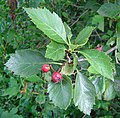 Fruit not yet ripe, a lighter colour than on some other individuals


See also edit
References edit
- ^ a b Cockerell, T.D.A. (1907). "The genus Crataegus in Colorado". University of Colorado Studies. 5: 41–45.
- ^ Andrews, D.M. 1923. New and noteworthy plants. Rockmont Nursery, Boulder, CO.
- ^ Phipps, J.B.; O’Kennon, R.J.; Lance, R.W. (2003). Hawthorns and medlars. Cambridge, U.K.: Royal Horticultural Society. ISBN 0881925918.
- ^ Phipps, J.B. (1999). "The relationships of the American black-fruited hawthorns Crataegus erythropoda, C. rivularis, C. saligna and C. brachyacantha to C. ser. Douglasianae (Rosaceae)". SIDA, Contributions to Botany. 18 (3): 647–660. JSTOR 41968885.
 Media related to Crataegus erythropoda at Wikimedia Commons
 | This Crataegus article is a stub. You can help Wikipedia by expanding it. |