
Crataegus douglasii is a North American species of hawthorn known by the common names black hawthorn and Douglas' thornapple. It is most abundant in the Pacific Northwest.
| Crataegus douglasii | |
|---|---|

| |
Scientific classification 
| |
| Kingdom: | Plantae |
| Clade: | Tracheophytes |
| Clade: | Angiosperms |
| Clade: | Eudicots |
| Clade: | Rosids |
| Order: | Rosales |
| Family: | Rosaceae |
| Genus: | Crataegus |
| Species: | C. douglasii
|
| Binomial name | |
| Crataegus douglasii | |

| |
| Natural range of Crataegus douglasii | |
| Synonyms | |
|
C. brockwayae Sarg.[1] | |
Description edit
Crataegus douglasii is a compact erect bushy shrub growing to 8–9 metres (26–30 feet) tall with a trunk of up to 10 centimetres (4 inches) thick.[3] It is covered in fan-shaped green leaves about 2.5–5 cm (1–2 in) long[3] with teeth along the distal margin. Thorns along the branches are 1–2.5 cm long.[3]
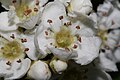
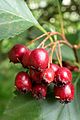
White flowers with greenish centers grow in bunches at the ends of each thin branch. The fruit is a blackish pome up to about 1 cm across, containing 3–5 rocklike seeds.[3]
Taxonomy edit
The species is named after David Douglas, who collected seed from the plant during his botanical explorations.[4]
Formerly placed within the species, Crataegus douglasii var. duchesnensis is now considered to be a synonym of Crataegus saligna.
Distribution edit
The thorny shrub is native to northern and western North America, where it grows in varied habitats from forest to scrubland. It is most abundant in the Pacific Northwest.
Ecology edit
The foliage is browsed by cattle and sheep. Various birds, including quail, the Hungarian partridge, and ring-necked pheasant feed on the berries,[4][5] as do bears and other animals.[3] Magpies nest in the branches.[3] The species is a larval host to the gray hairstreak, mourning cloak, pale tiger swallowtail, and western tiger swallowtail.[6]
Uses edit
The fruits were a good food source for Native American peoples such as the Cheyenne and Nlaka'pamux.[citation needed]
Gallery edit
-
![Straight, stout thorns are one to two centimeters long.[7]](//upload.wikimedia.org/wikipedia/commons/thumb/0/0a/Crataegus_douglasii_9816.JPG/80px-Crataegus_douglasii_9816.JPG) Straight, stout thorns are one to two centimeters long.[7]
Straight, stout thorns are one to two centimeters long.[7] -
 The white flowers have greenish centers.
 -
 Crataegus douglasii
 -
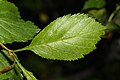 The leaf margin is toothed and usually slightly lobed.
 -
 Crataegus douglasii leaves changing color in fall.
 -
![The mature bark is grey and rough.[8]](//upload.wikimedia.org/wikipedia/commons/thumb/f/f4/Crataegus_douglasii_mature_bark.jpg/104px-Crataegus_douglasii_mature_bark.jpg) The mature bark is grey and rough.[8]
The mature bark is grey and rough.[8] -

-
-
 Crataegus douglasii
 -
 Crataegus douglasii JEPS109866 (4496863581)
![Straight, stout thorns are one to two centimeters long.[7]](/wiki/File:Crataegus_douglasii_9816.JPG)


.jpg)
![The mature bark is grey and rough.[8]](/wiki/File:Crataegus_douglasii_mature_bark.jpg)


.jpg)
See also edit
References edit

- ^ Kruschke, E.P. (1965). "Contributions to the taxonomy of Crataegus". Milwaukee Public Museum Publications in Botany. 3: 11–273.
- ^ Phipps, J.B. (1995). "The identity of Crataegus columbiana and its relationship to C. piperi (Rosaceae)". Taxon. 44 (3): 405–8. doi:10.2307/1223414. JSTOR 1223414.
- ^ a b c d e f Arno, Stephen F.; Hammerly, Ramona P. (2020) [1977]. Northwest Trees: Identifying & Understanding the Region's Native Trees (field guide ed.). Seattle: Mountaineers Books. pp. 248–249. ISBN 1-68051-329-X. OCLC 1141235469.
- ^ a b Whitney, Stephen (1985). Western Forests (The Audubon Society Nature Guides). New York: Knopf. p. 392. ISBN 0-394-73127-1.
- ^ Peattie, Donald Culross (1953). A Natural History of Western Trees. New York: Bonanza Books. p. 519.
- ^ The Xerces Society (2016), Gardening for Butterflies: How You Can Attract and Protect Beautiful, Beneficial Insects, Timber Press.
- ^ "Crataegus douglasii". WTU Herbarium Image Collection. Burke Museum, University of Washington. Retrieved 2009-12-12.
- ^ Pojar, Jim; Andy MacKinnon (1994). Plants of the Pacific Northwest. Lone Pine. p. 73. ISBN 1-55105-042-0.
External links edit
- Jepson Manual Treatment - Crataegus douglasii
- U.Mich: Ethnobotany
- Crataegus douglasii - Photo gallery
 | This Crataegus article is a stub. You can help Wikipedia by expanding it. |