
A plant canker is a small area of dead tissue, which grows slowly, often over years. Some cankers are of only minor consequence, but others are ultimately lethal and therefore can have major economic implications for agriculture and horticulture. Their causes include a wide range of organisms as fungi, bacteria, mycoplasmas and viruses. The majority of canker-causing organisms are bound to a unique host species or genus, but a few will attack other plants. Weather (via frost or windstorm damage) and animal damage can also cause stress to the plant resulting in cankers. Other causes of cankers is pruning when the bark is wet or using un-sterilized tools.[1]

Although fungicides or bactericides can treat some cankers, often the only available treatment is to destroy the infected plant to contain the disease.
Examples edit

- Apple canker, caused by the fungus Neonectria galligena
- Ash bacterial canker, now understood to be caused by the bacterium Pseudomonas savastanoi, rather than Pseudomonas syringae. After DNA-relatedness studies Pseudomonas savastanoi has been instated as a new species.[2]
- Butternut canker, caused by the fungus Sirococcus clavigignenti-juglandacearum
- Bleeding canker of horse chestnut, caused by the bacterium Pseudomonas syringae pv. aesculi
- Citrus canker, caused by the bacterium Xanthomonas axonopodis
- Cypress canker, caused by the fungus Seiridium cardinale
- Foamy bark canker of oaks in California, caused by the fungus Geosmithia putterillii
- Dogwood anthracnose, caused by the fungus Discula destructiva
- Grape canker, caused by the fungus Eutypa lata
- Honey locust canker, caused by the fungus Thyronectria austro-americana
- Larch canker, caused by the fungus Lachnellula willkommii
- Mulberry canker, caused by the fungus Gibberella baccata
- Oak canker, caused by the fungus Diplodia quercina
- Pine pitch canker, caused by the fungus Fusarium circinatum
- Plane anthracnose, caused by the fungus Apiognomonia veneta
- Poplar canker, caused by the bacterium Xanthomonas populi
- Rapeseed stem canker, caused by the blackleg fungus Leptosphaeria maculans
- Rose cankers, caused by the fungus Leptosphaeria coniothyrium and Cryptosporella umbrina
- Scleroderris canker, caused by the fungus Gremmeniella abietina
- Southwest canker, caused by environmental conditions (frost damage and sun-scalding)[3]
- Strawberry anthracnose, caused by the fungus species complexes Colletotrichum acutatum and C. gloeosporioides (incl. C. fragariae)[4][5][6]
- Tomato anthracnose, caused by the fungus Colletotrichum coccodes
- Willow anthracnose, caused by the fungus Marssonina salicicola
-
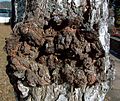 Canker on a birch
 -
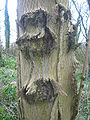
 Canker on a beech tree
 -
 Canker on an ash tree in North Ayrshire, Scotland


See also edit
References edit
- ^ "Canker Diseases". The Morton Arboretum. Retrieved 18 September 2023.
- ^ Gardan, L.; Shafik, H.; Belouin, S.; Broch, R.; Grimont, F.; Grimont, P. A. D. (1 April 1999). "DNA relatedness among the pathovars of Pseudomonas syringae and description of Pseudomonas tremae sp. nov. and Pseudomonas cannabina sp. nov. (ex Sutic and Dowson 1959)". International Journal of Systematic Bacteriology. 49 (2): 469–478. doi:10.1099/00207713-49-2-469. PMID 10319466.
- ^ Southwest Canker
- ^ Smith, B. J. (2007). "Developmental Stage and Temperature Affect Strawberry Flower and Fruit Susceptibility to Anthracnose". In Takeda, F.; Handley, D. T.; Poling, E. B. (eds.). Proceedings 2007 North American Strawberry Symposium. Kemptville, ON Canada: North American Strawberry Growers Association. pp. 55–57.
- ^ Dowling, Madeline; Peres, Natalia; Villani, Sara; Schnabel, Guido (2020). "Managing Colletotrichum on Fruit Crops: A "Complex" Challenge". Plant Disease. 104 (9): 2301–2316. doi:10.1094/PDIS-11-19-2378-FE. ISSN 0191-2917. PMID 32689886. S2CID 219479598.
- ^ Damm, U.; Cannon, P. F.; Woudenberg, J. H. C.; Crous, P. W. (2012). "The Colletotrichum acutatum species complex". Studies in Mycology. complex species or species complexes?. 73: 37–113. doi:10.3114/sim0010. ISSN 0166-0616. PMC 3458416. PMID 23136458.
External links edit

- [1] Canker Diseases of Trees