
Cameroonian cuisine is one of the most varied in Africa due to Cameroon's location on the crossroads between the north, west, and center of the continent; the diversity in ethnicity with mixture ranging from Bantus, Semi-bantus and Shuwa Arabs, as well as the influence of German, French and English colonialization.


Ingredients edit
The soil of most of the country is very fertile and a wide variety of vegetables and fruits, both domestic and imported species, are grown. These include:
Specialties edit

Among Cameroonian specialties are:
- Fufu corn and njama njama (garden huckleberry leaves)
- Brochettes, known locally as soya (a kind of barbecued kebab made from chicken, beef, or goat)
- Sangah (a mixture of maize, cassava leaf, and palm nut juice)
- Mbanga soup and Kwacoco
This is a Cameroonian meal made up of Kwacoco—cocoyams (taro) grated and steamed in banana leaves, and the Banga Soup - soup made out of fresh palm nuts. It is a native dish of the Bakweri people. Specialty from the Southwest region.
- Eru or Nfoh and Water Fufu
It is vegetable soup made up of finely shredded leaves of the eru. The eru is cooked with waterleaf or spinach, palm oil, crayfish, and either smoked fish, cow skin (kanda) or beef. normally eaten with Water fufu (cassava); It is a native dish of the Manyu people. Specialty from the Southwest region.
- Ndolé (a spicy stew containing bitterleaf greens, meat, shrimp, pork rind, and peanut paste)

- Koki (food) (primarily consisting of blackeyed peas and red palm oil)
- Koki cooking varieties (Vigna unguiculata)
-
 Koki fritter
 -
 Koki (Niébé cake)
 -
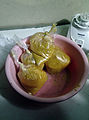 Base product

.jpg)

- Achu soup (cocoyam fufu with an orange/yellow red palm oil soup)

- Mbongo'o tjobi (a spicy black soup made with native herbs and spices)

- Egusi soup (ground pumpkin seeds often cooked with dark leafy greens or okra)
- Kondreh (stewed unripe plantains with herbs and spices, usually cooked with goat meat)
- Kati kati, a grilled chicken dish[1][2][3] and traditional food of the Kom.[4]
Curries, soups and fish dishes abound, as well as meats on skewers. Insects are eaten in some parts of the country (particularly the forested regions).
See also edit

References edit
- ^ Kouega, Jean-Paul (November 26, 2007). A Dictionary of Cameroon English Usage. Peter Lang. ISBN 9783039110278 – via Google Books.
- ^ Planet, Lonely; Ham, Anthony; Grosberg, Michael; Luckham, Nana; Maric, Vesna; Ranger, Helen; Sieg, Caroline; Smith, Helena; Louis, Regis St; Stiles, Paul; Butler, Stuart (September 1, 2017). Lonely Planet West Africa. Lonely Planet. ISBN 9781787012462 – via Google Books.
- ^ Nde, Nkwentie, Susan (March 16, 2014). The Mirror and Nine Other Short Stories. Langaa RPCIG. ISBN 9789956791552 – via Google Books.
{{cite book}}: CS1 maint: multiple names: authors list (link) - ^ Loh, Choves (January 31, 2018). "Cameroon: Laikom - the Bedrock of Kom Culture". allAfrica.com.