
Tweed is a rough, woollen fabric, of a soft, open, flexible texture, resembling cheviot or homespun, but more closely woven. It is usually woven with a plain weave, twill or herringbone structure. Colour effects in the yarn may be obtained by mixing dyed wool before it is spun.[1]

Tweeds are an icon of traditional Scottish, Irish, Welsh, and English clothing, being desirable for informal outerwear,[2] due to the material being moisture-resistant and durable. Tweeds are made to withstand harsh climates[3] and are commonly worn for outdoor activities such as shooting and hunting, in England, Wales, Ireland, and Scotland. In Ireland, tweed manufacturing is now most associated with County Donegal but originally covered the whole country.[4] In Scotland, tweed manufacturing is most associated with the Isle of Harris in the Hebrides.
Etymology edit

The original name of the cloth was tweel, Scots for twill, the material being woven in a twilled rather than a plain pattern. A traditional story has the name coming about almost by chance. Around 1831, a London merchant, James Locke, received a letter from a Hawick firm, Wm. Watson & Sons, Dangerfield Mills about some "tweels". The merchant misinterpreted the handwriting, understanding it to be a trade-name taken from the River Tweed that flows through the Scottish Borders textile area. The goods were subsequently advertised as Tweed and the name has remained since.[5]
Traditions and culture edit

Traditionally used for upper-class country clothing such as shooting jackets, tweed became popular among the Edwardian middle classes who associated it with the leisurely pursuits of the elite.[6] Due to their durability tweed Norfolk jackets and plus-fours were a popular choice[7] for hunters, cyclists, golfers, and early motorists, hence Kenneth Grahame's depiction of Mr. Toad in a Harris Tweed suit.[8] Popular patterns include houndstooth,[9] associated with 1960s fashion, windowpane, gamekeeper's tweed worn by academics, Glen plaid check, originally commissioned by Edward VII, and herringbone.[10]
During the 2000s and 2010s, members of long-established British and American land-owning families started to wear high-quality heirloom tweed inherited from their grandparents, some of which pre-dated the Second World War.[11][12]
In modern times, cyclists may wear tweed when they ride vintage bicycles on a Tweed Run. This practice has its roots in the British young fogey and hipster subcultures of the late 2000s and early 2010s, whose adherents appreciate both vintage tweed, and bicycles.[13]
Musical instruments edit
Some vintage Danemann upright pianos have a tweed cloth backing to protect the internal mechanism. Occasionally, Scottish bagpipes were covered in tweed as an alternative to tartan wool.[14]
The term "tweed" is used to describe coverings on instrument cables and vintage or retro guitar amplifiers, such as the Fender tweed and Fender Tweed Deluxe.[15] Despite the terminology, many of these coverings were not considered tweed but cotton twill due to the cover's design, which caused this misidentification of the design.
Types of tweed edit
This section needs additional citations for verification. (October 2021) |
- Harris Tweed: A handwoven tweed, defined in the Harris Tweed Act 1993 as cloth that is "Handwoven by the islanders at their homes in the Outer Hebrides, finished in the Outer Hebrides, and made from pure virgin wool dyed and spun in the Outer Hebrides".[16]
- Donegal tweed: A handwoven tweed which has been manufactured for several centuries in County Donegal, Ireland, using wool from locally-bred sheep and dye from indigenous plants such as blackberries, gorse (whins), and moss.
- Silk tweed: A fabric made of raw silk with flecks of colour typical of woollen tweed.
- Saxony tweed: Originated in Saxony, Germany. It is a fabric made from the wool of merino sheep. It is very smooth and soft.
Gallery edit
-
 Logo of the Harris Tweed authority
 -
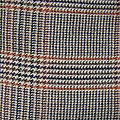 Glen plaid, Glenurquhart, or Prince of Wales check, frequently used to make overcoats and sportcoats in the 1950s
 -
 Example of the herringbone pattern, a popular choice for suits and outerwear
 -
 Houndstooth, the basis of the keeper's tweed popular among the upper classes from the 1860s until the 1930s
 -
 Grey Donegal tweed sportcoat
 -
 A deerstalker hat made of district or gamekeeper's tweed (contrasting mustard, green and brown checks)
 -
 Windowpane tweed popular in the late 19th century and again in the 1970s
 -

-
 Hunting apparel belonging to Gustaf V of Sweden, 1930s.
 -
 Harris Tweed Nike
 -
 Charlie Hunter (left) watches as Old Tom Morris plays a shot in 1863 at Prestwick. Both of the players are wearing the traditional tweeds.


See also edit
Notes edit
- ^ "Harris Tweed - The Cloth". The Harris Tweed Authority. Archived from the original on 15 August 2015. Retrieved 1 August 2015.
- ^ Fashion Institute of Technology (2006). ""The Tailor's Art" | Menswear Fabrics - A Glossary". The Museum at FIT. Archived from the original on 2 June 2007. Retrieved 24 November 2008.
- ^ "Tweed Jackets | A Closely Woven Thing". Cad & the Dandy. 20 November 2015. Retrieved 19 March 2019.
- ^ Corrigan, Vawn (2020). Irish Tweed: History, Tradition, Fashion. O'Brien Press. ISBN 9781788492010.
- ^ Kirkpatrick, Betty (2015). Treacle, Toast and Tweed ... English Word Origins for Language Lovers. Crombie Jardine Publishing Ltd. ISBN 978-1326384067.
- ^ Edward Minister and Son (August 1872). "The Norfolk Jacket". Gazette of Fashion, and Cutting-room Companion. 27 (316). Simpkin, Marshall & Co: 31.
- ^ Dutton, Edward (22 August 2014). "How to wear a tweed suit in the 21st century". A Suit That Fits. Archived from the original on 28 March 2019. Retrieved 26 January 2016.
- ^ loopy_lucy14 (31 October 1997). "Mr. Toad's Wild Ride (1996)". IMDb. Retrieved 27 July 2011.
{{cite web}}: CS1 maint: numeric names: authors list (link) - ^ Dunbar, John Telfer (1984). The Costume of Scotland. London: Batsford. ISBN 0-7134-2534-2.
- ^ "The RL Style Guide | Glossary | Herringbone". Ralph Lauren. Archived from the original on 19 September 2008. Retrieved 24 November 2008.
- ^ "Nigel Cabourn DB Tweed Jacket - Rare Classic Quality?". Grey Fox. 5 September 2012. Retrieved 17 October 2013.
- ^ Bath, Richard (25 July 2009). "Richard Bath: In defence of tweed". The Scotsman. JPIMedia Ltd. Retrieved 17 October 2013.
- ^ "#TheChapMag Vintage Garments". The Chap Magazine. 11 September 2012. Archived from the original on 25 October 2013. Retrieved 8 August 2013.
- ^ Price, Richard (16 March 2013). "Harris Tweed Bagpipe Covers". The Big Cloth and Me. Retrieved 8 August 2013.
- ^ Hunter, Dave (July 2012). "The Fender 5F4 Super Amp". Vintage Guitar. pp. 50–52.
- ^ "About Us - Guardians of the Orb". The Harris Tweed Authority. Archived from the original on 8 March 2013. Retrieved 1 August 2015.
References edit
- Corrigan, Vawn (2020). Irish Tweed: History, Tradition, Fashion. O'Brien Press. ISBN 9781788492010.
- "What is Tweed?". A Hume.
- Reynolds, Francis J., ed. (1921). . Collier's New Encyclopedia. New York: P. F. Collier & Son Company.
- National Library of Scotland: SCOTTISH SCREEN ARCHIVE (archive films relating to tweed manufacture in Scotland)
- Anderson, Fiona (2016). Tweed. London: Bloomsbury Academic Press. ISBN 978-1-84520-697-0.
External links edit
 Media related to Tweed at Wikimedia Commons
