
Southern Railway (SR) is one of the eighteen zones of Indian Railways. It is headquartered at Chennai and operates across the states of Tamil Nadu, Kerala, Andhra Pradesh and the union territory of Puducherry. The origin of the Southern Railway can be traced back to the Madras Railway formed in 1845. Southern Railway was created on 14 April 1951 by merging three state railways, namely, the Madras and Southern Mahratta Railway, the South Indian Railway Company, and the Mysore State Railway. Southern Railway maintains about 5,081 km (3,157 mi) of railway lines and operates 727 railway stations.
 | |
 7-Southern Railway | |
| Overview | |
|---|---|
| Headquarters | Chennai |
| Reporting mark | SR |
| Locale | Tamil Nadu, Kerala, Andhra Pradesh, Puducherry |
| Dates of operation | 14 April 1951– |
| Predecessor | South Indian Railway Madras and Southern Mahratta Railway Mysore State Railway |
| Successor | Southern Railway South Coast Railway South Central Railway South Western Railway |
| Technical | |
| Previous gauge | Broad gauge Metre gauge Narrow gauge |
| Length | 5,081 km (3,157 mi) route[1] |
| Other | |
| Website | Southern Railway |
History edit
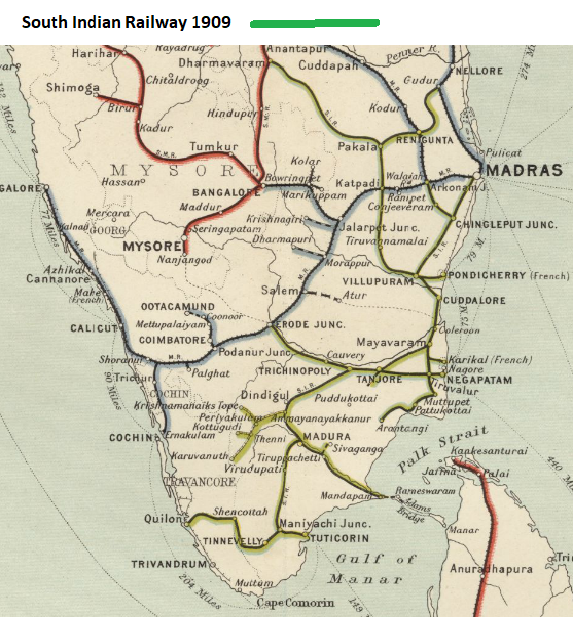
The history of the Southern Railway can be traced back to the Madras Railway. In 1832, the proposal to construct the first railway line in India at Madras was made by the British.[2] In 1835, the railway track was constructed between Little Mount and Chintadripet in Madras and became operational in 1837.[3] The Madras Railway was established later in 1845 and the construction on the first main line between Madras and Arcot started in 1853, which became operational in 1856.[4] In 1908, Madras Railway merged with Southern Mahratta Railway to form the Madras and Southern Mahratta Railway.[5][6]
In 1944, all the railway companies operating in British India were taken over by the Government.[7] Post Independence, various re-grouping proposals were studied as there were 42 different railway systems. In December 1950, the Central Advisory Committee for Railways approved the plan for Indian Railways into six zonal systems and the Southern Railway zone was created on 14 April 1951 by merging three state railways, namely, the Madras and Southern Mahratta Railway, the South Indian Railway Company, and the Mysore State Railway.[8]
Organisation edit

Southern Railway zone covers the states of Tamil Nadu, Kerala, Puducherry and a small portion of Andhra Pradesh.[8] Andaman and Nicobar will form part of the zone once the proposed new railway line between Port Blair and Diglipur becomes operational.[9]
The Southern Railway is headed by the General Manager, assisted by an Additional General Manager. Southern Railway is headquartered in Chennai and is divided into six divisions namely Chennai, Tiruchirappalli, Madurai, Palakkad, Salem and Thiruvananthapuram.[8]
| Name of Division | Established | Headquarters | Comments |
|---|---|---|---|
| Bezwada | 6-May-1956 | Vijaywada | Moved to SCR in 1966 and SCoR in 2019 |
| Madurai | 6-May-1956 | Madurai | |
| Tiruchirappalli | 6-May-1956 | Tiruchirappalli | |
| Madras | 1-August-1956 | Chennai | |
| Palakkad | 4-August-1956 | Palakkad | previously known as Olavacode |
| Guntakal | 10-October-1956 | Guntakal | Moved to SCR in 1977 and SCoR in 2019 |
| Mysore | 31-October-1956 | Mysuru | Moved to SWR in 2003 |
| Hubli | 31-October-1956 | Hubli | Moved to SCR in 1966 and SWR in 2003 |
| Bangalore | 31-October-1971 | Bangalore | Moved to SWR in 2003 |
| Thiruvananthapuram | 2-October-1979 | Thiruvananthapuram | |
| Salem | 14-November-2001 | Salem |
Operations and infrastructure edit
The zone operates both passenger and freight trains. Various classes of passenger trains including Vande Bharat Express, Shatabdi Express and Tejas Express are operated by Southern Railways.[10] Freight operations include container traffic from the ports, coal bound to the thermal power stations, oil and petroleum products from refineries, cement and food grains. Most of the lines inside ports, thermal stations, manufacturing industries and owned by the respective companies and the zone provides a link connecting to its network along with the wagons and locomotives. The zone has a larger proportion of passenger traffic compared to freight.[11][12] There are about 727 stations on the Southern railway network.[13]
Locomotives edit


Southern Railway utilizes various classes of electric and diesel locomotives to haul the trains. Steam locomotives are used by the Nilgiri Mountain Railway.[14] The zone has three electric locomotive sheds and four diesel locomotive sheds.[15]
| Name | Location | Type | Locomotive class | Count |
|---|---|---|---|---|
| Electric Loco Shed, Arakkonam | Arakkonam | Electric | WAP-4, WAG-5, WAG-9 | 171 |
| Electric Loco Shed, Erode | Erode | Electric | WAP-4, WAP-7, WAG-7 | 205 |
| Electric Loco Shed, Royapuram | Chennai | Electric | WAP-7 | 109 |
| Diesel Loco Shed, Ernakulam | Ernakulam | Diesel,Electric | WDM-3A, WDG-3A, WDM-3D, WDG-4, WAG-5 | 68 |
| Diesel Loco Shed, Erode | Erode | Diesel | WDM-3D, WAP-1, WAP-4, WAG-5, WAG-7 | 132 |
| Diesel Loco Shed, Golden Rock | Tiruchirappalli | Diesel | WDM-3A, WDG-3A, WDP-3A, WDM-3D, WDP-4, WDG-4, YDM-4 | 148 |
| Diesel Loco Shed, Tondiarpet | Chennai | Diesel | WDM-3A, WDG-3A, WDM-7, WDS-6, WDG-4 | 53 |
| Coonoor Loco Shed, Coonoor | Coonoor | Steam, Diesel | X Class, YDM-4 |

Maintenance and workshops edit
Southern Railway maintains wagon and locomotive workshops at Perambur, Chennai and Ponmalai, Tiruchirapalli, engineering workshop at Arakkonam, carriage maintenance workshops at Basin Bridge and Egmore and a signal and telecommunication workshop at Podanur, Coimbatore. It has three EMU car sheds in Chennai at Avadi, Tambaram, Velachery and MEMU sheds Kollam[16] and Palakkad.[17] Southern Railway maintains trip sheds at Basin Bridge, Egmore, Tondiarpet and Jolarpettai.[15] Southern Railway operated ticket printing presses at Royapuram, Thiruvananthapuram and Tiruchirappalli, but have been phased out due to digitization.[18][19]
Railway coaches and wagons edit
Southern Railways uses both ICF coaches and LHB coaches for its trains. ICF coaches manufactured by the Integral Coach Factory in Chennai have been used predominantly for over sixty years since the formation of the zone in 1951.[20] The ICF coaches are being slowly replaced by the newer LHB rakes which provide better passenger comfort and safety.[21][22]
Railway lines edit
Following are the list of railway lines operational.[23]


Defunct railway lines include Kundala Valley Railways,[24][25] Kochin Tramways,[26] Madras Tramways,[27] Tiruchendur Light Railway,[28] Dharmapuri and Krishnagiri famine light railways,[29][30] Kodaikanal Light Railway.[31] [32]
Trains edit
Southern Railways operates 41 sets of express trains and 97 sets of superfast trains. The superfast trains include: Vande Bharat Express (8), Shatabdi Express (2), Garib Rath Express (2), Duronto Express (1), Jan Shatabdi Express (4), Sampark Kranti Express (1), Anuvrat Express (1), Humsafar Express (1), Tejas Express (1), Uday Express (1), Antyodaya Express (2) and Double Decker Express (1). Apart from this, it operates various Passenger trains, DEMU, EMU services, Chennai Suburban and the Nilgiri Mountain Railway.[10]
Stations edit
There are about 727 stations on the Southern railway network including 486 non suburban stations, 74 suburban stations and 166 halt stations. The major and highest revenue earning stations are Chennai Central, Chennai Egmore, Tambaram, Coimbatore Junction, Madurai Junction, Thiruvananthapuram Central and Ernakulam Junction.[13]
Chennai Suburban edit

Chennai Suburban Railway is the commuter rail system in the city of Chennai, operated by the Southern Railways. The system operates four lines with a track length of 1,174.21 km (729.62 mi), of which 509.71 km (316.72 mi) are dedicated dual tracks for EMUs.[33][34]
| Line | Start | End | Type | Length | Stations |
|---|---|---|---|---|---|
| North Line | Chennai Central | Sullurpeta | Suburban | 82 km (51 mi) | 30 |
| South Line | Chennai Beach | Chengalpattu | Suburban | 60 km (37 mi) | 50 |
| West Line | Chennai Beach | Tiruttani | Suburban | 69 km (43 mi) | 57 |
| Chennai MRTS | Chennai Beach | Velachery | MRTS | 19 km (12 mi) | 25 |
Nilgiri Mountain Railway edit

Nilgiri Mountain Railway is a 1,000 mm (3 ft 3+3⁄8 in) metre gauge railway in Nilgiris district connecting Mettupalayam and Udagamandalam. It was built during the British Raj in 1908 and is currently operated by the Southern Railways.[35][36] It is the only rack railway in India and operates on its own fleet of steam locomotives between Coonoor and Udhagamandalam.[37] In July 2005, UNESCO added the Nilgiri Mountain Railway as an extension to the World Heritage Site of Mountain Railways of India.[36]
See also edit
References edit
- ^ "Southern Railway vital statistics" (PDF). Southern Railway. Retrieved 20 January 2019.
- ^ Understanding Indian Railway Heritage (PDF) (Report). Indian Railways. p. 6. Retrieved 1 December 2023.
- ^ "Chennai: The track record". New Indian Express. 16 April 2018. Retrieved 9 August 2023.
- ^ "On Forgotten Road". The Times of India. 31 March 2013. Retrieved 9 August 2023.
- ^ "Third oldest railway station in country set to turn 156". Indian Railways. Retrieved 13 February 2013.
- ^ The Cambridge Economic History of India. Vol. 2. Orient Longmans Private Limited. 2005. p. 755. ISBN 978-8-1250-2731-7.
- ^ Evolution of Indian Railways-Historical Background (Report). Indian Railways. Retrieved 1 December 2023.
- ^ a b c "Southern Railways, about us". Southern Railway. Retrieved 12 August 2023.
- ^ "Railways to show green signal to a train in Andaman and Nicobar". Indian Express. 6 February 2017. Retrieved 12 August 2023.
- ^ a b "Southern Railways". Indiarailinfo. Retrieved 12 August 2023.
- ^ "Southern Railway punctuality and fiscal performance hit". The Times of India. Retrieved 24 February 2018.
- ^ "Southern Railway's financial and operational performance dips". The Times of India. Retrieved 24 February 2018.
- ^ a b "Southern Railway stations" (PDF) (pdf). Indian Railways. Retrieved 12 August 2023.
- ^ "Coonoor loco shed opened for tourists". The Hindu. 29 September 2019. Retrieved 12 August 2023.
- ^ a b "Sheds and Workshops – Southern Railway". IRFCA. Retrieved 1 November 2023.
- ^ "Three ISO certificates for MEMU maintenance shed". The Hindu. 3 September 2019. Retrieved 27 September 2023.
- ^ "Memu rakes yet to reach Kerala". Deccan Chronicle. 18 May 2018. Retrieved 27 September 2023.
- ^ "Ticket to the Past". The Hindu. 30 August 2018. Retrieved 12 August 2023.
- ^ "Railway board plans to ease out 100 year old printing press". Times of India. 5 November 2017. Retrieved 12 August 2023.
- ^ "Is It Time for Indian Railways to Tear Up Ageing Tracks and Old Machinery?". Zee Media Corporation. 14 January 2022. Retrieved 6 June 2023.
- ^ Ayyappan, V. (4 January 2021). "Leakage Found in ICF Coaches". The Times of India. Retrieved 6 June 2023.
- ^ Debroy, Bibek (9 February 2018). "A 70-Year-Old Vs a 30-Year-Old: LHB Coaches Perform Better than ICF Ones". Business Standard. Retrieved 6 June 2023.
- ^ Southern Railway Route Map (PDF) (Report). Indian Railways. Retrieved 12 August 2023.
- ^ "Remains of Kundala Valley Railway, Munnar". IRFCA. Retrieved 30 December 2020.
- ^ Correspondent, A. (22 June 2019). "Monorail may return to Munnar". The Hindu. ISSN 0971-751X. Retrieved 30 December 2020.
- ^ "Cochin State Forest Tramway". FIBIS. Retrieved 30 December 2020.
- ^ "Madras Tramways – FIBIwiki". FIBIS. Retrieved 30 December 2020.
- ^ "Kulasekharapatnam Tissainvillai Light Railway – FIBIwiki". FIBIS. Retrieved 30 December 2020.
- ^ "Morappur-Dharmapuri-Hosur Railway – FIBIwiki". FIBIS. Retrieved 30 December 2020.
- ^ "Tirupattur-Krishnagiri Railway – FIBIwiki". FIBIS. Retrieved 30 December 2020.
- ^ "South Indian Railway 1909". FIBIS. Retrieved 30 December 2020.
- ^ "[IRFCA] Mysteries of a Defunct Ropeway". FIBIS. Retrieved 30 December 2020.
- ^ Transport in Chennai (PDF) (Report). Chennai Metropolitan Development Authority. p. 4. Retrieved 1 December 2023.
- ^ Project Brief of Chennai Metro Rail (PDF) (Report). Chennai Metro. Retrieved 24 May 2013.
- ^ "Nilgiri Mountain railway". Indianrailway.gov.in. Retrieved 21 August 2019.
- ^ a b "Mountain Railways of India". UNESCO World Heritage Centre. Retrieved 30 April 2006.
- ^ "he Nilgiri Mountain Railway as old as the hills". The Hindu. 27 July 2019. Retrieved 1 March 2023.
External links edit
