
Snow tires, also known as winter tires, are tires designed for use on snow and ice. Snow tires have a tread design with larger gaps than those on conventional tires, increasing traction on snow and ice. Such tires that have passed a specific winter traction performance test are entitled to display a 3PMSF (Three-Peak Mountain Snow Flake) symbol on their sidewalls. Tires designed for winter conditions are optimized to drive at temperatures below 7 °C (45 °F). Studded tires are a type of snow tires which have metal or ceramic studs that protrude from the tire to increase traction on hard-packed snow or ice. Studs abrade dry pavement, causing dust and creating wear in the wheel path.[2] Regulations that require the use of snow tires or permit the use of studs vary by country in Asia and Europe, and by state or province in North America.

All-season tires have tread gaps that are smaller than snow tires and larger than conventional tires. They are quieter than winter tires on clear roads, but less capable on snow or ice.[3]
Roadway conditions in winter edit
Snow tires operate on a variety of surfaces, including pavement (wet or dry), mud, ice, or snow. The tread design of snow tires is adapted primarily to allow penetration of the snow into the tread, where it compacts and provides resistance against slippage.[4] The snow strength developed by compaction depends on the properties of the snow, which depend on its temperature and water content—wetter, warmer snow compacts better than dry, colder snow up to a point where the snow is so wet that it lubricates the tire-road interface. New and powder snow have densities of 0.1 to 0.3 g/cm3 (6 to 20 lb/cu ft). Compacted snow may have densities of 0.45 to 0.75 g/cm3 (28 to 47 lb/cu ft).[5]
Snow or ice-covered roadways present lower braking and cornering friction, compared to dry conditions. The roadway friction properties of snow, in particular, are a function of temperature. At temperatures below −7 °C (20 °F), snow crystals are harder and generate more friction as a tire passes over them than at warmer conditions with snow or ice on the road surface. However, as temperatures rise above −2 °C (28 °F), the presence of free water increasingly lubricates the snow or ice and diminishes tire friction. Hydrophilic rubber compounds help create friction in the presence of water or ice.[6]
- Dry and moist snow conditions on roadways
-
 Vehicle in cold, dry, powder snow, which offers comparatively better traction than moist snow.
 -
 Vehicles in warm, moist, granular snow encounter decreased roadway traction.


Treads edit


Attributes that can distinguish snow tires from "all-season" and summer tires include:[6]
- An open, deep tread, with a high void ratio between rubber and spaces between the solid rubber
- Shoulder blocks, a specialized tread design at the outside of the tire tread to increase snow contact and friction
- A narrower aspect ratio between the diameter of the tire and the tread width to minimize resistance from the plowing effect of the tire through deeper snow
- Hydrophilic rubber compounds that improve friction on wet surfaces
- Additional siping, or thin slits in the rubber, that provide more biting edges and improve traction on wet or icy surfaces.
Wet-film conditions on hard-compacted snow or ice require studs or chains.[6]
Studs edit
Many jurisdictions in Asia, Europe, and North America seasonally allow snow tires with metal or ceramic studs to improve grip on packed snow or ice. Such tires are prohibited in other jurisdictions or during warmer months because of the damage they may cause to road surfaces.[7] The metal studs are fabricated by encapsulating a hard pin in a softer material base, sometimes called the jacket. The pin is often made of tungsten carbide, a very hard high performance ceramic. The softer base is the part that anchors the stud in the rubber of the tire. As the tire wears with use, the softer base wears so that its surface is at about the same level as the rubber, whereas the hard pin wears so that it continues to protrude from the tire. The pin should protrude at least 1 millimetre (0.04 in) for the tire to function properly.[8] Snow tires do not eliminate skidding on ice and snow, but they greatly reduce risks.[9]
Studdable tires are manufactured with molded holes on the rubber tire tread. Usually, there are 80 to 100 molded holes per tire for stud insertion. The insertion is done by using a special tool that spreads the rubber hole so that a stud jacket can be inserted and the flange at the bottom of the jacket can be fitted nicely to the bottom of the hole. The metal studs come in specific heights to match the depths of the holes molded into the tire tread based on the tread depths. For this reason, stud metals can only be inserted when the tires have not been driven on. A proper stud insertion results in the metal jacket that is flush with the surface of the tire tread having only the pin part that protrudes.[10]
Tire/snow interactions edit
The compacted snow develops strength against slippage along a shear plane parallel to the contact area of the tire on the ground. At the same time, the bottom of the tire treads compress the snow on which they are bearing, also creating friction. The process of compacting snow within the treads requires it to be expelled in time for the tread to compact snow anew on the next rotation. The compaction/contact process works both in the direction of travel for propulsion and braking, but also laterally for cornering.[5]
The deeper the snow that the tire rolls through, the higher the resistance encountered by the tire, as it compacts the snow it encounters and plows some of it to either side. At some point on a given angle of uphill pitch, this resistance becomes greater than the resistance to slippage achieved by the tread's contact with the snow and the tires with power begin to slip and spin. Deeper snow means that climbing a hill without spinning the powered wheels becomes more difficult. However, the plowing/compaction effect aids in braking to the extent that it creates rolling resistance.[5]
- Tire/snow interactions
-
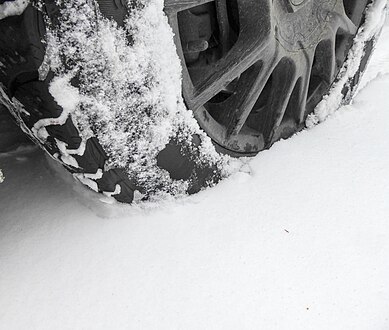 Compaction of snow under an advancing snow tire, causing rolling resistance while passing through about 10 centimetres (4 in) of snow.
 -
 Compaction in about 5 centimetres (2 in) of snow left behind a snow tire, showing tread-snow interaction.


Regulations edit

ASTM International (American Society for Testing and Materials International) is an international standards organization that develops and publishes voluntary consensus technical standards for a wide range of materials, products, systems, and services. The pertinent standard for snow tires is ASTM F1805 – 16, Standard Test Method for Single Wheel Driving Traction in a Straight Line on Snow- and Ice-Covered Surfaces, which assess tire performance on snow and ice. It measures the traction of tires under acceleration in the rolling direction.[12] Tires that pass this test are entitled to display the 3PMSF (Three-Peak Mountain Snow Flake) symbol.[13]
Asia edit
All prefectures of Japan, except for the southernmost prefecture of Okinawa, have a traffic regulation requiring motorized vehicles to be fitted with winter tires or tire chains when the road is covered by ice or snow.[14][15] In addition, tire chains must be fitted for all vehicles on rural designated highways in snow country regions when regulated by traffic signs requiring tire chains.[16]
In many prefectures, tread grooves of snow tires are worn off for more than 50% of their original depth, tires must be replaced to meet the legal requirements.[14] Drivers will be fined for failing to comply with the snow tire or tire chains requirements, and checkpoints are in place on major highways.
Nationwide studded tire restrictions in Japan for passenger vehicles came into effect in April 1991, followed by restrictions for commercial trucks in 1993.[17] Studded tires are still legal in Japan, but their usage is restricted by environmental law and it is a criminal offence to operate a vehicle fitted with a studded tire on dry asphalt or concrete.[17]
Europe edit

As of 2016, regulations pertaining to snow tires in Europe varied by country. The principal aspects of regulations were whether the use was mandatory and whether studded tires were permitted. [18] [19]

- Mandatory use – The following countries required snow tires between specified dates or when roads are snowy or icy: Austria, Bosnia-Herzegovina, Croatia, Czechia, Estonia, Finland, Germany, Latvia, Lithuania, Montenegro, Norway, Romania, Serbia, Slovakia, Slovenia, Sweden, and Russia.
- Studded tires banned – The following countries ban the use of studded tires: Albania, Belgium, Bosnia-Herzegovina, Bulgaria, Croatia, Czechia, Germany, Great Britain, Hungary, Luxembourg, North Macedonia, Montenegro, Netherlands, Poland, Portugal, Romania, Serbia, Slovakia, and Slovenia.
- Studded tires restricted – The following countries allowed the seasonally restricted use of studded tires: Austria, Denmark, Estonia, Finland, France, Iceland,[20] Ireland, Latvia, Lithuania, Norway, Russia, Spain, Sweden, and Switzerland.
North America edit
The U.S. National Highway Traffic Safety Administration (NHTSA) and Transport Canada allow display of a 3PMSF symbol to indicate that the tire has exceeded the industry requirement from a reference (non-snow) tire.[21][22] As of 2016, snow tires were 3.6% of the US market and 35% of the Canadian market.[23]
US states and Canadian provinces control the use of snow tires.[24] Of these, Quebec is the only jurisdiction that requires snow tires throughout.[25] Some may require snow tires or chains only in specified areas during the winter.[26][27][28]
See also edit
References edit
- ^ Heißing, Bernd; Ersoy, Metin (2010). Chassis Handbook: Fundamentals, Driving Dynamics, Components, Mechatronics, Perspectives. Springer Science & Business Media. p. 591. ISBN 9783834897893.
- ^ "Prall Tester - Studded Tyre Wear Test". www.cooper.co.uk. Cooper Research Technology Ltd. Retrieved 1 September 2014.
- ^ Newton, Richard (2007). Wheel and Tire Performance Handbook. St. Paul: MotorBooks International. p. 35. ISBN 9781610592512.
- ^ Taylor, Rich (January 1985), "How to pick the right winter tires", Popular Mechanics: 72–78
- ^ a b c Hays, Donald (2013). The Physics of Tire Traction: Theory and Experiment. Springer Science & Business Media. p. 428. ISBN 9781475713701. Retrieved 25 December 2016.
- ^ a b c Glenne, Bard (December 1989), "All about Snow Tires", Skiing: 52–55, 272
- ^ ScienceDaily (6 January 2011). "How Studded Winter Tires May Damage Public Health, as Well as Pavement". Retrieved 26 January 2011.
- ^ Nordström, Olle (2004), "Nya och begagnade vinterdäcks isfriktion: sammanfattningsrapport : undersökning avseende inverkan av ålder, mönsterdjup, slitbanehårdhet, dubbutstick och dubbkraft", VTI Meddelande (in Swedish) (966), ISSN 0347-6049
- ^ Gustafsson, M.; et al. (2006), Effekter av vinterdäck - en kunskapsöversikt, Väg-och transportforskningsinstitutet
- ^ "Studded Tires for Winter Driving". Tirerack.com. Retrieved 24 January 2015.
- ^ US Army, Stuttgart. "Winter Tire Rules" (PDF). stuttgart.army.mil. US Army. Archived from the original (PDF) on 22 January 2016. Retrieved 29 March 2017.
- ^
Subcommittee: F09.20 (2016). "ASTM F1805 – 16: Standard Test Method for Single Wheel Driving Traction in a Straight Line on Snow- and Ice-Covered Surfaces". ASTM Book of Standards. 9 (2): 14. doi:10.1520/F1805-16. Retrieved 26 March 2017.
{{cite journal}}: CS1 maint: numeric names: authors list (link) - ^ Department of Transportation (2007). §571.139 Standard 139 – New pneumatic radial tires for light vehicles. Vol. Title 49. Washington, DC: Office of Federal Register. p. 505. ISBN 9781577857778.
- ^ a b "冬のタイヤの滑り止めルールって?". Tire Fair Trade Council.
- ^ "Snow Tires on Your Car: Not Just a Necessity But Sometimes a Law". 1816 – The Magazine. Remington. 16 January 2015.
- ^ "チェーン規制について". Ministry of Land, Infrastructure, Transport and Tourism.
- ^ a b e-Gov Laws and Regulations Database (27 June 1990). "The Act on Prevention of the Generation of Spike Tire Dust (Act No. 55)". law.e-gov.go.jp/htmldata/H02/H02HO055.html. Government of Japan.
- ^ "Winter Regulations—European regulations for winter equipment on trucks and buses". continental-tires.com. Continental Tires. 2016. Retrieved 26 March 2017.
- ^ "Winter tyres legislation in Europe - An overview of the regulations | Uniroyal". www.uniroyal-tyres.com. Retrieved 23 July 2018.
- ^ Brimborg ehf. (10 December 2017). "Winter driving in Iceland on winter tyres". Dollar Rent-a-Car Iceland.
- ^ "Cooper Recalls 7,067 Discoverer M+S Sport Tires". moderntiredealer.com. Modern Tire Dealer. 21 February 2017. Retrieved 26 March 2017.
- ^ "What You Should Know—Tires for Winter Driving". tracanada.ca. Tire and Rubber Association of Canada. Retrieved 26 March 2017.
- ^ Dudley, David (6 December 2016). "The Joy and Terror of Urban Snow Driving". CityLab. Retrieved 13 December 2016.
- ^ "Legislation for Snow Tires in the USA". bartecusa.com. Bartec USA LLC. 2017. Retrieved 26 March 2017.
- ^ "Legislation for Snow Tires in Canada". bartecusa.com. Bartec USA LLC. 2017. Retrieved 26 March 2017.
- ^ TranBC (2017). "Designated Winter Tire & Chain-up Routes". gov.bc.ca. Transport British Columbia. Archived from the original on 27 March 2017. Retrieved 26 March 2017.
- ^ "National Parks Highway Traffic Regulations". justice.gc.ca. Government of Canada. 23 March 2017. Retrieved 26 March 2017.
- ^
"Winter Preparation". saaq.gouv.qc.ca. SAAQ. 2019. Retrieved 9 November 2019.
From 1 December to 15 March, your vehicle must be equipped with four winter tires that meet established standards and are in good condition.