
The Seima-Turbino culture, also Seima-Turbinsky culture or Seima-Turbino phenomenon, is a pattern of burial sites with similar bronze artifacts. Seima-Turbino is attested across northern Eurasia, particularly Siberia and Central Asia,[2] maybe from Fennoscandia to Mongolia, Northeast China, Russian Far East, Korea, and Japan.[3][4] The homeland is considered to be the Altai Mountains.[2] These findings have suggested a common point of cultural origin, possession of advanced metal working technology, and unexplained rapid migration. The buried were nomadic warriors and metal-workers, traveling on horseback or two-wheeled carts.[5][citation needed]
 The Seima-Turbino phenomenon ( ) in Eurasia.[1]
| |
| Geographical range | Northern Eurasia |
|---|---|
| Period | Bronze Age |
| Dates | c. 2200 BC – 1900 BC |
| Preceded by | Afanasievo culture, Corded Ware culture, Sintashta culture, Okunev culture |
| Followed by | Andronovo culture, Karasuk culture, Netted Ware culture |
Anthony (2007) dated Seima-Turbino to "before 1900 BCE onwards."[6] Currently, both Childebayeva (2017) and Marchenko (2017) date the Seima-Turbino complex to ca. 2200 – 1900 BCE.[7][2]
The name derives from the Seyma cemetery near the confluence of the Oka River and Volga River, first excavated around 1914, and the Turbino cemetery in Perm, first excavated in 1924.[5]
Characteristics edit


Seima-Turbino (ST) weapons contain tin bronze ore originating from the Altai Mountains region (central Mongolia and southern Siberia), with further ST discoveries pointing more specifically to the southeastern portions of the Altai and Xinjiang.[2] These sites have been identified with the origin of the ST culture.[8]
Originally, the lack of tin ore in Eurasian steppes meant that metallurgy was initially based on copper or "arsenical bronze" (actually copper with more or less arsenic content, with the effect of hardening it). It is only from the rise of the Seima-Turbino culture in the Saiano-Altai region that tin bronze (alloys of copper and tin) began to be used, initially through forging and progressively through casting techniques, marking the true start of the Bronze Age.[9]
Artifacts and weapons edit
The bronzes found were technologically advanced for the time, including lost wax casting, and showed high degree of artist input in their design.[10] Horses were the most common shapes for the hilts of blades.[2] Weapons such as spearheads with hooks, single-bladed knives and socketed axes with geometric designs traveled west and east from Xinjiang.[11]
Dispersal edit
The culture spread from the Altai mountains to the west and to the east.[12]
These cultures are noted for being nomadic forest and steppe societies with metal working, sometimes without having first developed agricultural methods.[8] The development of this metalworking ability appears to have occurred quite quickly.[12]
ST bronzes have been discovered as far west as the Baltic Sea[2] and the Borodino treasure in Moldavia.[13][full citation needed] [14]
Theories on transmission edit
Transmission of metallurgy to China edit

.jpg)


The Seima-Turbino culture may have been identical with the northern tribes of the Guifang ("Devil's Country") reported by Chinese historical chronicles of the Shang dynasty.[15] Several of the Shang dynasty artifacts of the Yin Ruins and from the tomb of Fu Hao (died c.1200 BCE), excavated in Shang capital of Anyang, are similar to Seima-Turbino culture artifacts, such as socketed spearheads with a single side hook, jade figurines and knives with deer-headed pommel.[15] These Late Shang artifacts, visibly derived from the Seima-Turbino culture to the north, were made precisely at the same time the Shang reported intense protracted conflicts with the northern tribes of the "Guifang". This would suggest that the Guifang were the Altaic Seima-Turbino culture itself, and that their century-long conflict with the Shang led to the transfer of various object and manufacturing techniques.[15][16]
Particularly, the introduction of the socketed spearheads with a single side hook seems to date back to the period of the Taosi culture, when the earliest and most faithfull Seima-Turbino types start to appear in China, circa 2100-2000 BCE.[15] These early artifacts suggest that Chinese bronze metallurgy initially derived from the cultures of the Eurasian steppes.[17] Soon however, China was able to appropriate this technology and refine it, particularly through its mastery of bronze casting, to create a highly sophisticated and massive bronze industry.[17]
Various types of Seima-Turbino style objects are known from the early cultures of China:[18]
-
![Stone macehead, Siba culture.[19]](//upload.wikimedia.org/wikipedia/commons/thumb/b/ba/Siba_Culture_Stone_Mace_Head_%2810094266803%29.jpg/120px-Siba_Culture_Stone_Mace_Head_%2810094266803%29.jpg) Stone macehead, Siba culture.[19]
Stone macehead, Siba culture.[19] -
![Bronze mace head with 4 sheep, Siba Culture, 1900-1400 BCE.[19]](//upload.wikimedia.org/wikipedia/commons/thumb/9/97/Bronze_mace_head_with_4_sheep%2C_Siba_Culture%2C_1900-1400_BC.JPG/120px-Bronze_mace_head_with_4_sheep%2C_Siba_Culture%2C_1900-1400_BC.JPG) Bronze mace head with 4 sheep, Siba Culture, 1900-1400 BCE.[19]
Bronze mace head with 4 sheep, Siba Culture, 1900-1400 BCE.[19] -
![Bronze axe and copper knife, Qijia culture, Gansu.[20]](//upload.wikimedia.org/wikipedia/commons/thumb/1/1c/Bronze_axe_%26_copper_knife%2C_Qijia_Culture%2C_Gansu.jpg/120px-Bronze_axe_%26_copper_knife%2C_Qijia_Culture%2C_Gansu.jpg) Bronze axe and copper knife, Qijia culture, Gansu.[20]
Bronze axe and copper knife, Qijia culture, Gansu.[20] -
![Shang dynasty curved bronze knives with turquoise inlays and animal pommel.[18]](//upload.wikimedia.org/wikipedia/commons/thumb/c/c1/Shang_dynasty_curved_bronze_knives_with_turquoise_inlays_and_animal_pommel._12th-11th_century_BCE.jpg/120px-Shang_dynasty_curved_bronze_knives_with_turquoise_inlays_and_animal_pommel._12th-11th_century_BCE.jpg) Shang dynasty curved bronze knives with turquoise inlays and animal pommel.[18]
Shang dynasty curved bronze knives with turquoise inlays and animal pommel.[18] -
![Seima-Turbino type Late Shang dynasty bronze ibex-headed knife. Shaanxi Museum.[21]](//upload.wikimedia.org/wikipedia/commons/thumb/4/4d/Late_Shang_Bronze_Knives%2C_Shaanxi_Provincial_Museum.jpg/120px-Late_Shang_Bronze_Knives%2C_Shaanxi_Provincial_Museum.jpg) Seima-Turbino type Late Shang dynasty bronze ibex-headed knife. Shaanxi Museum.[21]
Seima-Turbino type Late Shang dynasty bronze ibex-headed knife. Shaanxi Museum.[21]
![Stone macehead, Siba culture.[19]](/wiki/File:Siba_Culture_Stone_Mace_Head_(10094266803).jpg)
![Bronze mace head with 4 sheep, Siba Culture, 1900-1400 BCE.[19]](/wiki/File:Bronze_mace_head_with_4_sheep,_Siba_Culture,_1900-1400_BC.JPG)
![Bronze axe and copper knife, Qijia culture, Gansu.[20]](/wiki/File:Bronze_axe_%26_copper_knife,_Qijia_Culture,_Gansu.jpg)
![Shang dynasty curved bronze knives with turquoise inlays and animal pommel.[18]](/wiki/File:Shang_dynasty_curved_bronze_knives_with_turquoise_inlays_and_animal_pommel._12th-11th_century_BCE.jpg)
![Seima-Turbino type Late Shang dynasty bronze ibex-headed knife. Shaanxi Museum.[21]](/wiki/File:Late_Shang_Bronze_Knives,_Shaanxi_Provincial_Museum.jpg)
Transmission into Southeast Asia edit

It has been conjectured that changes in climate in this region around 2000 BCE and the ensuing ecological, economic and political changes triggered a rapid and massive migration westward into northeast Europe, eastward into Korea, and southward into Southeast Asia (Vietnam and Thailand) across a frontier of some 4,000 miles. Supposedly this migration took place in just five to six generations and enabled people from Finland in the west to Thailand in the east to employ the same metal working technology and in some areas, horse breeding and riding.[3]
However, further excavations and research in Ban Chiang and Ban Non Wat (both Thailand) argue the idea that Seima-Turbino brought metal workings into southeast Asia is based on inaccurate and unreliable radiocarbon dating at the site of Ban Chiang. It is now agreed by virtually every specialist in Southeast Asian prehistory that the Bronze Age of Southeast Asia occurred too late to be related to ST, and the cast bronzes are quite different.[23]
Archaeogenetics edit
.png)

The distribution of Seima-Turbino sites is argued to display a correlation with the range of paternal haplogroup N-M231 (N3a3’6 [corrected to 2020: "N" basic]) as well as the westwards spread of "Neo-Siberian" ancestry, both being maximized among the Uralic-speaking Nganasans. Seima-Turbino material culture and "Neo-Siberian" ancestry are suggested to have arrived in the western part of Eurasia (Northeastern Europe) during the interval of 4.2–3.7 kya, paralleling the suggested arrival time of Uralic languages, although one study argued that the first influx of "Neo-Siberian" ancestry to northeast Europe was already 7,500 years ago.[24][25][26][3][27][28][29][30][31][32]
Childebayeva et al. (2023; pre-print) analysed DNA from nine individuals (eight males and one female) buried at the Seima-Turbino-associated site of Rostovka in Omsk (Russia), one of the few Seima-Turbino sites with preserved human remains. The individuals were found to carry diverse ancestry components, ranging between a genetic profile represented by the Western Steppe Middle-Late Bronze Age Herders (similar to the Sintashta culture), to that of the Late Neolithic/Bronze Age Eastern Siberians, which peaks among Uralic-speaking Nganasan people. They also displayed affinity to Okunevo culture remains, which in turn is affilated with the Seima-Turbino culture. One male could be modelled as deriving their ancestry entirely from Sintashta Middle-Late Bronze Age. Two males were assigned to the Y-haplogroup R1a (R1a-M417 and R1a-Z645), two to C2a, one to N1a1a1a1a (N-L392), one to Q1b (Q-M346), and one to R1b1a1a (R1b-M73). The mtDNA haplogroups of the individuals included those common in both east Eurasia (A10, C1, C4, G2a1) and west Eurasia (H1, H101, U5a, R1b, R1a). According to the study authors, the Seima-Turbino associated samples "harbor an extremely diverse mix of western and eastern Eurasian ancestries", and the observed genetic heterogeneity "can either suggest a group at an early stage of admixture, or signify the heterogeneous nature of the Seima-Turbino complex." They further state that the genetic data is "temporally and geographically consistent with the proposal that Uralic languages could have spread within the ST network", which also correlates to the spread of haplogroup N-L392 and Eastern Siberian ancestry westwards.[33]
Gallery edit
-
 Spearheads from Turbino cemetery
 -
 Bronze artefacts
 -
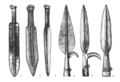 Blades and spears with single side hook
 -
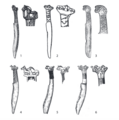 Decorated knives
 -
 Seima-Turbino knives, Tallgren 1938


See also edit
References edit
- ^ Bjørn, Rasmus G. (January 2022). "Indo-European loanwords and exchange in Bronze Age Central and East Asia: Six new perspectives on prehistoric exchange in the Eastern Steppe Zone". Evolutionary Human Sciences. 4: e23. doi:10.1017/ehs.2022.16. ISSN 2513-843X. PMC 10432883. PMID 37599704.
- ^ a b c d e f Marchenko et al. 2017.
- ^ a b c Keys, David (January 2009). "Scholars crack the code of an ancient enigma". BBC History Magazine. Vol. 10, no. 1. p. 9.
- ^ Kang, In Uk (May 2020). Archaeological perspectives on the early relations of the Korean peninsula with the Eurasian steppe (PDF). Sino-Platonic Papers. p. 34 – via sino-platonic.org.
- ^ a b
Shaw, Ian; Jameson, Robert, eds. (6 May 2002) [1 January 1999]. A Dictionary of Archaeology. Wiley-Blackwell. p. 517. ISBN 978-0-631-23583-5.
1999 ed.: Blackwell Publishers doi:10.1002/9780470753446 ISBN 978-0-470-75344-6 - ^ Anthony 2007, pp. 447.
- ^ Childebayeva, Ainash; et al. (October 1, 2023). "Bronze Age Northern Eurasian Genetics in the Context of Development of Metallurgy and Siberian Ancestry". BioRxiv. doi:10.1101/2023.10.01.560195. S2CID 263672903.
- ^ a b Anthony 2007.
- ^ Lin, Meicun (2016). "Seima-Turbino Culture and the Proto-Silk Road". Chinese Cultural Relics. 3 (1–002): 241–262. doi:10.21557/CCR.48032340. ISSN 2330-5169.
Due to the lack of access to tin mines, early metallurgy in the Eurasian Steppe used copper or arsenical bronze for metalworking. Only with the rise of the Seima-Turbino culture in the Saiano-Altai region, did the cultures of the Eurasian Steppe began to use tin bronze for metal working, and this could be officially understood as the entry of the Bronze Age.
- ^ Anthony 2007, pp. 443–444.
- ^ Chernykh 1992, figs. 74 & 75, pp. 220–221.
- ^ a b Chernykh, E.N. (2008). "Formation of the Eurasian "steppe belt" of stockbreeding cultures". Archaeology, Ethnology and Anthropology of Eurasia. 35 (3): 36–53. doi:10.1016/j.aeae.2008.11.003.
- ^ Frachetti, Michael David. Pastoralist Landscapes and Social Interaction in Bronze Age Eurasia. pp. 52–53.
- ^ Anthony 2007, pp. 444–447.
- ^ a b c d e f Lin, Meicun (2016). "Seima-Turbino Culture and the Proto-Silk Road". Chinese Cultural Relics. 3 (1–002): 256–257. ISSN 2330-5169.
The report on the archaeological excavation of the Yin (Shang) ruins published in 2011 shows a Seima-Turbino style bronze socketed spearhead with a single side hook. (...) It is worth noting that a jade figurine (Figure 15:5) that resembles a Seima-Turbino-style bronze figurine (Figure 15:3) and a knife with deer-head pommel (Figure 15:6) were unearthed from the tomb of Fu Hao at the Yin ruins. A similar knife with deer-head pommel is also in the collection of the Baoji Museum of Bronze Collections (Figure 12:4). These discoveries and collected artifacts reveal the cultural transmission between ancient inhabitants of the Yellow River region and nomads of the Eurasian Steppe.(...) The Illustrious Ancestor [King Gaozong of Yin] disciplines the Devil's Country. After three years he conquers it." (...) Seima-Turbino-style artifacts unearthed at the Yin ruins, including the bronze socketed spearhead with a single side hook, the jade figurine and the knife with deer-head pommel, indicate that the "Devil's Country" refers to the far-away Altai Mountains.
- ^ Meicun, Lin; Liu, Xiang (October 2017). "The origins of metallurgy in China". Antiquity. 91 (359): e6. doi:10.15184/aqy.2017.177. ISSN 0003-598X.
- ^ a b Lin, Meicun (2016). "Seima-Turbino Culture and the Proto-Silk Road". Chinese Cultural Relics. 3 (1–002): 256–257. ISSN 2330-5169.
The discovery of the Seima-Turbino culture in China is of great importance, as it demonstrates with material evidence that Chinese metallurgy derives from the cultures of the Eurasian Steppe.
- ^ a b Lin, Meicun (2016). "Seima-Turbino Culture and the Proto-Silk Road". Chinese Cultural Relics. 3 (1–002): 241–262. doi:10.21557/CCR.48032340. ISSN 2330-5169.
- ^ a b Lin, Meicun (2016). "Seima-Turbino Culture and the Proto-Silk Road". Chinese Cultural Relics. 3 (1–002): 249, Figure 9. ISSN 2330-5169.
- ^ Lin, Meicun (2016). "Seima-Turbino Culture and the Proto-Silk Road". Chinese Cultural Relics. 3 (1–002): 251, Figure 11. ISSN 2330-5169.
- ^ Lin, Meicun (2016). "Seima-Turbino Culture and the Proto-Silk Road". Chinese Cultural Relics. 3 (1–002): 251, Figure 12. ISSN 2330-5169.
- ^ Grigoriev, Stanislav A. (2022). "Internal and External Impulses for the Development of Ancient Chinese Metallurgy". Geoarchaeology and Archaeological Mineralogy. Springer Proceedings in Earth and Environmental Sciences. Springer International Publishing: 8, Fig.2. doi:10.1007/978-3-030-86040-0_1. ISBN 978-3-030-86039-4. S2CID 245719183.
- ^ Higham, C.; Higham, T.; Kijngam, A. (2011). "Cutting a Gordian knot: The Bronze Age of southeast Asia: Origins, timing and impact". Antiquity. 85 (328): 583–598. doi:10.1017/S0003598X00067971. S2CID 163064575.
- ^ Chernykh, E.N. (2008). "The "steppe belt" of stockbreeding cultures in Eurasia during the early Metal Age". Trab. Prehist. 65: 73–93. doi:10.3989/tp.2008.08004.
- ^ Sarkissian, Clio Der; Balanovsky, Oleg; Brandt, Guido; Khartanovich, Valery; Buzhilova, Alexandra; Koshel, Sergey; et al. (14 February 2013). "Ancient DNA reveals prehistoric gene-flow from Siberia in the complex human population history of north east Europe". PLOS Genetics. 9 (2): e1003296. doi:10.1371/journal.pgen.1003296. ISSN 1553-7404. PMC 3573127. PMID 23459685.
- ^ Illumäe; et al. (2016). "Human Y chromosome haplogroup N: A non-trivial time-resolved phylogeography that cuts across language families". The American Journal of Human Genetics. 99 (1): 163–173. doi:10.1016/j.ajhg.2016.05.025. PMC 5005449. PMID 27392075. S2CID 20536258.
- ^ Tambets, Kristiina; Metspalu, Mait; Lang, Valter; Villems, Richard; Kivisild, Toomas; Kriiska, Aivar; Thomas, Mark G.; Díez del Molino, David; Crema, Enrico Ryunosuke (2019). "The Arrival of Siberian Ancestry Connecting the Eastern Baltic to Uralic Speakers further East". Current Biology. 29 (10): 1701–1711.e16. doi:10.1016/j.cub.2019.04.026. ISSN 0960-9822. PMC 6544527. PMID 31080083.
- ^ Sikora, Martin; Pitulko, Vladimir V.; Sousa, Vitor C.; Allentoft, Morten E.; Vinner, Lasse; Rasmussen, Simon; Margaryan, Ashot; de Barros Damgaard, Peter; de la Fuente, Constanza; Renaud, Gabriel; Yang, Melinda A.; Fu, Qiaomei; Dupanloup, Isabelle; Giampoudakis, Konstantinos; Nogués-Bravo, David (June 2019). "The population history of northeastern Siberia since the Pleistocene". Nature. 570 (7760): 182–188. Bibcode:2019Natur.570..182S. doi:10.1038/s41586-019-1279-z. hdl:1887/3198847. ISSN 1476-4687. PMID 31168093. S2CID 174809069.
Most modern Siberian speakers of Neosiberian languages genetically fall on an East- West cline between Europeans and Early East Asians. Taking Even speakers as representatives, the Neosiberian turnover from the south, which largely replaced Ancient Paleosiberian ancestry, can be associated with the northward spread of Tungusic and probably also Turkic and Mongolic. However, the expansions of Tungusic as well as Turkic and Mongolic are too recent to be associable with the earliest waves of Neosiberian ancestry, dated later than ~11 kya, but discernible in the Baikal region from at least 6 kya onwards. Therefore, this phase of the Neosiberian population turnover must initially have transmitted other languages or language families into Siberia, including possibly Uralic and Yukaghir.
- ^ Tambets, Kristiina; Yunusbayev, Bayazit; Hudjashov, Georgi; Ilumäe, Anne-Mai; Rootsi, Siiri; Honkola, Terhi; Vesakoski, Outi; Atkinson, Quentin; Skoglund, Pontus; Kushniarevich, Alena; Litvinov, Sergey; Reidla, Maere; Metspalu, Ene; Saag, Lehti; Rantanen, Timo (2018-09-21). "Genes reveal traces of common recent demographic history for most of the Uralic-speaking populations". Genome Biology. 19 (1): 139. doi:10.1186/s13059-018-1522-1. ISSN 1474-760X. PMC 6151024. PMID 30241495.
- ^ Bjørn, Rasmus G. (2022). "Indo-European loanwords and exchange in Bronze Age Central and East Asia: Six new perspectives on prehistoric exchange in the Eastern Steppe Zone". Evolutionary Human Sciences. 4: e23. doi:10.1017/ehs.2022.16. ISSN 2513-843X. PMC 10432883. PMID 37599704.
- ^ Grünthal, Riho (2022). "Drastic demographic events triggered the Uralic spread". Diachronica. 39 (4): 490–524. doi:10.1075/dia.20038.gru. hdl:10138/347633. S2CID 248059749.
- ^ Zeng, Tian Chen; et al. (October 1, 2023). "Postglacial genomes from foragers across Northern Eurasia reveal prehistoric mobility associated with the spread of the Uralic and Yeniseian languages". BioRxiv. doi:10.1101/2023.10.01.560332. S2CID 263706090.
We show how Yakutia_LNBA ancestry spread from an east Siberian origin ∼4.5kya, along with subclades of Y-chromosome haplogroup N occurring at high frequencies among present-day Uralic speakers, into Western and Central Siberia in communities associated with Seima-Turbino metallurgy: a suite of advanced bronze casting techniques that spread explosively across an enormous region of Northern Eurasia ∼4.0kya.
- ^ Childebayeva, Ainash; et al. (October 1, 2023). "Bronze Age Northern Eurasian Genetics in the Context of Development of Metallurgy and Siberian Ancestry". BioRxiv. doi:10.1101/2023.10.01.560195. S2CID 263672903.
Sources edit
- Christian, David (1998). A History of Russia, Central Asia, and Mongolia. ISBN 978-0-631-20814-3.[full citation needed]
- Anthony, David W. (2007). The Horse, the Wheel, and Language: How Bronze-Age riders from the Eurasian steppes shaped the modern world.[full citation needed]
- Marchenko, Z.V.; Svyatko, S.V.; Molodin, V.I.; Grishin, A.E.; Rykun, M.P. (Oct 2017). "Radiocarbon chronology of complexes with Seima-Turbino type objects (Bronze Age) in southwestern Siberia" (PDF). Radiocarbon. 59 (5): 1381–1397. Bibcode:2017Radcb..59.1381M. doi:10.1017/RDC.2017.24. S2CID 133742189 – via pureadmin.qub.ac.uk.
- Chernykh, Evgenil Nikolaevich (1992). Ancient Metallurgy in the USSR: The Early Metal Age. New Studies in Archaeology. Translated by Wright, Sarah. Cambridge, UK: Cambridge University Press. ISBN 9780-521-25257-7.
