
Romalea is a genus of grasshoppers native to the Southeastern and South-central United States. As traditionally defined, it contains a single species, Romalea microptera, known commonly as the Georgia Thumper, eastern lubber grasshopper, Florida lubber, or Florida lubber grasshopper, although some recent authorities regard Taeniopoda as a junior synonym, in which case there are about a dozen Romalea species in southern United States, Mexico and Central America.[1]
| Romalea | |
|---|---|
,_mating.jpg)
| |
| R. microptera, mating | |
Scientific classification 
| |
| Domain: | Eukaryota |
| Kingdom: | Animalia |
| Phylum: | Arthropoda |
| Class: | Insecta |
| Order: | Orthoptera |
| Suborder: | Caelifera |
| Family: | Romaleidae |
| Subfamily: | Romaleinae |
| Tribe: | Romaleini |
| Genus: | Romalea Serville, 1831 |
| Species: | R. microptera
|
| Binomial name | |
| Romalea microptera (Palisot de Beauvois, 1817)
| |
| Synonyms | |
| |
R. microptera is one of the most distinctive grasshopper species within the Southeastern US, and is well known for its relatively large size and its unique coloration.[2]
Taxonomy edit
Romalea is the type genus of the family Romaleidae and tribe Romaleini. It has been suggested that the valid name for Romalea microptera is Romalea guttata.[3] However, microptera has been marked as a nomen protectum by the ICZN, making guttata a synonym.[4]
As traditionally defined, Romalea only contains the species R. microptera, but recent authorities regard Taeniopoda as a synonym, in which case there are about a dozen Romalea species.[1][5] Romalea and Taeniopoda have generally been separated based on color and pronotum, but more comprehensive morphological data and genetic data do not support their separation.[5] Their wild distributions do not overlap, but in captivity R. microptera can produce fertile hybrids at least with T. eques (western horse lubber grasshopper), showing their very close relations.[6]
Life cycle edit

R. microptera grows through several stages, like all insects. When in the nymph stage, it is smaller than in the adult stage, wingless, and completely black with one or more yellow, orange, or red stripes. The adult stage has wings that are half the length of its body, and become either a dull yellow often characterized by black spots and markings, a bright orange with black markings, or entirely black (as in the nymph stage) with yellow or red striping. In the black adult color phase, the grasshopper is widely known by the name "diablo" or "black diablo". In Louisiana, they are known as the "devil's horse" or cheval-diable. The insect is also colloquially known as a "graveyard grasshopper". In Mississippi, they are known as the "giant locust".[7]
Many factors influenced the growth rates of these grasshoppers. The three that were most important were size at adult eclosion, the time to get to adult eclosion, and growth during the last stage. According to the article “Effects of growth rates on development to metamorphosis in the lubber grasshopper, Romalea microptera” by Virginia Flanagan, she talks about size eclosion. She noticed a correlation that grasshoppers who were fed more reached adulthood and a larger size significantly quicker compared to grasshoppers who weren't. “Food availability during the first stadium significantly affected its duration (F1,32=24.23, P=0.0001) and, as expected, low food significantly prolonged the stadium, but only by an average of less than 4 days.” (Flanagin, p.5, 2000). Another factor that affected growth rates was the time to get to adult eclosion. The researchers noticed that grasshoppers that were fed during the middle stage of their lives were able to reach eclosion or adulthood faster compared to those that were fed small amounts in the same stage. In the article it says “The first group with short times to eclosion (about 60 days), consisted of individuals receiving high food during the three middle stadia” (Flanagin, p.4, 2000) and it also says “during the second stadium had no effect (HLL vs HHL; Fig. 2C). Only individuals receiving high food during both the second and third stadia (LHH, HHH) had third stadia of short duration.” (Flanagin, p.5, 2000) The final factor that affected the growth rates of the grasshoppers was the growth during the last stage. This is very important because the researchers who conducted this experiment noticed that grasshoppers who received no food during the last stage failed to mold into adulthood. In the article, it says “None of the nymphs receiving no food during the fifth stadium successfully molted to adulthood (n=7). Mean (±SE) masses of these nymphs at the start of the fifth stadium (1.52±0.10) did not differ significantly from the mean masses the day before adult eclosion from treatments receiving low food during at least two stadia” (Flanagin, p.5, 2000).
Range edit
R. microptera inhabits regions west of North Carolina to Tennessee, in Georgia, Alabama, Mississippi, Louisiana, Arkansas, and Texas, and throughout Florida, Missouri, and Arizona. They live in open pinewoods, weedy vegetation, and weedy fields.[2]
Size and wings edit
R. microptera and Taeniopoda eques (western horse lubber grasshopper) are the largest grasshoppers in the United States.[6] Adult males of R. microptera typically are 4.3–5.5 cm (1.7–2.2 in) long and adult females 5–7 cm (2.0–2.8 in) long, but can exceptionally reach 9 cm (3.5 in).[2] Their wings are rarely half the length of the abdomen; most of the time, they are much smaller, and cannot be used for flight.[2]
Defense edit

R. microptera has several defense strategies. The first is its brightly colored pattern (aposematism) to warn predators that it is unpleasant eating. The second is that it emits a foul-smelling and foul-tasting, foamy secretion from its thorax when it is disturbed. The secretion is dark colored and opaque. The final strategy is that it lets off a loud hissing sound which can scare animals.[2] Whereas most predatory vertebrates avoid R. microptera because of its toxicity, this does not protect it from predatory invertebrates; however, most predatory invertebrates are unable to catch and kill adult R. microptera because of its relatively large size.[6]
Research edit
A quantitative analysis of the distribution of tritium labeled DNA among chromosomes during meiosis in Romalea microptera led to the conclusion that most exchanges reflected breakage and reciprocal exchange between (non-sister) homologous chromatids.[8]
Gallery edit
-
 Female eastern lubber grasshopper (R. microptera) in Everglades National Park, Florida
 -
 Close-up of R. microptera from the Everglades
 -
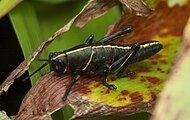 Nymph R. microptera with its characteristic black and yellow-striped body
 -
 Lubber grasshopper, Loxahatchee National Wildlife Refuge, Delray, Florida
 -
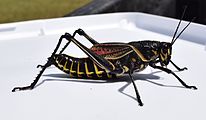 Adult dark morph, University of Mississippi Field Station
 -
 R. microptera, Fort Myers, Florida
 -
 R. microptera at Bear Island Campground in the Big Cypress National Preserve
 -
 Louisiana Romalea Grasshopper From Louisiana Wetlands, Lake Pontchartrain.


.jpg)

References edit


- ^ a b "genus Romalea Serville, 1831". orthoptera.speciesfile.org. Retrieved 11 August 2023.
- ^ a b c d e Capinera, John; Scherer, C. W. (October 1996). "eastern lubber grasshopper - Romalea guttata (Houttuyn)". University of Florida. Retrieved March 3, 2021.
- ^ D. K. M. Kevan (1980). "Romalea guttata (Houttuyn), name change for well-known "eastern lubber grasshopper" (Orthoptera: Romaleidae)". Entomological News. 91 (4): 139–140.
- ^ "Species Romalea microptera - Eastern Lubber Grasshopper". Bugguide.net. August 1, 2014. Retrieved June 9, 2015.
- ^ a b Jesús-Bonilla, V.S.D.; Barrientos-Lozano, L.; Zaldívar-Riverón, A (2023). "Taxonomic revision of the transitional Nearctic-Neotropical lubber grasshopper genus Romalea (Orthoptera: Romaleidae)". Rev. Mex. Biodiv. 94.
- ^ a b c Whitman, D.; Vincent, S. (2008). "Large size as an antipredator defense in an insect". Journal of Orthoptera Research. 17 (2): 353–371. doi:10.1665/1082-6467-17.2.353.
- ^ Fox, Richard (October 6, 2006). "Romalea microptera, Eastern Lubber Grasshopper". Invertebrate Anatomy Online. Lander University. Archived from the original on February 19, 2012. Retrieved April 4, 2011.
- ^ Taylor JH. DISTRIBUTION OF TRITIUM-LABELED DNA AMONG CHROMOSOMES DURING MEIOSIS : I. Spermatogenesis in the Grasshopper. J Cell Biol. 1965 May 1;25(2):57-68. doi: 10.1083/jcb.25.2.57. PMID: 19866667; PMCID: PMC2106657
External links edit
 Media related to Romalea microptera at Wikimedia Commons
- Sarah Sue Goldsmith (May 4, 1999). "Black grasshoppers munch their way across South Louisiana". Louisiana State University.
