

Introduction

The visual arts are art forms such as painting, drawing, printmaking, sculpture, ceramics, photography, video, filmmaking, comics, design, crafts, and architecture. Many artistic disciplines, such as performing arts, conceptual art, and textile arts, also involve aspects of the visual arts as well as arts of other types. Also included within the visual arts are the applied arts, such as industrial design, graphic design, fashion design, interior design, and decorative art.
Current usage of the term "visual arts" includes fine art as well as applied or decorative arts and crafts, but this was not always the case. Before the Arts and Crafts Movement in Britain and elsewhere at the turn of the 20th century, the term 'artist' had for some centuries often been restricted to a person working in the fine arts (such as painting, sculpture, or printmaking) and not the decorative arts, crafts, or applied visual arts media. The distinction was emphasized by artists of the Arts and Crafts Movement, who valued vernacular art forms as much as high forms. Art schools made a distinction between the fine arts and the crafts, maintaining that a craftsperson could not be considered a practitioner of the arts. The increasing tendency to privilege painting, and to a lesser degree sculpture, above other arts has been a feature of Western art as well as East Asian art. In both regions, painting has been seen as relying to the highest degree on the imagination of the artist and being the furthest removed from manual labour – in Chinese painting, the most highly valued styles were those of "scholar-painting", at least in theory practiced by gentleman amateurs. The Western hierarchy of genres reflected similar attitudes. (Full article...)
Selected article

House with Chimaeras (Ukrainian: Будинок з химерами, Budynok z khymeramy) or Horodetsky House (named for Władysław Horodecki) is an Art Nouveau building located in the historic Lypky neighborhood of Kyiv, the capital of Ukraine. Situated across the street from the President of Ukraine's office at No. 10, Bankova Street, the building has been used as a presidential residence for official and diplomatic ceremonies since 2005. The street in front of the building is closed off to all automobile traffic, and is now a patrolled pedestrian zone due to its proximity to the Presidential Administration building.
The Polish architect Władysław Horodecki originally constructed the House with Chimaeras for use as his own upmarket apartment building during 1901–02. However, as the years went by, Horodecki eventually had to sell the building due to financial troubles, after which it changed ownership numerous times before finally being occupied by an official Communist Party polyclinic until the early 2000s. When the building was vacated, its interior and exterior decor were fully reconstructed and restored according to Horodecki's original plans. (Full article...)Selected picture
.jpg)
Selected quote
| “ | When I've painted a woman's behind so that I want to touch it, then it's finished! | ” |
| — Pierre-Auguste Renoir, Vollard, Ambroise (1925). Renoir: an initimate record. Translated by Van Dooren, Harold L.; Weaver, Randolph T. New York: Alfred A. Knopf. p. 57. OCLC 631984646. |
Related portals


Selected biography
.jpg)
Maria Dulębianka (21 October 1861 – 7 March 1919) was a Polish artist and activist, notable for promoting women’s suffrage and higher education.
She studied art in Warsaw, Vienna and Paris, two of her works gaining distinctions in the 1900 Paris Exposition. Many of her paintings were portraits of her lifelong companion, the poet Maria Konopnicka. In 1908, Dulębianka stood for the Agrarian Party in the elections to the Galician Parliament, but was disallowed as a woman by parliamentary rules. When Polish women gained the vote in 1918, Dulębianka served as a delegate to the Provisional Government. She died of typhus, contracted while assisting prisoners in the Polish–Ukrainian War of 1919. (Full article...)Did you know (auto generated) -

- ... that Kip Andersen and Keegan Kuhn were co-nominees for the 2018 Cinema for Peace Award for their documentary What the Health?
- ... that the documentary Lynch/Oz incorporates hundreds of film clips to illustrate the influence of The Wizard of Oz on the work of filmmaker David Lynch?
- ... that Percy Kelly hoarded his drawings and paintings until the end of his life, saying that his cottage would someday "upstage Beatrix Potter's home"?
- ... that John Hoke III, who is dyslexic and the chief design officer of Nike, has described drawing as his first language?
- ... that filmmaker Randal Plunkett, 21st Baron of Dunsany, has seen the return of many species of bird and plant, as well as pine martens, stoats and otters, to his ancestral lands with rewilding?
- ... that as a senior in high school, manga artist Yama Wayama began drawing male–male romance manga as a hobby?
- ... that Diminish and Ascend has been called a real-life M. C. Escher drawing?
- ... that the art of Irma Blank, of "drawing languages without words" and including sounds, was recognised in the 1970s but fell into obscurity until a rediscovery in the 2010s?
General images
-
-
 Max Beckmann, The Night (Die Nacht), 1918–1919, Kunstsammlung Nordrhein-Westfalen, Düsseldorf (from History of painting)
 -
-

-
 Hand stencils in the "Tree of Life" cave painting in Gua Tewet, Kalimantan, Indonesia (from History of painting)
 -

-
 Cueva de las Manos (Spanish for Cave of the Hands) in the Santa Cruz province in Argentina, c. 7300 BC (from History of painting)
 -
 Joan Miró, Horse, Pipe and Red Flower, 1920, abstract Surrealism, Philadelphia Museum of Art (from History of painting)
 -
 Golden section in book design (from Graphic design)
 -
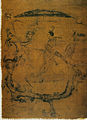 Silk painting depicting a man riding a dragon, painting on silk, dated to 5th–3rd century BC, Warring States period, from Zidanku Tomb no. 1 in Changsha, Hunan Province (from History of painting)
 -
 Young Mother Sewing, Mary Cassatt (from History of painting)
 -

-
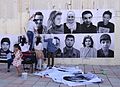 Irbid, Jordan, "We are Arabs. We are Humans". Inside Out is a global participatory art project, initiated by the French photographer JR, an example of Street art (from Contemporary art)
 -
 Due to its interdisciplinary nature, graphic design can be performed in different areas of application: branding, technical and artistic drawing, signage, photography, image and video editing, 3D modeling, animation, programming, among other fields. (from Graphic design)
 -

-
-
 An Ethiopian illuminated Evangelist portrait of Mark the Evangelist, from the Ethiopian Garima Gospels, 6th century AD, Kingdom of Aksum (from History of painting)
 -

-
 Francis Picabia, (Left) Le saint des saints c'est de moi qu'il s'agit dans ce portrait, 1 July 1915; (center) Portrait d'une jeune fille americaine dans l'état de nudité, 5 July 1915: (right) J'ai vu et c'est de toi qu'il s'agit, De Zayas! De Zayas! Je suis venu sur les rivages du Pont-Euxin, New York, 1915 (from History of painting)
 -
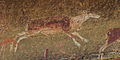
 Gwion Gwion rock paintings found in the north-west Kimberley region of Western Australia c. 15,000 BC (from History of painting)
 -
 Colour (from Graphic design)
 -

-
-

-
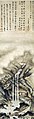 Muromachi period, Shingei (1431–1485), Viewing a Waterfall, Nezu Museum, Tokyo. (from History of painting)
 -
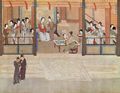 Spring Morning in the Han Palace, by Ming-era artist Qiu Ying (1494–1552 AD) (from History of painting)
 -
 The Eternal Father Painting the Virgin of Guadalupe. Attributed to Joaquín Villegas (1713 – active in 1753) (Mexican) (painter, Museo Nacional de Arte. (from History of painting)
 -

-
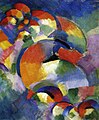
-

-

-
 Diego Rivera, Recreation of Man at the Crossroads (renamed Man, Controller of the Universe), originally created in 1934, Mexican muralism movement (from History of painting)
 -
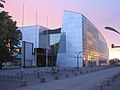
-
 Pettakere Cave are more than 44,000 years old, Maros, South Sulawesi, Indonesia (from History of painting)
 -
 A fresco showing Hades and Persephone riding in a chariot, from the tomb of Queen Eurydice I of Macedon at Vergina, Greece, 4th century BC (from History of painting)
 -

-
-
 The Sakyamuni Buddha, by Zhang Shengwen, 1173–1176 AD, Song dynasty period. (from History of painting)
 -
 Cover of the Thanksgiving 1895 issue of The Chap-Book, designed by Will H. Bradley (from Graphic design)
 -
 Loquats and Mountain Bird, anonymous artist of the Southern Song dynasty; paintings in leaf album style such as this were popular in the Southern Song (1127–1279). (from History of painting)
 -

-
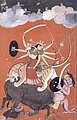 Mother Goddess A miniature painting of the Pahari style, dating to the eighteenth century. Pahari and Rajput miniatures share many common features. (from History of painting)
 -
 Wayang beber, 17th century (from History of painting)
 -
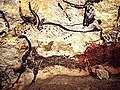
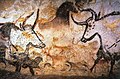 Lascaux, Bulls and Horses (from History of painting)
 -
-
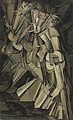
 A Chinese painted jar from the Western Han Era (202 BCE – 9 CE) (from History of painting)
 -

-

-
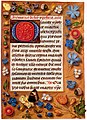 Book of Hours (from History of painting)
 -
 A Boeing 747 aircraft with livery designating it as Air Force One. The cyan forms, the US flag, presidential seal and the Caslon lettering, were all designed at different times, by different designers, for different purposes, and combined by designer Raymond Loewy in this one single aircraft exterior design. (from Graphic design)
 -
 Bharat Mata by Abanindranath Tagore (1871–1951), a nephew of the poet Rabindranath Tagore, and a pioneer of the movement (from History of painting)
 -
 Spanish cave painting of Bulls (from History of painting)
 -

-
 Two Scribes Seated with Books and a Writing Table Fragment of a decorative margin Northern India (Mughal school), ca. 1640–1650 (from History of painting)
 -

-
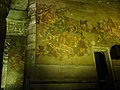 A fresco from Cave 1 of Ajanta. (from History of painting)
 -
 Lascaux, Horse (from History of painting)
 -
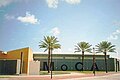
 The Château de Montsoreau-Museum of Contemporary Art (France), is a private institution based in a Renaissance castle. (from Contemporary art)
 -
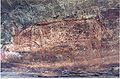
 Pictographs from the Great Gallery, Canyonlands National Park, Horseshoe Canyon, Utah, c. 1500 BCE (from History of painting)
 -

-

-
 Graphic symbols are often functionalist and anonymous, as these pictographs from the US National Park Service illustrate. (from Graphic design)
 -
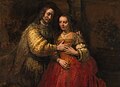 Rembrandt van Rijn, The Jewish Bride, ca. 1665–1669 (from History of painting)

,_oil_on_canvas,_133_x_154_cm,_Kunstsammlung_Nordrhein-Westfalen,_D%C3%BCsseldorf.jpg)


.jpg)


.jpg)


%27_by_Barnett_Newman,_1968.jpg)

.jpg)


.JPG)


Major topics
- Types of visual art – Architecture • Art intervention • Ceramic art • Computer art • Drawing • Fashion • Film • Installation art • Land art • Mixed media • Painting • Performance art • Photography • Printmaking • Sculpture • Stained glass
- Art history – Pre-historic art • Ancient art • Art of Ancient Egypt • Art in Ancient Greece • Minoan pottery • Scythian art • Roman art • Women artists
- Western art periods and movements – Medieval art • Gothic art • Renaissance • Mannerism • Baroque • Rococo • Neoclassicism • Romanticism • Realism • Modern Art • Impressionism • Symbolism • Fauvism • Proto-Cubism • Cubism • Futurism • Dada • Art Deco • Surrealism • Abstract Expressionism • Lyrical abstraction • Conceptual Art • Contemporary Art • Postmodern art visual arts.
- Eastern and Middle Eastern art – Buddhist art • Chinese art • Islamic art • Japanese art • Laotian art • Thai art • Tibetan art
- Lists – Architects • Art movements • Art periods • Painters • Printmakers • Sculptors • Statues
- Lists of basic topics – Visual arts • Architecture • Film • Painting • Photography • Sculpture
Subcategories

Architecture | Ceramic art | Comics | Crafts | Design | Drawing | Illustration | Film | Glass | Graphic design | Industrial design | Landscape architecture | Multimedia | Painting | Photography | Pottery | Printmaking | Public art | Sculpture | Typography | Mosaic
Artists | Visual arts awards | Artist collectives | Art collectors | Art critics | Art curators | Visual arts exhibitions | Art forgery | Art history | Visual arts materials | Art schools | Artistic techniques |
WikiProjects
Things you can do

Associated Wikimedia
The following Wikimedia Foundation sister projects provide more on this subject:
-
 Commons
Free media repository -
 Wikibooks
Free textbooks and manuals -
 Wikidata
Free knowledge base -
 Wikinews
Free-content news -
 Wikiquote
Collection of quotations -
 Wikisource
Free-content library -
 Wikiversity
Free learning tools -
 Wiktionary
Dictionary and thesaurus


