
This article may need to be rewritten to comply with Wikipedia's quality standards. (July 2014) |
In database design, a lossless join decomposition is a decomposition of a relation into relations such that a natural join of the two smaller relations yields back the original relation. This is central in removing redundancy safely from databases while preserving the original data.[1] Lossless join can also be called nonadditive.[2]


Criteria edit
Let and be a decomposition of a relation .


The decomposition is lossless if and only if the natural join of and results in the original relation (i.e., ).[3][unreliable source?]

Equivalently, the decomposition is lossless if and only if one of the sub-relations (i.e. or ) is a subset of the closure of their intersection.[4] In other words, the decomposition of is lossless if either or is true.
![{\displaystyle R_{1}\subseteq [R_{1}\cap R_{2}]^{+}}](https://wikimedia.org/api/rest_v1/media/math/render/svg/e5dfd089a52bb44085aa6e0b3247407f040b4d1c)
![{\displaystyle R_{2}\subseteq [R_{1}\cap R_{2}]^{+}}](https://wikimedia.org/api/rest_v1/media/math/render/svg/ad6902bf84bfcd95b9b38e108362021b9970b5d0)
Criteria for multiple sub-relations edit
Multiple sub-relations have a lossless join if there is some way in which we can repeatedly perform lossless joins until all the relations have been joined into a single relation. Once we have a new sub-relation made from a lossless join, we are not allowed to use any of its isolated sub-relations to join with any of the other relations. For example, if we can do a lossless join on a pair of relations to form a new relation , we use this new relation (rather than or ) to form a lossless join with another relation (which may already be joined (e.g., )).



Examples edit
- Let be the relation schema, with attributes A, B, C and D.
- Let be the set of functional dependencies.
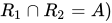
- Decomposition into and is lossless under F because . A is a superkey in , meaning we have a functional dependency . In other words, now we have proven that .






References edit
- ^ Pohler, K (2015). "Lossless-Join Decomposition: applications in quantitative computing metrics". International Journal of Applied Computer Science. 21 (4): 190–212.
- ^ Elmasri, Ramez (2016). Fundamentals of database systems (Seventh ed.). Hoboken, NJ: Pearson. p. 461. ISBN 978-0133970777.
- ^ "Lossless Join Property". Stackoverflow.com. Retrieved 2016-02-07.
- ^ "Lossless Join Decomposition" (PDF). University at Buffalo. Jan Chomicki. Retrieved 2012-02-08.
- ^ "Lossless-Join Decomposition". Cs.sfu.ca. Retrieved 2016-02-07.
- ^ "www.data-e-education.com - Lossless Join Decomposition". Archived from the original on 2014-02-21. Retrieved 2014-02-12.