
Lead telluride is a compound of lead and tellurium (PbTe). It crystallizes in the NaCl crystal structure with Pb atoms occupying the cation and Te forming the anionic lattice. It is a narrow gap semiconductor with a band gap of 0.32 eV.[4] It occurs naturally as the mineral altaite.
| Names | |
|---|---|
| Other names
Lead(II) telluride
Altaite | |
| Identifiers | |
| ChemSpider | |
| ECHA InfoCard | 100.013.862 |
| EC Number |
|
PubChem CID
|
|
| UNII | |
CompTox Dashboard (EPA)
|
|
| Properties | |
| PbTe | |
| Molar mass | 334.80 g/mol |
| Appearance | gray cubic crystals. |
| Density | 8.164 g/cm3 |
| Melting point | 924 °C (1,695 °F; 1,197 K) |
| insoluble | |
| Band gap | 0.25 eV (0 K) 0.32 eV (300 K) |
| Electron mobility | 1600 cm2 V−1 s−1 (0 K) 6000 cm2 V−1 s−1 (300 K) |
| Structure | |
| Halite (cubic), cF8 | |
| Fm3m, No. 225 | |
a = 6.46 Angstroms
| |
| Octahedral (Pb2+) Octahedral (Te2−) | |
| Thermochemistry | |
Std molar
entropy (S⦵298) |
50.5 J·mol−1·K−1 |
Std enthalpy of
formation (ΔfH⦵298) |
-70.7 kJ·mol−1 |
Std enthalpy of
combustion (ΔcH⦵298) |
110.0 J·mol−1·K−1 |
| Hazards | |
| GHS labelling: | |
  
| |
| Danger | |
| H302, H332, H351, H360, H373, H410 | |
| P201, P202, P260, P261, P264, P270, P271, P273, P281, P301+P312, P304+P312, P304+P340, P308+P313, P312, P314, P330, P391, P405, P501 | |
| Flash point | Non-flammable |
| Safety data sheet (SDS) | External MSDS |
| Related compounds | |
Other anions
|
Lead(II) oxide Lead(II) sulfide Lead selenide |
Other cations
|
Carbon monotelluride Silicon monotelluride Germanium telluride Tin telluride |
Related compounds
|
Thallium telluride Bismuth telluride |
Except where otherwise noted, data are given for materials in their standard state (at 25 °C [77 °F], 100 kPa).
| |


Properties edit
- Dielectric constant ~1000.
- Electron Effective mass ~ 0.01me
- Hole mobility, μp = 600 cm2 V−1 s−1 (0 K); 4000 cm2 V−1 s−1 (300 K)
Applications edit
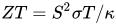
PbTe has proven to be a very important intermediate thermoelectric material. The performance of thermoelectric materials can be evaluated by the figure of merit, , in which is the Seebeck coefficient, is the electrical conductivity and is the thermal conductivity. In order to improve the thermoelectric performance of materials, the power factor ( ) needs to be maximized and the thermal conductivity needs to be minimized.[5]


The PbTe system can be optimized for power generation applications by improving the power factor via band engineering. It can be doped either n-type or p-type with appropriate dopants. Halogens are often used as n-type doping agents. PbCl2, PbBr2 and PbI2 are commonly used to produce donor centers. Other n-type doping agents such as Bi2Te3, TaTe2, MnTe2, will substitute for Pb and create uncharged vacant Pb-sites. These vacant sites are subsequently filled by atoms from the lead excess and the valence electrons of these vacant atoms will diffuse through crystal. Common p-type doping agents are Na2Te, K2Te and Ag2Te. They substitute for Te and create vacant uncharged Te sites. These sites are filled by Te atoms which are ionized to create additional positive holes.[6] With band gap engineering, the maximum zT of PbTe has been reported to be 0.8 - 1.0 at ~650K.
Collaborations at Northwestern University boosted the zT of PbTe by significantly reducing its thermal conductivity using ‘all-scale hierarchical architecturing'.[7] With this approach, point defects, nanoscale precipitates and mesoscale grain boundaries are introduced as effective scattering centers for phonons with different mean free paths, without affecting charge carrier transport. By applying this method, the record value for zT of PbTe that has been achieved in Na doped PbTe-SrTe system is approximately 2.2.[8]
In addition, PbTe is also often alloyed with tin to make lead tin telluride, which is used as an infrared detector material.
See also edit
- Yellow Duckling, which used a lead telluride sensor to make the first infrared linescan camera
References edit
This article needs additional citations for verification. (May 2009) |
- ^ Lide, David R. (1998), Handbook of Chemistry and Physics (87 ed.), Boca Raton, Florida: CRC Press, pp. 4–65, ISBN 978-0-8493-0594-8
- ^ CRC Handbook, pp. 5–24.
- ^ Lawson, William D (1951). "A method of growing single crystals of lead telluride and selenide". J. Appl. Phys. 22 (12): 1444–1447. doi:10.1063/1.1699890.
- ^ Kanatzidis, Mercouri G. (2009-10-07). "Nanostructured Thermoelectrics: The New Paradigm? †". Chemistry of Materials. 22 (3): 648–659. doi:10.1021/cm902195j.
- ^ He, Jiaqing; Kanatzidis, Mercouri G.; Dravid, Vinayak P. (2013-05-01). "High performance bulk thermoelectrics via a panoscopic approach". Materials Today. 16 (5): 166–176. doi:10.1016/j.mattod.2013.05.004.
- ^ Dughaish, Z. H. (2002-09-01). "Lead telluride as a thermoelectric material for thermoelectric power generation". Physica B: Condensed Matter. 322 (1–2): 205–223. Bibcode:2002PhyB..322..205D. doi:10.1016/S0921-4526(02)01187-0.
- ^ Biswas, Kanishka; He, Jiaqing; Zhang, Qichun; Wang, Guoyu; Uher, Ctirad; Dravid, Vinayak P.; Kanatzidis, Mercouri G. (2011-02-01). "Strained endotaxial nanostructures with high thermoelectric figure of merit". Nature Chemistry. 3 (2): 160–166. Bibcode:2011NatCh...3..160B. doi:10.1038/nchem.955. ISSN 1755-4330. PMID 21258390.
- ^ Biswas, Kanishka; He, Jiaqing; Blum, Ivan D.; Wu, Chun-I.; Hogan, Timothy P.; Seidman, David N.; Dravid, Vinayak P.; Kanatzidis, Mercouri G. (2012-09-20). "High-performance bulk thermoelectrics with all-scale hierarchical architectures". Nature. 489 (7416): 414–418. Bibcode:2012Natur.489..414B. doi:10.1038/nature11439. ISSN 0028-0836. PMID 22996556. S2CID 4394616.