
The Keihin–Tōhoku Line (Japanese: 京浜東北線, Hepburn: Keihin-tōhoku-sen) is a railway line in Japan which connects the cities of Saitama, Kawaguchi, Tokyo, Kawasaki, and Yokohama. It is part of the East Japan Railway Company (JR East) network. The line's name is derived from the characters for Tokyo (Japanese: 東京), Yokohama (Japanese: 横浜) and the Tōhoku Main Line (Japanese: 東北本線). The line runs parallel with the Tōkaidō Main Line between Yokohama and Tokyo and the Utsunomiya Line (part of the Tōhoku Main Line) except between Ueno and Akabane stations where the two lines are physically separate and thus alternate routes.
| Keihin-Tōhoku Line | |||
|---|---|---|---|
| JK | |||
 JR East E233 series EMU at Saitama-Shintoshin Station | |||
| Overview | |||
| Native name | 京浜東北線 | ||
| Locale | Tokyo, Saitama, Kanagawa prefectures | ||
| Termini | |||
| Stations | 36 | ||
| Service | |||
| Type | Heavy rail | ||
| Operator(s) |  JR East JR East | ||
| Depot(s) | Saitama | ||
| Rolling stock | E233 series | ||
| Daily ridership | 2,974,504 (daily 2015)[1] | ||
| History | |||
| Opened | December 20, 1914 | ||
| Technical | |||
| Line length | 59.1 km (36.7 mi) | ||
| Number of tracks | Double-track | ||
| Track gauge | 1,067 mm (3 ft 6 in) | ||
| Electrification | 1,500 V DC (overhead catenary) | ||
| Operating speed | 90 km/h (55 mph) | ||
| |||

Most Keihin–Tōhoku Line trains have a through service onto the Negishi Line between Yokohama and Ōfuna stations. As a result, the entire service between Ōmiya and Ōfuna is typically referred to as the Keihin-Tōhoku–Negishi Line (Japanese: 京浜東北・根岸線) on system maps and in-train station guides. Keihin-Tōhoku Line–Negishi Line trains are recognizable by their light blue stripe (the line's color on maps is also light blue).
Service outline edit
Trains run every 2–3 minutes at peak hours, every 5-6 minutes during the daytime, and less frequently the rest of the time. In general, these trains are classified as "Local" (各駅停車, Kakueki-Teisha), stopping at all stations en route. However, all trains in the daytime (10:30-15:30) are classified as "Rapid" (快速, kaisoku). These rapid trains skip some stations in central Tokyo, where the Keihin-Tōhoku Line runs parallel to the Yamanote Line.
Station list edit
- Local trains stop at all stations. Rapid trains stop at stations marked "●" and "■". (Stations marked "■" allow cross-platform transfers to the Yamanote Line). Additionally, stations marked "▲" are served by rapid trains on weekends and national holidays only.
Keihin–Tōhoku Line edit
| Line name | No. | Station | Japanese | Distance (km) | Rapid | Transfers | Location | ||||
|---|---|---|---|---|---|---|---|---|---|---|---|
| Between stations |
Total | ||||||||||
| from Ōmiya |
from Tokyo | ||||||||||
| Tōhoku Main Line | OMYJK47
|
Ōmiya | 大宮 | - | 0.0 | 30.3 | ● | Ōmiya-ku, Saitama | Saitama | ||
| JK46 | Saitama-Shintoshin | さいたま新都心 | 1.6 | 1.6 | 28.7 | ● |
| ||||
| JK45 | Yono | 与野 | 1.1 | 2.7 | 27.6 | ● | Urawa-ku, Saitama | ||||
| JK44 | Kita-Urawa | 北浦和 | 1.6 | 4.3 | 26.0 | ● | |||||
URWJK43
|
Urawa | 浦和 | 1.8 | 6.1 | 24.2 | ● |
| ||||
| JK42 | Minami-Urawa | 南浦和 | 1.7 | 7.8 | 22.5 | ● | JM Musashino Line | Minami-ku, Saitama | |||
| JK41 | Warabi | 蕨 | 2.8 | 10.6 | 19.7 | ● | Warabi | ||||
| JK40 | Nishi-Kawaguchi | 西川口 | 1.9 | 12.5 | 17.8 | ● | Kawaguchi | ||||
| JK39 | Kawaguchi | 川口 | 2.0 | 14.5 | 15.8 | ● | |||||
ABNJK38
|
Akabane | 赤羽 | 2.6 | 17.1 | 13.2 | ● |
|
Kita | Tokyo | ||
| JK37 | Higashi-Jūjō | 東十条 | 1.8 | 18.9 | 11.4 | ● | |||||
| JK36 | Ōji | 王子 | 1.5 | 20.4 | 9.9 | ● |
| ||||
| JK35 | Kami-Nakazato | 上中里 | 1.1 | 21.5 | 8.8 | ● | |||||
| JK34 | Tabata | 田端 | 1.7 | 23.2 | 7.1 | ■ | JY Yamanote Line | ||||
| JK33 | Nishi-Nippori | 西日暮里 | 0.8 | 24.0 | 6.3 | | |
|
Arakawa | |||
NPRJK32
|
Nippori | 日暮里 | 0.5 | 24.5 | 5.8 | | |
| ||||
| JK31 | Uguisudani | 鶯谷 | 1.1 | 25.6 | 4.7 | | | JY Yamanote Line | Taitō | |||
UENJK30
|
Ueno | 上野 | 1.1 | 26.7 | 3.6 | ■ |
| ||||
| JK29 | Okachimachi | 御徒町 | 0.6 | 27.3 | 3.0 | ▲ |
| ||||
AKBJK28
|
Akihabara | 秋葉原 | 1.0 | 28.3 | 2.0 | ■ |
|
Chiyoda | |||
KNDJK27
|
Kanda | 神田 | 0.7 | 29.0 | 1.3 | ■ |
| ||||
TYOJK26
|
Tokyo | 東京 | 1.3 | 30.3 | 0.0 | ■ |
| ||||
| Tōkaidō Main Line | |||||||||||
| JK25 | Yūrakuchō | 有楽町 | 0.8 | 31.1 | 0.8 | | |
| ||||
SMBJK24
|
Shimbashi | 新橋 | 1.1 | 32.2 | 1.9 | | |
|
Minato | |||
HMCJK23
|
Hamamatsuchō | 浜松町 | 1.2 | 33.4 | 3.1 | ■ |
| ||||
| JK22 | Tamachi | 田町 | 1.5 | 34.9 | 4.6 | ■ |
| ||||
TGWJK21
|
Takanawa Gateway [2] | 高輪ゲートウェイ | 1.3 | 36.2 | 5.9 | ●[3] |
| ||||
SGWJK20
|
Shinagawa | 品川 | 0.9 | 37.1 | 6.8 | ● |
| ||||
| JK19 | Ōimachi | 大井町 | 2.4 | 39.5 | 9.2 | ● | Shinagawa | ||||
| JK18 | Ōmori | 大森 | 2.2 | 41.7 | 11.4 | ● | Ōta | ||||
| JK17 | Kamata | 蒲田 | 3.0 | 44.7 | 14.4 | ● | |||||
KWSJK16
|
Kawasaki | 川崎 | 3.8 | 48.5 | 18.2 | ● |
|
Kawasaki-ku, Kawasaki | Kanagawa | ||
| JK15 | Tsurumi | 鶴見 | 3.5 | 52.0 | 21.7 | ● |
|
Tsurumi-ku, Yokohama | |||
| JK14 | Shin-Koyasu | 新子安 | 3.1 | 55.1 | 24.8 | ● | KK Keikyu Main Line (Keikyū Shinkoyasu) | Kanagawa-ku, Yokohama | |||
| JK13 | Higashi-Kanagawa | 東神奈川 | 2.2 | 57.3 | 27.0 | ● |
| ||||
YHMJK12
|
Yokohama | 橫浜 | 1.8 | 59.1 | 28.8 | ● |
|
Nishi-ku, Yokohama | |||
| Through service via the JK Negishi Line to Sakuragichō, Isogo, and Ōfuna | |||||||||||


Rolling stock edit

As of January 2010, all Keihin-Tohoku Line services are formed of E233-1000 series 10-car electrical multiple unit (EMU) trains. These were phased in from December 2007, and replaced the previous 209 series 10-car EMUs by 24 January 2010. All Keihin-Tohoku Line rolling stock is based at Urawa Depot. Yokohama Line E233-6000 series 8-car EMUs also operate on through services over the Keihin-Tohoku Line between Higashi-Kanagawa and Ofuna stations.
Keihin–Tohoku Line & Negishi Line services edit
- E233-1000 series 10-car EMUs (sky blue stripe) (from December 2007)[4]
Yokohama Line through services edit
- E233-6000 series 8-car EMUs (light/dark green stripe) (from February 2014)
-
 A Yokohama Line E233-6000 series EMU

Rolling stock used in the past edit
- 72 series 8-car EMUs (brown livery) (until October 1970)
- 101 series 10-car EMUs (sky blue livery) (from December 1970 until March 1978)[4]
- 103 series 10-car EMUs (sky blue livery) (from October 1965 until March 1998)[4]
- 205 series 10-car EMU (sky blue stripe) (from October 1989 until February 1996)[4]
- 205 series 8-car EMUs (light/dark green stripe, on Yokohama Line through services until August 2014)[5]
- 209-900 series 10-car EMUs (sky blue stripe) (from May 1992 until August 2007)[6]
- 209-0 series 10-car EMUs (sky blue stripe) (from March 1993 until January 2010)[7]
- 209-500 series 10-car EMUs (sky blue stripe) (from January 2001 until 2009)
-
 A Keihin-Tohoku Line 103 series EMU in March 1998
 -
 A Keihin-Tohoku Line 205 series EMU in February 1992
 -
 A Yokohama Line 205 series EMU
 -
 A Keihin-Tohoku Line 901 series (later 209-900 series) EMU in March 1993
 -
 A Keihin-Tohoku Line 209 series EMU, March 2009
 -
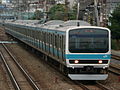 A Keihin-Tohoku Line 209-500 series EMU in November 2008


Timeline edit
History edit

The line opened on 20 December 1914 as an electrified passenger line connecting Shinagawa Station in Tokyo with Takashimacho Station in Yokohama.[8] (The latter station was renamed Yokohama Station in August 1915, when the former Yokohama Station was renamed Sakuragicho Station).[8] It was originally called the Tokaido Electric Line (Japanese: 東海道電車線) and was subsequently renamed to the Keihin Line (Japanese: 京浜線).[8] From 30 December 1915, services were extended south to the new Sakuragicho Station.[8]
The Keihin Line service was extended north via the Tohoku Main Line to Akabane Station in February 1928, and to Ōmiya Station in September 1932.[8]
The Keihin Line initially had third-class and second-class cars, analogous to today's ordinary cars and Green Cars respectively. Second-class service ended in 1938 in order to accommodate special military cars during the World War II. The military seating was converted to seating for women and children after the war, and back to ordinary seating in 1973 amid overcrowding concerns: second-class service was briefly restored in the 1950s but abandoned shortly thereafter.[citation needed]

From November 1956, the Keihin-Tohoku Line was physically separated from the Yamanote Line between Tamachi and Tabata, allowing more frequent service.[8] Through service with the Negishi Line began on 19 May 1964.[8] 10-car trains (103 series) began operating from 1 April 1966.[8]
Limited-stop "Rapid" services were introduced in 1988 to further ease congestion along the Yamanote Line corridor.[citation needed] From 14 March 2015, all rapid services began serving Kanda Station. Additionally, rapid services began serving Okachimachi Station on weekends and national holidays only.[9]
On 20 August 2016, station numbering was introduced with stations being assigned station numbers between JK12 and JK47.[10][11] Numbers increase towards in the northbound direction towards Omiya.
A new station, the Takanawa Gateway Station,[12] opened on 14 March 2020, in time for the 2020 Summer Olympics to be held in Tokyo.[13] The station is located on the Yamanote Line and Keihin-Tohoku Line between Shinagawa and Tamachi stations.[14] The distance between Shinagawa and Tamachi stations was 2.2 km (1.4 mi).[14] Takanawa Gateway was constructed on top of the 20-hectare former railyard, which is undergoing rationalization and redevelopment by JR East. The Yamanote Line and the Keihin Tohoku Line tracks were moved slightly to the east to be aligned closer to the Tokaido Shinkansen tracks. The area on the west side of the yard made available will be redeveloped with high-rise office buildings, creating an international business center with connections to the Shinkansen and Haneda Airport.[14]
Accidents edit
At around 01:11 in the morning of 23 February 2014, an empty stock train operating from Sakuragicho to Kamata hit a track maintenance vehicle on the track close to Kawasaki Station.[15] The first two cars of the 10-car E233 series train derailed, with the first car ending up on its side.[16] The train was carrying no passengers, and the driver and conductor escaped with minor injuries.[17]
See also edit

References edit
- ^ "平成27年 大都市交通センサス 首都圏報告書" (PDF). P.92. 国土交通省.
- ^ "山手線新駅「高輪ゲートウェイ」|NHK 首都圏のニュース". Archived from the original on 4 December 2018. Retrieved 4 December 2018.
- ^ 2020年3月ダイヤ改正について [Timetable revision on March 2020] (PDF) (in Japanese). Japan: East Japan Railway Company. 13 December 2019. Retrieved 13 December 2019.
- ^ a b c d 鉄道友の会 東京支部 JR電車部会 (December 2007). "京浜東北線を駆け抜けた車両たち 後編". Japan Railfan Magazine. 48 (562): 77–84.
- ^ 横浜線用の205系が営業運転を終了 [End of 205 series revenue operations on Yokohama Line]. Japan Railfan Magazine Online (in Japanese). Japan: Koyusha Co., Ltd. 24 August 2014. Retrieved 30 September 2014.
- ^ 鉄道友の会 東京支部 JR電車部会 (November 2007). "京浜東北線を駆け抜けた車両たち 前編". Japan Railfan Magazine. 48 (561): 86–93.
- ^ Hobidas: "京浜東北線・根岸線209系引退で記念イベント" (14 December 2009) Archived 31 March 2015 at the Wayback Machine. Retrieved 14 December 2009. (in Japanese)
- ^ a b c d e f g h "京浜東北・根岸線" [Keihin-Tohoku Line and Negishi Line]. Tetsudō Daiya Jōhō Magazine. 37 (293). Japan: Kotsu Shimbun: 2–11. September 2008.
- ^ "2015年3月 ダイヤ改正について" [Information regarding the March 2015 timetable amendment] (PDF). East Japan Railway Company. 19 December 2014. p. 10. Retrieved 16 April 2015.
- ^ "⾸都圏エリアへ 「駅ナンバリング」を導⼊します" [Introduce “station numbering” to the Tokyo metropolitan area] (PDF). jreast.co.jp (in Japanese). 6 April 2016. Archived from the original (PDF) on 7 December 2022. Retrieved 7 January 2023.
- ^ Kusamachi, Yoshikazu (7 April 2016). "JA・JK・JT・AKB…JR東日本、首都圏で駅ナンバリングなど導入へ" [JA, JK, JT, AKB … JR East to introduce station numbering in the Tokyo metropolitan area]. Response Automotive Media (in Japanese). Archived from the original on 6 August 2022. Retrieved 7 January 2023.
- ^ "Introducing the newest stop on Tokyo's Yamanote Line: Takanawa Gateway". The Japan Times Online. 4 December 2018. Retrieved 5 December 2018.
- ^ 田町~品川駅間に新駅を設置し、まちづくりを進めます [New station to be constructed between Tamachi and Shinagawa] (PDF). News release (in Japanese). East Japan Railway Company. 3 June 2014. Retrieved 4 June 2014.
- ^ a b c "New Yamanote Line station eyed". The Japan Times. 5 January 2012. Retrieved 4 February 2014.
- ^ 京浜東北線事故:1両目が横転 蒲田−鶴見間始発から不通 [Keihin-Tohoku Line accident: 1st car overturned, line closed between Kamata and Tsurumi]. Mainichi Shimbun (in Japanese). Japan: The Mainichi Newspapers. 23 February 2014. Archived from the original on 24 February 2014. Retrieved 24 February 2014.
- ^ "JR East train derails near Kawasaki". The Japan Times. Japan: The Japan Times Ltd. 23 February 2014. Retrieved 24 February 2014.
- ^ "JR京浜東北線横転事故 運輸安全委の調査官らが原因を調査" [Keihin-Tohoku Line accident: Transport Safety Board investigators start investigation]. FNN (in Japanese). Japan: Fuji News Network. 23 February 2014. Archived from the original on 24 February 2014. Retrieved 24 February 2014.
External links edit

- Stations of the Keihin-Tōhoku Line (JR East) (in Japanese)
- japan-guide.com: JR Keihin-Tōhoku Line