
Iberis umbellata, common name garden candytuft[1] or globe candytuft,[2] is a herbaceous annual flowering plant of the genus Iberis and the family Brassicaceae.
| Iberis umbellata | |
|---|---|

| |
| Flower of Iberis umbellata | |
Scientific classification 
| |
| Kingdom: | Plantae |
| Clade: | Tracheophytes |
| Clade: | Angiosperms |
| Clade: | Eudicots |
| Clade: | Rosids |
| Order: | Brassicales |
| Family: | Brassicaceae |
| Genus: | Iberis |
| Species: | I. umbellata
|
| Binomial name | |
| Iberis umbellata | |
Etymology edit
The genus name derives from "Iberia", the ancient name of Spain, while the species epithet comes from the Latin "umbel", meaning "umbrella" and refers to the shape of the inflorescence.
Description edit
The biological form of Iberis umbellata is hemicryptophyte scapose,[3] as its overwintering buds are situated just below the soil surface and the floral axis is more or less erect with a few leaves.
The stem is twisted at the base while the flowering branches are erect and leafy. This plant reaches a height of 30–50 centimetres (12–20 in).[3] The leaves are green and linear-lanceolate, 15–25 millimetres (0.59–0.98 in) long.[3] The flowers are in umbel-shaped corymbs. The calyx is violet and the corolla is composed of four white, pink or purple petals. The petals are rounded at the apex, with the peripheral ones forming a large vexillum 8–10 millimetres (0.31–0.39 in) long.[3] The flowering period extends from May through June.[3] The flowers are hermaphroditic and pollinated by bees and butterflies. The fruit is a silique 7–10 millimetres (0.28–0.39 in) long.
Distribution edit
This species is native to the Mediterranean region. It is present in most of Europe, especially along the coasts, from Spain to Greece and in northern America.[4]
Habitat edit
It grows in dry rocky hillsides, in bushy areas and in clearings, preferably on calcareous soils, at an altitude of 0–1,300 metres (0–4,265 ft) above sea level.[3]
Gallery edit
-
 Plants of Iberis-umbellata
 -
 Plant of Iberis-umbellata
 -
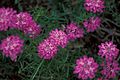 Flowers of Iberis-umbellata
 -
 Flower of Iberis-umbellata
 -
 Seedlings.
_Iberis_umbellata.jpg)


References edit
- ^ BSBI List 2007 (xls). Botanical Society of Britain and Ireland. Archived from the original (xls) on 2015-06-26. Retrieved 2014-10-17.
- ^ USDA, NRCS (n.d.). "Iberis umbellata". The PLANTS Database (plants.usda.gov). Greensboro, North Carolina: National Plant Data Team. Retrieved 22 January 2016.
- ^ a b c d e f Pignatti S. - Flora d'Italia – Edagricole – 1982. Vol. I, pag. 454
- ^ Iberis umbellata
External links edit


-_Cardamine_flexuosa_inflorescence.jpg) | This Brassicales article is a stub. You can help Wikipedia by expanding it. |