
Dandan noodles or dandanmian (traditional Chinese: 擔擔麵; simplified Chinese: 担担面), literally "carrying-pole noodles",[2] is a noodle dish originating from Chinese Sichuan cuisine. It consists of a spicy sauce usually containing preserved vegetables (often including zha cai (榨菜), lower enlarged mustard stems, or ya cai (芽菜), upper mustard stems), chili oil, Sichuan pepper, minced pork, and scallions served over noodles. The dish can either be served dry or as a noodle soup.
| Dandan noodles | |||||||||||||
|---|---|---|---|---|---|---|---|---|---|---|---|---|---|
 Hong Kong–style dandan noodle soup (擔擔湯麵) served in a Sichuan restaurant in Shanghai with traditional red chili oil sauce, pork, and spring onions | |||||||||||||
| Chinese name | |||||||||||||
| Traditional Chinese | 擔擔麵 | ||||||||||||
| Simplified Chinese | 担担面 | ||||||||||||
| Literal meaning | "carrying-pole noodles"[1] | ||||||||||||
| |||||||||||||
| Japanese name | |||||||||||||
| Kanji | 担々麺 | ||||||||||||
| Kana | タンタンメン | ||||||||||||
| |||||||||||||
The dandanmian originated in Chengdu, the capital of Sichuan province. The original dish is served with no soup in a small bowl covered in a mala meat sauce and pickled vegetables, with peanuts and spring onions served on top. The soup variant is from Hong Kong and is more widespread across the rest of China but it is uncommon in Sichuan itself where the traditional style dominates.
Sesame paste or peanut butter is sometimes added, and occasionally replaces the spicy sauce, usually in the American Chinese style of the dish.[3] In this case, dandanmian is considered a variation of ma jiang mian (麻醬麵), sesame sauce noodles, although ma jiang mian usually refers to a specific Shanghainese dish.
Origin and name edit

The name refers to a type of carrying pole (dan dan) that was used by walking street vendors who sold the dish to passers-by. The pole was carried over the shoulder, with two baskets containing noodles and sauce attached at either end. As the noodles were affordable due to their low cost, the local people gradually came to call them dandan noodles, referencing the street vendors. The name translates directly as 'noodles carried on a pole', but may be better translated as 'peddler's noodles'.
A variety of English spellings are used. The first word may be either dandan, dundun or tantan, and the last word may also be spelled mein (Cantonese pronunciation).
Related dishes edit
-
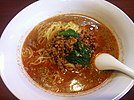 Japanese tantanmen
 -
 Japanese soupless tantanmen


The same sauce is frequently served over poached chicken (called bonbon or bangbang chicken (棒棒雞), and on steamed, meat-filled dumplings in another Sichuan dish called suanla chaoshou. The corresponding Japanese dish is tantan-men, a form of ramen (formally 担担麺, as in Chinese, but often written with an iteration mark as 担々麺, or with 坦 instead of 担).
Jinsimian edit
Jinsimian (金絲麵) or "gold thread noodle" is a variation of the dandan noodles, which was invented by chef Li Hong-kai (李紅凱) in 1989.[4] Using a special kneading technique, Li was able to make a dough consistency that does not become mushy when cooking even if cut really thin. The noodles are cut so thin they can be threaded through a needle. Li was registered in Guinness World Records for the most noodles (45) thread through a needle,[4] which was beaten by Li Enhai in 2010 by adding two more threads.[5] The latter also holds the record of the thinnest noodle at 0,18 mm.[6] As of 2024, there are other chefs as well, who cook the dandan dish using jinsimian.[7]
See also edit


References edit
- ^ Schaller, G.B. (1994). The Last Panda. University of Chicago Press. p. 42. ISBN 978-0-226-73629-7.
- ^ Alisa Joyce and David Barba (1990-10-14). "the spot for hot pot the culinary delights of sichuan province". The Washington Post.
- ^ Dunlop, Fuchsia (2008). Shark's Fin and Sichuan Pepper. W. W. Norton & Co. ISBN 0-393-06657-6.
- ^ a b "Jinsi Mian – die dünnste handgemachte Nudel aus China" (in German). CRI.cn. Retrieved 2024-03-15.
- ^ "Most strings of noodle threaded". Guinness World Records. Retrieved 2024-03-15.
- ^ "Thinnest handmade noodle". Guinness World Records. Retrieved 2024-03-15.
- ^ "The special 'gold' Chinese noodle that's thin as a thread". South China Morning Post. Retrieved 2024-03-15.
External links edit

- Authentic Dan Dan Mian recipe at KitchenChick.com
- Americanized Dan-Dan Noodles at FoodNetwork.com