
In mathematics, a Coulomb wave function is a solution of the Coulomb wave equation, named after Charles-Augustin de Coulomb. They are used to describe the behavior of charged particles in a Coulomb potential and can be written in terms of confluent hypergeometric functions or Whittaker functions of imaginary argument.


Coulomb wave equation edit
The Coulomb wave equation for a single charged particle of mass is the Schrödinger equation with Coulomb potential[1]


where is the product of the charges of the particle and of the field source (in units of the elementary charge, for the hydrogen atom), is the fine-structure constant, and is the energy of the particle. The solution, which is the Coulomb wave function, can be found by solving this equation in parabolic coordinates



Depending on the boundary conditions chosen, the solution has different forms. Two of the solutions are[2][3]

where is the confluent hypergeometric function, and is the gamma function. The two boundary conditions used here are




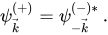
which correspond to -oriented plane-wave asymptotic states before or after its approach of the field source at the origin, respectively. The functions are related to each other by the formula


Partial wave expansion edit
The wave function can be expanded into partial waves (i.e. with respect to the angular basis) to obtain angle-independent radial functions . Here .



A single term of the expansion can be isolated by the scalar product with a specific spherical harmonic

The equation for single partial wave can be obtained by rewriting the laplacian in the Coulomb wave equation in spherical coordinates and projecting the equation on a specific spherical harmonic


The solutions are also called Coulomb (partial) wave functions or spherical Coulomb functions. Putting changes the Coulomb wave equation into the Whittaker equation, so Coulomb wave functions can be expressed in terms of Whittaker functions with imaginary arguments and . The latter can be expressed in terms of the confluent hypergeometric functions and . For , one defines the special solutions [4]






where

is called the Coulomb phase shift. One also defines the real functions

Regular Coulomb wave function F plotted from 0 to 20 with repulsive and attractive interactions in Mathematica 13.1



In particular one has

The asymptotic behavior of the spherical Coulomb functions , , and at large is





where

The solutions correspond to incoming and outgoing spherical waves. The solutions and are real and are called the regular and irregular Coulomb wave functions. In particular one has the following partial wave expansion for the wave function [5]


Properties of the Coulomb function edit
The radial parts for a given angular momentum are orthonormal. When normalized on the wave number scale (k-scale), the continuum radial wave functions satisfy [6][7]

Other common normalizations of continuum wave functions are on the reduced wave number scale ( -scale),


and on the energy scale

The radial wave functions defined in the previous section are normalized to

as a consequence of the normalization

The continuum (or scattering) Coulomb wave functions are also orthogonal to all Coulomb bound states[8]
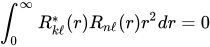
due to being eigenstates of the same hermitian operator (the hamiltonian) with different eigenvalues.
Further reading edit
- Bateman, Harry (1953), Higher transcendental functions (PDF), vol. 1, McGraw-Hill, archived from the original (PDF) on 2011-08-11, retrieved 2011-07-30.
- Jaeger, J. C.; Hulme, H. R. (1935), "The Internal Conversion of γ -Rays with the Production of Electrons and Positrons", Proceedings of the Royal Society of London. Series A, Mathematical and Physical Sciences, 148 (865): 708–728, Bibcode:1935RSPSA.148..708J, doi:10.1098/rspa.1935.0043, ISSN 0080-4630, JSTOR 96298
- Slater, Lucy Joan (1960), Confluent hypergeometric functions, Cambridge University Press, MR 0107026.
References edit
- ^ Hill, Robert N. (2006), Drake, Gordon (ed.), Handbook of atomic, molecular and optical physics, Springer New York, pp. 153–155, doi:10.1007/978-0-387-26308-3, ISBN 978-0-387-20802-2
- ^ Landau, L. D.; Lifshitz, E. M. (1977), Course of theoretical physics III: Quantum mechanics, Non-relativistic theory (3rd ed.), Pergamon Press, p. 569
- ^ Messiah, Albert (1961), Quantum mechanics, North Holland Publ. Co., p. 485
- ^ Gaspard, David (2018), "Connection formulas between Coulomb wave functions", J. Math. Phys., 59 (11): 112104, arXiv:1804.10976, doi:10.1063/1.5054368
- ^ Messiah, Albert (1961), Quantum mechanics, North Holland Publ. Co., p. 426
- ^ Formánek, Jiří (2004), Introduction to quantum theory I (in Czech) (2nd ed.), Prague: Academia, pp. 128–130
- ^ Landau, L. D.; Lifshitz, E. M. (1977), Course of theoretical physics III: Quantum mechanics, Non-relativistic theory (3rd ed.), Pergamon Press, p. 121
- ^ Landau, L. D.; Lifshitz, E. M. (1977), Course of theoretical physics III: Quantum mechanics, Non-relativistic theory (3rd ed.), Pergamon Press, pp. 668–669