
Cleomella serrulata (syns. Cleome serrulata and Peritoma serrulata), commonly known as Rocky Mountain beeplant/beeweed, stinking-clover,[3] bee spider-flower,[4] skunk weed,[5] Navajo spinach,[6] and guaco,[7] is a species of annual plant in the genus Cleomella. Many species of insects are attracted to it, especially bees, which helps in the pollination of nearby plants. It is native to southern Canada and the western and central United States. The plant has often been used for food, to make dyes for paint, and as a treatment in traditional medicine.
| Cleomella serrulata | |
|---|---|

| |
Scientific classification 
| |
| Kingdom: | Plantae |
| Clade: | Tracheophytes |
| Clade: | Angiosperms |
| Clade: | Eudicots |
| Clade: | Rosids |
| Order: | Brassicales |
| Family: | Cleomaceae |
| Genus: | Cleomella |
| Species: | C. serrulata
|
| Binomial name | |
| Cleomella serrulata (Pursh) Roalson & J.C.Hall (2015)
| |
| Synonyms[2] | |
| |
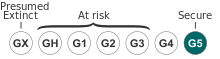
Taxonomy edit
In 1814, Frederick Traugott Pursh described this species in the first volume of Flora Americae Septentrionalis,[8] based upon specimens collected by the Lewis and Clark Expedition near the Vermillion River in South Dakota.[9][10]
In the first volume of Prodromus Systematis Naturalis Regni Vegetabilis in 1824, Augustin Pyramus de Candolle moved this species to a genus which he named Peritoma (replacing the earlier illegitimate name Atalanta Nuttall[11]), and calling the species Peritoma serrulatum.[12]
In 1901, Edward Lee Greene expanded Candolle's Peritoma, including this species as Peritoma serrulatum DC. and Peritoma lutem Raf. as well as two other species that he knew little about.[11] At least Peritoma serrulata has been determined to be a synonym of Cleome serrulata.[3]
Description edit
Cleomella serrulata is an annual plant growing to 10–150 cm (4–59 in) tall, with spirally arranged leaves. The leaves are trifoliate, diminutive teeth,[10] and with three slender leaflets each 1–7 cm (0.5–3 in) long. The flowers are reddish-purple, pink, or white, with four petals and six long stamens.[7] The fruit is a capsule 3–6 cm (1–2.5 in) long containing several seeds.[13][14] Flowering lasts an extended period because it begins at the bottom of the stalk and works its way up. The onset of flowering and seed pods comes at the same time.[10] Cell wall elasticity is higher in specimens that live in drier climates.[15] The pollen is about 0.015 millimeters (0.00059 in) in length with three furrows which have one pore each.[7]
Moisture, temperature, and time are critical in seed germination.[16] Germination occurs during summer and plants can quickly grow to 1–2 meters (3.3–6.6 ft). Flowers are often covered with a variety of insects, especially bees. Elongated capsules contain the seeds, which are dark brown to black, curved, and have a wart-like appearance.[10] After the seeds are dispersed, the plants begin decomposing.[7]
The plant is called waaʼ in the Navajo language,[17] tumi in the Hopi language, and both aʼpilalu and ado꞉we in the Zuni language.[7]
Distribution and habitat edit
Cleomella serrulata is native in southern Canada from British Columbia to Ontario and in the United States from the west coast of the United States east to Ohio and southwest to Texas.[18] It is also naturalized farther east in North America,[13][14][19] including Maine.[20] This species is often found in disturbed lands—such as roadsides, open woods, mountain foothills, and prairies.[5] The plants prefer moist alkaline soils that are light or sandy.[7][9][10] It grows in a wide range of pH levels and prefers mild shade or full sun while being drought tolerant. It is commonly found at elevations of 760–2,200 metres (2,490–7,220 ft) in the northern Rocky Mountains. It is often found with the following species: Pascopyrum smithii (western wheatgrass), Pseudoroegneria spicata (bluebunch wheatgrass), Koeleria macrantha (prairie Junegrass), Poa secunda (Sandberg bluegrass), Gaillardia aristata (common gaillardia), Artemisia tridentata (big sagebrush), and Ratibida columnifera (prairie coneflower).[10]
Uses edit
Cleomella serrulata has been used in the southwestern United States as a food, medicine, and dye since prehistoric times and is one of very few wild foods still in use.[7] As food, its seeds can be eaten raw or cooked, or dried and ground into meal for use as a mush. The tender leaves, flowers and shoots can be cooked and eaten as a cooked vegetable[21] or added to cornmeal porridge.[7][22][23] Among the Zuni, the leaves gathered in large quantities and hung indoors to dry for winter use.[24] The young leaves are cooked with corn strongly flavored with chili peppers.[24][25] To reduce its bitter taste, pieces of iron or rust were sometimes added to the cooking pot.[7] Animals rarely feed on this plant because of its disagreeable taste and odor. Nitrate poisoning can result if too much is consumed. Birds do eat the seeds, and the plant provides good cover for land reclamation and upland birds.[10] The Tewa and other Southwestern United States tribes often included Cleome serrulata as a 'fourth sister' in the Three Sisters agriculture system because it attracts bees to help pollinate the beans and squash.[26]
In traditional Native American and frontier medicine, an infusion of the plant is used to treat stomach troubles and fevers, and poultices made from it can be used on the eyes.[7][27] As a dye, the plant can be boiled down until it is reduced to a thick, black syrup; this was used as a binder in pigments for painting black-on-white pottery at least as long ago as 900-1300 by the Ancestral Puebloans.[7][22][23] The Navajo still use it to make yellow-green dye for their rugs and blankets.[6] Plant paste is used with black mineral paint to color sticks of plume offerings to anthropic gods,[24] and the whole plant except for the root is used in pottery decorations.[24]
Ecology edit
The flowers are attractive to and support a wide variety of pollinators.[28] It is a larval host to the checkered white.[28]
Gallery edit
-
 Habitat
 -
 Purple flowers
 -
 White flowers
 -
 Fruit
Fruit
.jpg)


.jpg)
Notes edit
- ^ NatureServe (2024). "Cleome serrulata". Arlington, Virginia. Retrieved 1 February 2024.
- ^ Cleomella serrulata (Pursh) Roalson & J.C.Hall. Plants of the World Online. Retrieved 4 December 2023.
- ^ a b "Cleomella serrulata". Germplasm Resources Information Network. Agricultural Research Service, United States Department of Agriculture. Retrieved November 18, 2013.
- ^ "Cleome serrulata - Pursh". NatureServe. Retrieved November 15, 2014.
- ^ a b "Cleome serrulata". Lady Bird Johnson Wildflower Center, University of Texas at Austin. Retrieved November 15, 2014.
- ^ a b Prendusi, Teresa. "Rocky Mountain Bee Plant (Cleome serrulata)". USDA Forest Service. Retrieved November 15, 2014.
- ^ a b c d e f g h i j k Adams, Karen R.; Stewart, Joe D.; Baldwin, Stuart J. (2002). "Pottery Paint and Other Uses of Rocky Mountain Beeweed (Cleome serrulata Pursh) in the Southwestern United States: Ethnographic Data, Archæological Record, and Elemental Composition". Kiva. 67 (4). Leeds, UK: Maney Publishing: 339–362. doi:10.1080/00231940.2002.11758462. JSTOR 30246404. S2CID 132078645.
- ^ Pursh, F. (1814). Flora Americæ Septentrionalis. Vol. I. London: White, Cochrane, and Co. p. 441. Retrieved November 15, 2014.
- ^ a b "Rocky Mountain Beeplant (Cleome serrulata)". Native Wildflowers of the North Dakota Grasslands. Retrieved November 15, 2014.
- ^ a b c d e f g Winslow, Susan R. (September 2014). "Rocky Mountain Beeplant Cleome serrulata Pursh" (PDF). Natural Resources Conservation Service, United States Department of Agriculture. Retrieved November 17, 2014.
- ^ a b Greene, E. L. (1901). Pittonia A Series of Papers Relating to Botany and Botanists. Vol. 4. Washington, D.C.: Press of the Law Reporter Company. p. 208. Retrieved November 15, 2014.
- ^ de Candolle, Augustin Pyramus (1824). Prodromus Systematis Naturalis Regni Vegetabilis. Paris: Sumptibus Sociorum Treuttel et Würtz. p. 237. doi:10.5962/bhl.title.286.
- ^ a b "Peritoma serrulata (Pursh) DC". University of British Columbia. Retrieved November 15, 2014.
- ^ a b "Peritoma serrulata Pursh". Jepson Herbarium, University of California, Berkeley. Retrieved November 15, 2014.
- ^ Farris, M. A. (1987). "Natural Selection on the Plant-Water Relations of Cleome serrulata Growing along Natural Moisture Gradients". Oecologia. 72 (3). Berlin: Springer: 434–439. Bibcode:1987Oecol..72..434F. doi:10.1007/bf00377576. JSTOR 4218288. PMID 28311142. S2CID 29838766.
- ^ Mogensen, Susana H. A. C.; Allen, Phil S.; Meyer, Susan E. (2001). "Prechill Temperature and Duration are Important in Determining Seed Quality for 12 Wildflowers". Seed Technology. 23 (2): 145–150. JSTOR 23433047.
- ^ Bryan, Nonabah Gorman; Young, Stella (2002). Navajo Native Dyes: Their Preparation and Use. Toronto: General Publishing Company. p. 23. ISBN 978-0-4-8642105-6.
- ^ "Cleome serrulata". Global Plants. JSTOR. Retrieved November 18, 2014.
- ^ "Cleome serrulata". USDA Plants Profile. Retrieved November 15, 2014.
- ^ Knight, O. W. (April 1904). "Cleome serrulata in Maine". Rhodora. 6 (64). New England Botanical Club, Inc.: 79. JSTOR 23293557.
- ^ Freedman, Robert Louis (1976). "Native North American Food Preparation Techniques". Boletín Bibliográfico de Antropología Americana (1973-1979). 38 (47). Pan American Institute of Geography and History: 119. JSTOR 43996285., s.v. Beeweed Pueblo
- ^ a b "Bee Weed (V. Cornell)". Paleoethnobotany Manual. Northern Arizona University. Archived from the original on March 5, 2016. Retrieved November 15, 2014.
- ^ a b "Bee Weed (L. Caruthers)". Paleoethnobotany Manual. Northern Arizona University. Retrieved November 15, 2014.
- ^ a b c d Stevenson, Matilda Coxe (1908). "Ethnobotany of the Zuni Indians". Thirtieth Annual Report of the Bureau of American Ethnology for 1908. Washington, D. C.: Government Printing Office: 69, 82, 96.
- ^ Castetter, E. F. (1935). "Uncultivated Native Plants Used as Sources of Food". Ethnobiological Studies in the American Southwest I. 4 (1). University of New Mexico Bulletin: 1–44.
- ^ Hemenway, Toby (2000). Gaia's Garden: A Guide to Home-Scale Permaculture. White River Junction, VT: Chelsea Green Publishing. p. 149. ISBN 1-890132-52-7.
- ^ Swinski, Kirsten. "Cleome serrulata Pursh". Northern Arizona University. Retrieved November 18, 2014.
- ^ a b The Xerces Society (2016), Gardening for Butterflies: How You Can Attract and Protect Beautiful, Beneficial Insects, Timber Press.
External links edit
