
C/2011 L4 (PanSTARRS), also known as Comet PANSTARRS, is a non-periodic comet discovered in June 2011 that became visible to the naked eye when it was near perihelion in March 2013.[4][5] It was discovered using the Pan-STARRS telescope located near the summit of Haleakalā, on the island of Maui in Hawaii. Comet C/2011 L4 probably took millions of years to come from the Oort cloud. After leaving the planetary region of the Solar System, the post-perihelion orbital period (epoch 2050) is estimated to be roughly 107000 years.[1] Dust and gas production suggests the comet nucleus is roughly 1 kilometer (0.62 mi) in diameter,[6] while based on the absolute nuclear magnitude and a geometric albedo of 0.04 the diameter of the nucleus is over 2.4 kilometers (1.5 mi).[7] A method based on coma magnitude decay function estimated the effective radius at 2.317 ± 0.190 km.[8]
 Image of Comet PanSTARRS by Gingin Observatory | |
| Discovery | |
|---|---|
| Discovered by | Pan-STARRS |
| Discovery date | 6 June 2011 |
| Orbital characteristics | |
| Epoch | 20 Mar 2012 (JD 2456006.5) |
| Observation arc | 3.27 years |
| Number of observations | 5413 |
| Orbit type | Oort cloud |
| Aphelion | 68000 AU (inbound)[1] 4500 AU (outbound) |
| Perihelion | 0.30161 AU (q) |
| Eccentricity | 1.000087 |
| Orbital period | Millions of years (inbound) ~107,000 yr (outbound solution for epoch 2050)[1] |
| Max. orbital speed | 76.7 km/s (172,000 mph)[2] |
| Inclination | 84.199° |
| Last perihelion | 10 March 2013[3] |
| Jupiter MOID | 0.17 AU |
Observational history edit

Comet C/2011 L4 was still 7.9 AU from the Sun[5] with an apparent magnitude of 19 when it was discovered in June 2011.[9] By early May 2012, it had brightened to magnitude 13.5,[10] and could be seen visually when using a large amateur telescope from a dark site. In October 2012, the coma (expanding tenuous dust atmosphere) was estimated to be about 120,000 kilometers (75,000 miles) in diameter.[11] C/2011 L4 was spotted without optical aid on 7 February 2013 at a magnitude of ~6.[12] Comet PANSTARRS was visible from both hemispheres in the first weeks of March,[13] and passed closest to Earth on 5 March 2013 at a distance of 1.09 AU.[5] It came to perihelion (closest approach to the Sun) on 10 March 2013.[3] Original estimates predicted that C/2011 L4 would brighten to roughly apparent magnitude 0 (roughly the brightness of Alpha Centauri A or Vega). An estimate in October 2012 predicted that it might brighten to magnitude −4 (roughly equivalent to Venus).[14] In January 2013 there was a noticeable brightening slowdown that suggested that it may only brighten to magnitude +1.[15] During February the brightness curve showed a further slowdown suggesting a perihelion magnitude of around +2.[16]
However, a study using the secular light curve indicates that C/2011 L4 had a "slowdown event" when it was 3.6 AU from the Sun at a magnitude 5.6.[17] The brightness increase rate decreased and the estimated magnitude at perihelion was predicted as +3.5. Comet Halley would be magnitude −1.0 at the same perihelion distance. The same study concluded that C/2011 L4 is very young and belongs to the class of "baby comets" (i.e. those with a photometric age of less than 4 comet years).[17]
When C/2011 L4 reached perihelion in March 2013, the actual peak magnitude turned out to be around +1,[18] as estimated by various observers all over the planet. However, its low altitude over the horizon made these estimates difficult and subject to significant uncertainties, both because of the lack of suitable reference stars in the area and the need for differential atmospheric extinction corrections. As of mid-March 2013, due to the brightness of twilight and low elevation in the sky, C/2011 L4 was best seen in binoculars about 40 minutes after sunset.[19] On 17–18 March, C/2011 L4 was near the 2.8-magnitude star Algenib (Gamma Pegasi).[20] On 22 April, it was near Beta Cassiopeiae.[16] On 12–14 May, it was near Gamma Cephei.[21] C/2011 L4 continued moving North until 28 May. The comet may have had a sodium tail as Comet Hale–Bopp had.[22]
Gallery edit
-
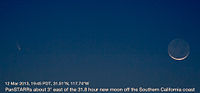 Comet PANSTARRS as observed from Southern California, USA, about 3° east of the new crescent Moon
 -
 Photo taken 12 March 2013 in Woodland Hills, Los Angeles, USA.
 -
 Comet C/2011 L4 (PanSTARRS) with a fan-shaped tail 2013-03-24 17:00UT in Special Astrophysical Observatory of the Russian Academy of Science near the village of Nizhny Arkhyz.
 -
 Photo taken 18 March 2013, at Orbetello, Italy).
 -
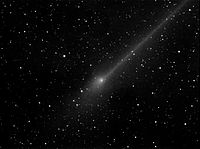 Photo taken by John Maclean at the Norman Lockyer Observatory, Sidmouth, Devon.

.png)


See also edit
- C/2012 S1 (ISON) – a highly anticipated comet that disintegrated near perihelion in November 2013.
References edit
- ^ a b c Horizons output. "Barycentric Osculating Orbital Elements for Comet C/2011 L4 (PANSTARRS)". Solution using the Solar System Barycenter. Ephemeris Type:Elements and Center:@0 (To be outside planetary region, inbound epoch 1950 and outbound epoch 2050)
- ^ "Horizons Batch for 2013-Mar-10 perihelion velocity". JPL Horizons. Retrieved 22 January 2023.
- ^ a b "JPL Small-Body Database Browser: C/2011 L4 (PANSTARRS)". Jet Propulsion Laboratory. Archived from the original on 16 March 2017. Retrieved 12 June 2012.
- ^ "Comet Pan-STARRS: Still on Track". Sky & Telescope. 12 April 2012. Archived from the original on 22 October 2013. Retrieved 12 April 2012.
- ^ a b c Kronk, Gary W. "C/2011 L4 (PANSTARRS)". Archived from the original on 5 April 2001. Retrieved 13 June 2012.
{{cite web}}: CS1 maint: bot: original URL status unknown (link)() - ^ ScienceAtNASA (14 March 2013). "ScienceCasts: Sunset Comet". YouTube. Retrieved 17 March 2013.
- ^ Ferrín, Ignacio (1 August 2014). "The location of Oort Cloud comets C/2011 L4 Panstarrs and C/2012 S1 ISON on a comet evolutionary diagram". Monthly Notices of the Royal Astronomical Society. 442 (2): 1731–1754. doi:10.1093/mnras/stu820. hdl:10495/8143.
- ^ Paradowski, Mieczyslaw Leszek (1 March 2020). "A new method of determining brightness and size of cometary nuclei". Monthly Notices of the Royal Astronomical Society. 492 (3): 4175–4188. doi:10.1093/mnras/stz3597.
- ^ "MPEC 2011-L33 : COMET C/2011 L4 (PANSTARRS)". IAU Minor Planet Center. 8 June 2011. Retrieved 17 May 2012. (CK11L040)
- ^ "MPEC 2012-J16 : OBSERVATIONS AND ORBITS OF COMETS". IAU Minor Planet Center. 4 May 2012. Retrieved 17 May 2012.
- ^ Jakub Cerny (7 October 2012). "Watching comet Panstarrs activity". Robotic telescope FRAM. Archived from the original on 14 March 2013. Retrieved 8 October 2012.
- ^ David Seargent (10 February 2013). "L4 naked-eye and T5 faded". comets-ml · Comets Mailing List. Archived from the original on 12 April 2013. Retrieved 10 February 2013.
- ^ Geert Barentsen (5 March 2013). "Map: when can you see comet PanSTARRS". Archived from the original on 10 March 2013. Retrieved 5 March 2013.
- ^ J.P.Navarro Pina (23 October 2012). "UPDATE THE LIGHT VISUAL CURVE OF COMET C/2011 L4 PANSTARRS". COMETS & ASTROPHYSICAL. Archived from the original on 28 January 2013. Retrieved 23 October 2012.
- ^ Jakub Cerny (12 January 2013). "Comet Panstarrs brightening slowdown". comets-ml · Comets Mailing List. Archived from the original on 10 February 2013. Retrieved 12 January 2013.
- ^ a b Yoshida, Seiichi. "C/2011 L4 ( PanSTARRS )". www.aerith.net. Retrieved 25 February 2013.
- ^ a b Ferrin, Ignacio (2013). "Secular Light Curves of Comets C/2011 L4 Panstarrs and C/2012 S1 ISON". University of Antioquia. arXiv:1302.4621. Bibcode:2013arXiv1302.4621F.
{{cite journal}}: Cite journal requires|journal=(help) - ^ "Recent Comet Brightness Estimates". Retrieved 15 March 2013.
- ^ Stuart Atkinson (7 March 2013). "Comet PANSTARRS". Retrieved 10 March 2013.
- ^ Deborah Byrd. "Everything you need to know: How to see Comet PANSTARRS". Earthsky. Retrieved 17 March 2013.
- ^ King, Bob (3 May 2013). "Comet PANSTARRS for die-hards". Retrieved 5 May 2013.
- ^ Comet C/2011 L4 (PanSTARRS) with sodium tail - 15 March 2013
External links edit

- C/2011 L4 (PANSTARRS) – Cometography.com by Gary W. Kronk
- C/2011 L4 (PanSTARRS) – Seiichi Yoshida @ aerith.net
- C/2011 L4 (PanSTARRS) animated orbit diagram – Shadow & Substance
- Elements and Ephemeris for C/2011 L4 (PANSTARRS) – Minor Planet Center
- The complete guide to viewing Comet PANSTARR
- The view STEREO-B will have of PanSTARRS in March (Bill Thompson via Twitter account Sungrazing Comets) / C/2011 L4 on 2013-March-09[permanent dead link] (entering STEREO/SECCHI HI-1B field of view below the "2013")
- Update on comet C/2011 L4 (PANSTARRS) – Remanzacco Observatory (18 May 2012)
- Very quick high-resolution "first look" at PanSTARRS in STEREO HI-1B / 2013-March-10 GIF animation / 2013-March-12 up close (Twitter account Sungrazing Comets)
- Video of Comet Panstarrs seen from Paris
- Don’t let Comets PANSTARRS and Lemmon out of your sight … yet – AstroBob (19 May 2013)

