
The Bengal bush lark (Mirafra assamica) or Bengal lark is a species of lark in the family Alaudidae found in southern Asia.
| Bengal bush lark | |
|---|---|

| |
| At Joka in Kolkata. | |
Scientific classification 
| |
| Domain: | Eukaryota |
| Kingdom: | Animalia |
| Phylum: | Chordata |
| Class: | Aves |
| Order: | Passeriformes |
| Family: | Alaudidae |
| Genus: | Mirafra |
| Species: | M. assamica
|
| Binomial name | |
| Mirafra assamica Horsfield, 1840
| |

| |
Taxonomy and systematics edit
The differences within the genus Mirafra are often very subtle and confusing with many differences apparent only when specimens are examined in hand.
The Bengal bush lark was earlier classified into several races, the Bengal race assamica and the Madras race affinis. These were subsequently split, on the basis of diagnostic song and display characters, into the Jerdon's bush lark (Mirafra affinis) and assamica in the strict sense. Formerly, both the Burmese bush lark and Jerdon's bush lark were considered subspecies of the Bengal bush lark (as M. a. microptera and M. a. affinis respectively) until split to form a separate species. The alternate name "rufous-winged bush lark" may also be used to describe the red-winged lark.[2] Another alternate name for the Bengal bush lark is the rufous-winged lark.[3]
Description edit
The Bengal bush lark is short-tailed and has a strong stout bill. It is not as long as the skylark, measuring about 15 centimetres in length. It is dark-streaked grey above, and buff below, with spotting on the breast and behind the eye. The wings are rufous.
The song of the Bengal bush lark is a repetition of thin disyllabic notes, delivered in a song-flight.[4]
Distribution and habitat edit
The Bengal bush lark is a resident breeder in the Indian subcontinent and south-east Asia, and found in the countries of Bangladesh, Bhutan, India, Myanmar and Nepal, with an estimated global extent of occurrence of 100,000-1,000,000 square kilometres.[1]
The Bengal bush lark is a common bird of dry, open, stony country often with sparse shrubs, and cultivated areas.
Behaviour and ecology edit
It nests on the ground, laying three or four speckled eggs. This lark feeds primarily on seeds and insects, especially the latter during the breeding season.
Gallery edit
-
 In Kolkata
 -
 Showing wing colour while preening in Kolkata
 -
 In Kolkata, West Bengal, India
 -
 With paddyfield pipit (Anthus rufulus) in Kolkata, West Bengal, India
 -
 In Kolkata, West Bengal, India
 -
 In Kolkata, West Bengal, India
 -
 Preening in Kolkata, West Bengal, India
 -
 In Kolkata, West Bengal, India
 -

-
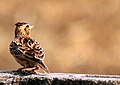 Bengal bush lark in Boshipota, West Bengal, India
 -
 In Gazipur, Bangladesh


_in_Kolkata_W_IMG_4592.jpg)
_with_Paddyfield_Pipit_(Anthuis_rufulus)_in_Kolkata_W_IMG_4571.jpg)
_in_Kolkata_W_IMG_4599.jpg)
_in_Kolkata_W_IMG_4596.jpg)


References edit
- ^ a b BirdLife International (2017) [amended version of 2016 assessment]. "Mirafra assamica". IUCN Red List of Threatened Species. 2017: e.T22734352A118710813. doi:10.2305/IUCN.UK.2017-3.RLTS.T22734352A118710813.en. Retrieved 10 January 2020.
- ^ "Mirafra hypermetra - Avibase". avibase.bsc-eoc.org. Retrieved 2016-11-28.
- ^ "Mirafra assamica - Avibase". avibase.bsc-eoc.org. Retrieved 2016-12-10.
- ^ Alström, Per (1998). "Taxonomy of the Mirafra assamica complex" (PDF). Forktail. 13: 97–107. Archived from the original (PDF) on March 7, 2008. Retrieved May 1, 2009.
External links edit


- Species factsheet - BirdLife International